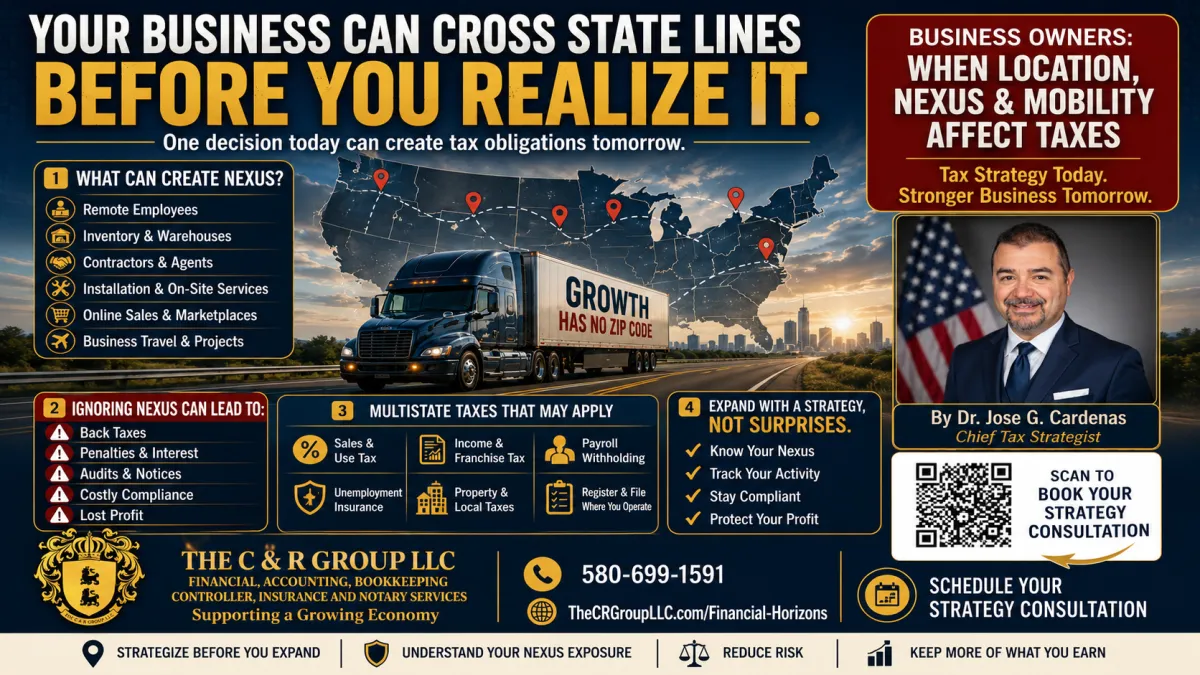
Business Owners: When Location, Nexus, and Mobility Start Affecting Taxes
Financial Horizons: Insights for Building Wealth and Securing Your Legacy
Business Owners: When Location, Nexus, and Mobility Start Affecting Taxes
By Dr. Jose G. Cardenas, Chief Tax Strategist at The C & R Group, LLC
A business does not have to open a storefront in another state before that state begins asking tax questions.
One employee working remotely, inventory stored in a third-party warehouse, a sales representative visiting customers, a rental property, a consulting project performed on-site, or a growing volume of online sales may be enough to create new registration, collection, withholding, or filing obligations.
That legal connection is commonly called nexus.
Nexus determines whether a state has enough connection with a business to require it to comply with one or more state tax systems. Those systems may include:
Income or franchise tax;
Sales and use tax;
Payroll withholding;
Unemployment insurance;
Gross-receipts taxes;
Local business taxes;
Property taxes; and
Entity-registration requirements.
The dangerous assumption is that the state where the business was formed controls everything.
It does not.
A company organized in Delaware, Wyoming, Texas, Oklahoma, or any other jurisdiction may still have obligations wherever it owns property, employs people, performs services, stores inventory, delivers products, or generates sufficient economic activity.
Modern business mobility creates opportunity—but opportunity without tax visibility can become an expensive compliance problem.
State Tax Compliance Is Not the Same as State Tax Strategy
State tax compliance asks what the company must file based on activities that have already occurred.
State tax strategy examines where the business should operate, hire, store inventory, perform services, register, and expand before those activities create avoidable costs or administrative burdens.
Compliance asks:
In which states does the company already have nexus?
Which returns are due?
Was sales tax collected correctly?
Were employees registered in the proper states?
Was income apportioned correctly?
Were annual reports and franchise taxes filed?
Are penalties or back taxes due?
Strategy asks:
Will hiring a remote employee create a new state obligation?
Should inventory be stored in another jurisdiction?
Will a new customer contract require on-site work?
Does the company understand the tax consequences before entering a new market?
Can processes be centralized without sacrificing growth?
Should the business use employees, contractors, distributors, or third-party providers?
Is the expected revenue from a state worth the added compliance cost?
The objective is not to avoid legitimate tax obligations.
The objective is to understand them before expansion turns one successful business into a multistate filing maze.
What Nexus Means for a Business
Nexus is the connection between a business and a taxing jurisdiction that allows the jurisdiction to impose a tax-related obligation.
Historically, businesses often focused on physical presence: offices, employees, inventory, or property.
Physical presence remains important, but it is no longer the only standard.
In South Dakota v. Wayfair, the U.S. Supreme Court rejected the prior rule that a seller generally needed physical presence before a state could require it to collect sales tax. The Court concluded that substantial economic and virtual contacts could establish a sufficient connection with a state.
This means a business may create nexus through:
Physical presence;
Employee activity;
Property or inventory;
In-state services;
Economic sales thresholds;
Marketplace activity;
Affiliate relationships;
Professional licensing;
Contractors or representatives;
Trade-show participation;
Delivery operations; or
Other state-defined contacts.
The rules vary by tax type and by state.
A company can have sales-tax nexus without income-tax nexus, payroll obligations without substantial sales, or entity-registration requirements even when no income tax is due.
There is no universal “one nexus test.”
1. Physical Presence Still Matters
The expansion of economic nexus did not eliminate physical nexus.
Physical presence remains one of the clearest ways a business can create state tax exposure.
Common physical-presence triggers include:
An office;
A retail location;
A warehouse;
Real estate;
Inventory;
Equipment;
Employees;
Traveling sales representatives;
On-site service personnel;
Installation crews;
Delivery vehicles;
Temporary project locations; and
Regular participation in trade shows.
Oklahoma’s corporate nexus rules, for example, identify activities such as maintaining a business location, owning real estate, and owning inventory stored in the state as potential nexus-creating activities.
The physical location does not have to be large.
A remote employee working from a spare bedroom may create a stronger connection to the state than an owner realizes.
A few pallets of inventory stored by a fulfillment company may require analysis.
A temporary job site may trigger registrations that did not exist before the contract began.
Small footprint does not automatically mean small obligation.
2. Remote Employees Can Create More Than Payroll Work
Hiring a remote employee in another state may create obligations involving:
State income-tax withholding;
Unemployment insurance;
Workers’ compensation;
Paid-leave programs;
Disability insurance;
Local payroll taxes;
Corporate income or franchise tax;
Sales-tax nexus;
Foreign-entity registration; and
Employment-law compliance.
Oklahoma instructs qualifying out-of-state employers with employees working in Oklahoma to register for state income-tax withholding and address unemployment-tax requirements.
This issue applies even when:
The company never asked the employee to relocate;
The employee works from home;
The company has no traditional office in the state;
The employee is the only worker there;
The employee handles administrative duties rather than sales; or
The arrangement began as temporary.
Questions to ask before approving remote work
Where will the employee physically work?
Is the arrangement permanent, temporary, or hybrid?
Does the state require payroll registration immediately?
Will the employee perform sales, management, or customer service?
Does the employee have authority to sign contracts?
Will business property be stored at the employee’s home?
Does the arrangement create income-tax or sales-tax nexus?
Must the company register as a foreign entity?
Are local taxes or paid-leave programs involved?
Will the employee move again without notifying the company?
A remote-work policy should require employees to obtain approval before changing their work state.
Otherwise, the company may discover its new “office” only after receiving a notice from a tax or employment agency.
3. Economic Nexus Can Apply Without Employees or Property
A business may have no office, employee, warehouse, or inventory in a state and still create sales-tax nexus by exceeding that state’s economic threshold.
The Wayfair decision allowed states to rely on economic and virtual contacts rather than requiring traditional physical presence.
Oklahoma generally requires a remote seller to obtain a sales-tax permit and collect Oklahoma sales tax when taxable Oklahoma sales exceed $100,000 during the preceding or current calendar year.
Thresholds and measurement rules differ among states. A state may consider:
Gross sales;
Taxable sales;
Retail sales;
Transaction counts;
Current-year sales;
Prior-year sales;
Sales made through marketplaces;
Exempt sales;
Services;
Digital products; and
Related entities.
Business owners should not copy one state’s threshold across the entire country.
A company selling nationwide needs a state-by-state monitoring process.
Economic-nexus checklist
Track:
Customer location;
Ship-to address;
Sales volume by state;
Taxable versus exempt sales;
Marketplace sales;
Direct website sales;
Wholesale transactions;
Exemption certificates;
Product and service classifications; and
The date each threshold is approached or exceeded.
Waiting until year-end may be too late if the registration and collection obligation began earlier.
4. Marketplace Sales Do Not Eliminate Every Responsibility
Online marketplaces often collect and remit sales tax on transactions they facilitate.
That can reduce the seller’s collection burden, but it does not always eliminate all state responsibilities.
A marketplace seller may still need to evaluate:
Direct sales outside the marketplace;
Inventory stored in fulfillment centers;
Income or franchise-tax nexus;
Business-registration requirements;
Information returns;
Exemption documentation;
Local licenses;
Property-tax reporting;
Sales-tax returns showing marketplace sales; and
Whether marketplace transactions count toward a state threshold.
Oklahoma’s remote-seller guidance distinguishes marketplace-facilitated activity from direct sales when applying certain sales-tax requirements.
The fact that a platform handles one tax does not make the business invisible to the state.
Marketplace collection is a service—not a complete multistate tax strategy.
5. Inventory Can Create Tax Exposure
Inventory is one of the most frequently overlooked nexus triggers.
A business may own inventory stored in:
A public warehouse;
A fulfillment center;
A marketplace provider’s facility;
A distributor’s location;
A consignment location;
A third-party logistics facility;
An employee’s home; or
A temporary staging area.
The owner may not control where a marketplace moves the inventory. That does not mean the location is irrelevant.
The tax result depends on the state’s law, the business’s ownership and control, the marketplace arrangement, and the type of tax being examined.
A 2026 Oklahoma Tax Commission letter ruling addressed whether inventory stored in a marketplace facilitator’s Oklahoma warehouse created sales-tax nexus under the specific facts presented. The ruling illustrates why inventory arrangements require detailed factual review rather than blanket assumptions.
Maintain inventory-location records
Preserve:
Fulfillment contracts;
Marketplace agreements;
Warehouse reports;
Monthly inventory-location reports;
Bills of lading;
Shipping records;
Ownership terms;
Insurance records;
Consignment agreements; and
Records showing who controls inventory movement.
A business cannot manage exposure it does not track.
6. Performing Services Across State Lines Can Create Nexus
Service businesses often assume nexus is mainly a retail-sales issue.
It is not.
A consultant, accountant, contractor, advisor, engineer, trainer, photographer, healthcare provider, or technology professional may create nexus by physically performing services in another state.
Potential triggers include:
Working at a client’s location;
Conducting recurring training;
Managing a project on-site;
Installing or repairing equipment;
Performing inspections;
Supervising construction;
Attending repeated client meetings;
Maintaining a temporary office;
Using subcontractors; or
Sending employees into the state.
The tax consequences may include:
Income-tax filing;
Gross-receipts tax;
Sales tax on taxable services;
Payroll withholding;
Local taxes;
Professional licensing;
Foreign registration; and
Apportionment of revenue.
Questions service businesses should ask
Where are the services physically performed?
Where does the customer receive the benefit?
How many days are employees present?
Are contractors being used?
Is the service taxable in that state?
Does the state source revenue based on performance or customer benefit?
Are travel and lodging reimbursed?
Does the contract require ongoing presence?
Is the project temporary or indefinite?
Are local registrations required?
Remote delivery does not automatically eliminate state sourcing.
Conversely, traveling into a state for one limited project does not always create every possible tax obligation.
The answer depends on the activity, duration, tax type, and state law.
7. Business Travel and Tax Home Are Separate Issues
Business owners should distinguish state nexus from the federal concept of a tax home.
For federal travel-expense purposes, a taxpayer’s tax home is generally the area of the main place of business or employment, regardless of where the family residence is maintained. Deductible business travel generally requires the taxpayer to be traveling away from that tax home under the applicable federal rules.
That federal travel analysis does not independently determine whether a state has nexus with the company.
A business trip can involve several separate questions:
Is the travel deductible federally?
Does the activity create state tax nexus?
Must wages be sourced to the destination state?
Does the employer need payroll registration?
Is the business required to register locally?
Does the contract create a permanent or temporary business location?
One trip does not automatically answer all six.
8. Contractors and Agents Can Create Connections
A business may create state exposure through people who are not treated as employees.
Potential relationships include:
Independent contractors;
Sales agents;
Installers;
Service technicians;
Referral partners;
Franchisees;
Representatives;
Affiliates;
Distributors; and
Professional service providers.
The analysis may depend on:
What the person does;
How regularly the person acts;
Whether the person solicits sales;
Whether the person performs post-sale services;
Whether contracts can be accepted;
Whether the person represents multiple businesses;
Whether inventory or equipment is maintained;
Whether the relationship is independent in substance; and
Whether state attribution rules apply.
Calling someone an independent contractor does not prevent the person’s activities from creating nexus.
The contract label is evidence—but the real-world activity carries more weight.
9. Sales-Tax Nexus and Income-Tax Nexus Are Not the Same
Business owners frequently make one of two mistakes:
They assume sales-tax registration means every tax applies; or
They assume no sales-tax obligation means no state return is required.
Both conclusions can be wrong.
Sales-tax nexus
Sales-tax nexus generally addresses whether the business must register, collect, report, and remit tax on taxable sales.
Income or franchise-tax nexus
Income or franchise-tax nexus addresses whether the company must file a business return, calculate state taxable income, pay a franchise tax, or satisfy another business-activity tax.
Payroll nexus
Payroll obligations address employee withholding, unemployment insurance, and employment-related programs.
Entity-registration nexus
A company may need to register with a secretary of state or licensing agency because it is conducting business there.
Each system may apply a different threshold or legal standard.
The Multistate Tax Commission has developed model factor-presence standards for business-activity taxes based on property, payroll, and sales thresholds, but individual states decide whether and how to adopt such standards.
A multistate review must examine each tax separately.
10. Public Law 86-272 Offers Limited Protection
Federal Public Law 86-272 can restrict a state’s authority to impose a net income tax on an out-of-state business when the company’s in-state activity is limited to soliciting orders for tangible personal property and the orders are approved and fulfilled outside the state.
The protection is limited.
It generally does not provide universal protection for:
Services;
Digital products;
Real estate;
Leasing;
Post-sale services;
Installation;
Repairs;
Inventory;
Local order approval;
Activities beyond protected solicitation; or
Taxes that are not net income taxes.
The Multistate Tax Commission has issued guidance addressing how internet-based activities may affect P.L. 86-272 protection.
A company should not rely on P.L. 86-272 merely because it sells products across state lines.
Its actual in-state and online activities must be reviewed.
11. Foreign Qualification Is Not the Same as Tax Registration
A company formed in one state may be required to register as a foreign entity before doing business in another.
Despite the terminology, “foreign” in this context often means formed in another U.S. state—not another country.
Foreign qualification may require:
Filing an application;
Appointing a registered agent;
Obtaining a certificate of authority;
Paying annual fees;
Filing annual reports;
Maintaining good standing; and
Disclosing owners or managers where required.
Tax registration may separately require:
Sales-tax permits;
Payroll withholding accounts;
Unemployment accounts;
Income or franchise-tax accounts;
Local business licenses; and
Industry-specific registrations.
Obtaining one registration does not automatically complete the others.
The business must coordinate legal, tax, payroll, licensing, and operational requirements.
12. Mobility Can Affect Pass-Through Owners
Owners of partnerships and S corporations may receive state-source income even when they do not personally live or work in the state.
A pass-through entity operating in several states may face:
State apportionment;
Owner withholding;
Composite returns;
Pass-through entity taxes;
Nonresident owner returns;
State K-1 schedules;
Estimated payments; and
Credits in the owner’s resident state.
The owner may need to file in several jurisdictions because the entity has activity there.
Changing the owner’s residence does not necessarily change where business income is sourced.
Likewise, forming the entity in a no-income-tax state does not automatically move income away from states where the business actually operates.
Owners should review:
Each state listed on the entity’s tax schedules;
State withholding paid on the owner’s behalf;
Composite-return elections;
Pass-through entity tax elections;
Apportionment percentages;
Resident-state credits;
Owner basis and distributions; and
Whether projected payments are sufficient.
A federal Schedule K-1 is only part of the story.
13. Relocating the Owner Does Not Automatically Relocate the Business
An owner may personally move to another state while the business remains connected to the former state.
For example, the company may still have:
Employees;
Clients;
Inventory;
Property;
Leases;
Licenses;
Bank accounts;
Management activity;
Contractors;
Equipment;
A mailing address; or
Continuing projects there.
The owner’s domicile and the company’s nexus are related but separate.
A personal move may change the owner’s resident return while leaving business filings largely unchanged.
Conversely, a business may expand into another state even though the owner never moves.
Before claiming the business relocated, ask:
Where are management decisions made?
Where do employees work?
Where are books and records maintained?
Where are contracts negotiated?
Where are customers served?
Where is property stored?
Where are bank accounts managed?
Where are licenses maintained?
Where is revenue generated?
Which offices or addresses remain active?
A new business address is not a magic eraser.
14. Moving a Business Can Create Exit and Entry Obligations
A business relocation should include both a departure plan and an arrival plan.
Departure issues may include:
Final state tax returns;
Closing payroll accounts;
Canceling sales-tax permits;
Filing final unemployment reports;
Withdrawing foreign registration;
Terminating leases;
Updating licenses;
Resolving property-tax accounts;
Maintaining a registered agent;
Handling remaining inventory; and
Preserving records.
Arrival issues may include:
Forming or qualifying the entity;
Payroll registration;
Sales-tax registration;
Unemployment insurance;
Local licensing;
Professional permits;
Property taxes;
Workers’ compensation;
New withholding forms;
Bank and insurance updates; and
Revised customer contracts.
The company may temporarily have obligations in both states.
Closing a bank account or moving the office furniture does not automatically terminate a tax account.
Formal closure procedures matter.
15. Mobility Can Distort Financial Statements
Multistate growth affects more than tax returns.
It can also distort accounting and profitability when state costs are not tracked separately.
Potential expenses include:
Registration fees;
Registered-agent fees;
State income taxes;
Franchise taxes;
Gross-receipts taxes;
Sales-tax software;
Payroll registrations;
Local business licenses;
Professional fees;
Additional bookkeeping;
Compliance labor;
Workers’ compensation;
Paid-leave programs;
Audits and notices; and
Penalties for missed filings.
A new state may generate significant revenue while producing weak net profit after compliance and fulfillment costs.
Management reporting should show:
Revenue by state;
Gross margin by state;
Payroll by employee location;
Property and inventory by state;
Sales-tax collections;
State filing costs;
Professional fees;
Penalties and interest;
Travel costs;
Customer-acquisition costs; and
Net contribution by market.
Expansion should be measured by profit, not applause.
A million dollars of new revenue is not impressive if multistate costs and weak margins consume it.
16. Build a Nexus-Tracking System
Nexus should not be reviewed only during tax-return preparation.
The business should establish an ongoing process.
Monthly review
Track:
Sales by customer location;
Employee work locations;
Contractor locations;
New property or equipment;
Inventory locations;
New leases;
On-site projects;
Marketplace reports;
Travel into other states;
New licenses;
Customer contracts; and
State correspondence.
Quarterly review
Evaluate:
Economic-nexus thresholds;
Payroll registrations;
Sales-tax permits;
Income and franchise-tax filings;
Foreign qualifications;
Apportionment;
Owner withholding;
Composite returns;
Estimated payments; and
New markets under consideration.
Annual review
Confirm:
All required returns were filed;
Accounts that should close are closed;
Nexus positions are documented;
Exemption certificates are current;
State tax credits are claimed;
Employee-location records are accurate;
Registered agents are active;
Compliance costs are measured; and
Expansion remains financially worthwhile.
The goal is to catch exposure while it is still manageable.
Common Nexus and Mobility Mistakes
Mistake 1: Assuming the formation state controls all taxes
The business may owe taxes where it actually operates, hires, owns property, or sells.
Mistake 2: Approving remote work without a state review
One employee can create payroll, tax, legal, and insurance obligations.
Mistake 3: Tracking national revenue but not state revenue
Economic thresholds cannot be monitored without geographic data.
Mistake 4: Assuming marketplace collection solves everything
Income tax, registration, inventory, and direct-sale obligations may remain.
Mistake 5: Ignoring inventory stored by third parties
Ownership and location can matter even when the business does not control the warehouse.
Mistake 6: Treating all nexus standards as identical
Sales tax, income tax, payroll tax, and foreign qualification use different rules.
Mistake 7: Believing contractors cannot create nexus
Their activities may be attributed to the company depending on the facts.
Mistake 8: Moving the owner and assuming the company moved too
The business may retain substantial connections with the former state.
Mistake 9: Entering a state for a major project without registering
On-site services can create immediate obligations.
Mistake 10: Measuring expansion by revenue alone
State compliance costs can turn attractive revenue into poor profit.
Practical Example: The Online Business That Became Multistate Without Realizing It
Assume an Oklahoma-based company sells specialty equipment nationwide.
The company:
Operates from the owner’s Oklahoma home;
Uses an online marketplace;
Stores inventory in several fulfillment centers;
Has one remote customer-service employee in Colorado;
Uses an independent sales representative in Texas;
Sends technicians to install equipment in Kansas;
Sells directly through its website; and
Recently exceeded $100,000 of direct taxable sales into Oklahoma.
The owner believes the company has obligations only in Oklahoma because the LLC was formed there.
That conclusion is incomplete.
Potential exposure
The company may need to evaluate:
Oklahoma sales-tax collection on direct sales;
Sales-tax treatment of marketplace sales;
Inventory-related nexus;
Colorado payroll and employment registrations;
Texas nexus arising from the representative’s activities;
Kansas obligations created by installation services;
Foreign qualification;
Income or franchise-tax filings;
Property-tax reporting;
State apportionment; and
Sales-tax thresholds in other customer states.
Oklahoma’s guidance generally requires remote sellers exceeding the state’s applicable $100,000 taxable-sales threshold to register and collect sales tax.
Correction plan
The company should:
Map every sales, employee, contractor, inventory, and service location;
Separate direct sales from marketplace sales;
Review economic thresholds by state;
Identify physical-presence states;
Register payroll accounts where employees work;
Review contractor and representative activities;
Analyze installation projects;
Determine income and franchise-tax obligations;
File voluntary disclosures or delinquent returns where appropriate;
Implement sales-tax software;
Update contracts and remote-work policies; and
Track state-level profitability going forward.
The business did not become multistate when it opened another office.
It became multistate when its activities crossed state lines.
Business Location and Nexus Checklist
Entity and operations
Confirm the entity’s formation state.
Identify every state where the business is registered.
Identify where management decisions occur.
Identify all offices, warehouses, and project sites.
Review foreign-qualification requirements.
Maintain active registered agents.
Close obsolete registrations properly.
Employees and contractors
Confirm each employee’s physical work location.
Require approval before employees relocate.
Register for state payroll withholding where required.
Review unemployment and workers’ compensation obligations.
Track contractor and sales-agent locations.
Review whether third-party activities create nexus.
Document temporary and permanent assignments.
Sales and customers
Track sales by destination state.
Separate direct and marketplace sales.
Monitor economic-nexus thresholds.
Review whether products and services are taxable.
Collect exemption certificates.
Confirm the correct destination tax rates.
Register before collection obligations begin.
Property and inventory
Identify all inventory locations.
Review fulfillment-center reports.
Identify equipment and leased property by state.
Review warehouse and consignment arrangements.
Determine whether property-tax returns are required.
Preserve shipping and inventory records.
Services and travel
Track employee travel by state.
Identify where services are performed.
Review installation and repair activity.
Track trade-show participation.
Review temporary project locations.
Confirm professional and local licenses.
Distinguish federal travel deductions from state nexus.
State taxes
Review sales and use tax.
Review income and franchise tax.
Review gross-receipts tax.
Review payroll withholding.
Review unemployment insurance.
Review local taxes.
Review pass-through owner withholding.
Review composite and pass-through entity tax elections.
Calculate state estimated payments.
Claim resident-state credits where available.
Financial management
Track revenue and margin by state.
Track state compliance expenses.
Measure the profitability of each market.
Budget for registrations and professional fees.
Reconcile sales-tax liabilities.
Record penalties separately.
Review expansion before committing resources.
AI-Search Quick Answers
What is business nexus?
Business nexus is a sufficient connection between a company and a state that allows the state to require tax registration, collection, reporting, or payment.
Can a business have nexus without an office?
Yes. Economic sales, remote employees, inventory, contractors, services, or other activities may create nexus without a traditional office.
Can one remote employee create nexus?
Potentially. A remote employee may create payroll, unemployment, entity-registration, sales-tax, or income-tax obligations depending on the state and the employee’s activities.
What is economic nexus?
Economic nexus is a tax connection based primarily on the amount or volume of business conducted in a state rather than traditional physical presence.
Does an online marketplace handle every state tax obligation?
No. A marketplace may collect sales tax on facilitated sales, but the seller may still have direct-sales, income-tax, inventory, registration, or filing obligations.
Does inventory stored in another state create nexus?
It can. The result depends on the state, tax type, ownership, control, and fulfillment arrangement.
Does forming an LLC in a no-income-tax state prevent taxes elsewhere?
No. The business may owe taxes where it operates, employs people, stores property, performs services, or earns state-sourced income.
Can independent contractors create nexus?
They may. The analysis depends on their activities, authority, frequency, and relationship with the business.
Is sales-tax nexus the same as income-tax nexus?
No. Different tax systems may use different nexus standards and filing thresholds.
Does relocating the owner relocate the business?
Not automatically. The company may retain nexus wherever employees, property, customers, management, or operating activities remain.
Planning Questions for Business Owners
Before hiring, traveling, storing inventory, or entering a new market, ask:
Where is the company currently operating?
Where do all employees physically work?
Has anyone relocated without notifying management?
Where are contractors and sales representatives located?
Where is inventory stored?
Which states receive direct sales?
Which sales occur through marketplaces?
Are economic thresholds being monitored?
Where are services physically performed?
Does the company install, repair, or train on-site?
Which states require payroll registration?
Has the company registered as a foreign entity where required?
Does P.L. 86-272 apply, and are activities limited enough to preserve protection?
Which states require income, franchise, or gross-receipts returns?
Is each market profitable after compliance costs?
What to Do Next
Create a complete business mobility map.
List every state connected to:
Owners;
Employees;
Contractors;
Sales representatives;
Offices;
Inventory;
Equipment;
Warehouses;
Customers;
Marketplace sales;
Direct sales;
Installations;
Repairs;
Professional licenses;
Rental property;
Business travel; and
Pass-through ownership.
Then determine which connections create:
Tax nexus;
Payroll registration;
Sales-tax collection;
Entity qualification;
Income or franchise-tax filing;
Local licensing; and
Additional accounting requirements.
Do not wait until a state sends a questionnaire asking when business activity began.
By then, the state is no longer asking whether you have a problem.
It is asking how many years the problem has existed.
Final Thought
Mobility allows a business to hire talent anywhere, serve customers nationwide, store products closer to buyers, and expand without building traditional offices.
But mobility does not eliminate borders.
It multiplies the number of jurisdictions that may have a legitimate interest in the company’s activities.
The strongest multistate businesses do not treat nexus as an annual tax-return issue. They integrate it into hiring, sales, contracting, inventory, travel, budgeting, and expansion decisions.
Before entering a new state, determine the revenue opportunity, the operational requirements, and the full compliance cost.
Growth is good.
Growth that creates hidden taxes, penalties, and administrative chaos is merely expensive movement.
Book Your Strategy Consultation
Schedule a consultation to review the topic discussed in the article and how it may apply to your financial or business situation.
Phone: 580-699-1591
Booking your appointment now:

https://api.leadconnectorhq.com/widget/booking/T4UHUjCijCtIB3rwoTDI
ABOUT THE AUTHOR
Dr. Jose G. Cardenas is a retired U.S. Army Finance Officer and the Chief Tax Strategist at The C & R Group, LLC. With a Doctorate in Business Administration and over 20 years of experience in tax planning and financial strategy, Dr. Cardenas helps individuals and business owners legally reduce taxes, strengthen cash flow, and build lasting wealth and legacy. Learn more at www.thecrgroupllc.com
DISCLOSURE
This article is for educational and informational purposes only and is not intended to serve as personalized legal, tax, or investment advice. Tax laws and regulations change over time and may vary by jurisdiction. You should consult with a qualified tax professional regarding your specific circumstances before implementing any strategy discussed here. Dr. Jose G. Cardenas, DBA, provides tax advisory services through The C & R Group, LLC. Insurance and investment strategies may be offered through his role as a licensed financial professional affiliated with Experior Financial Group.