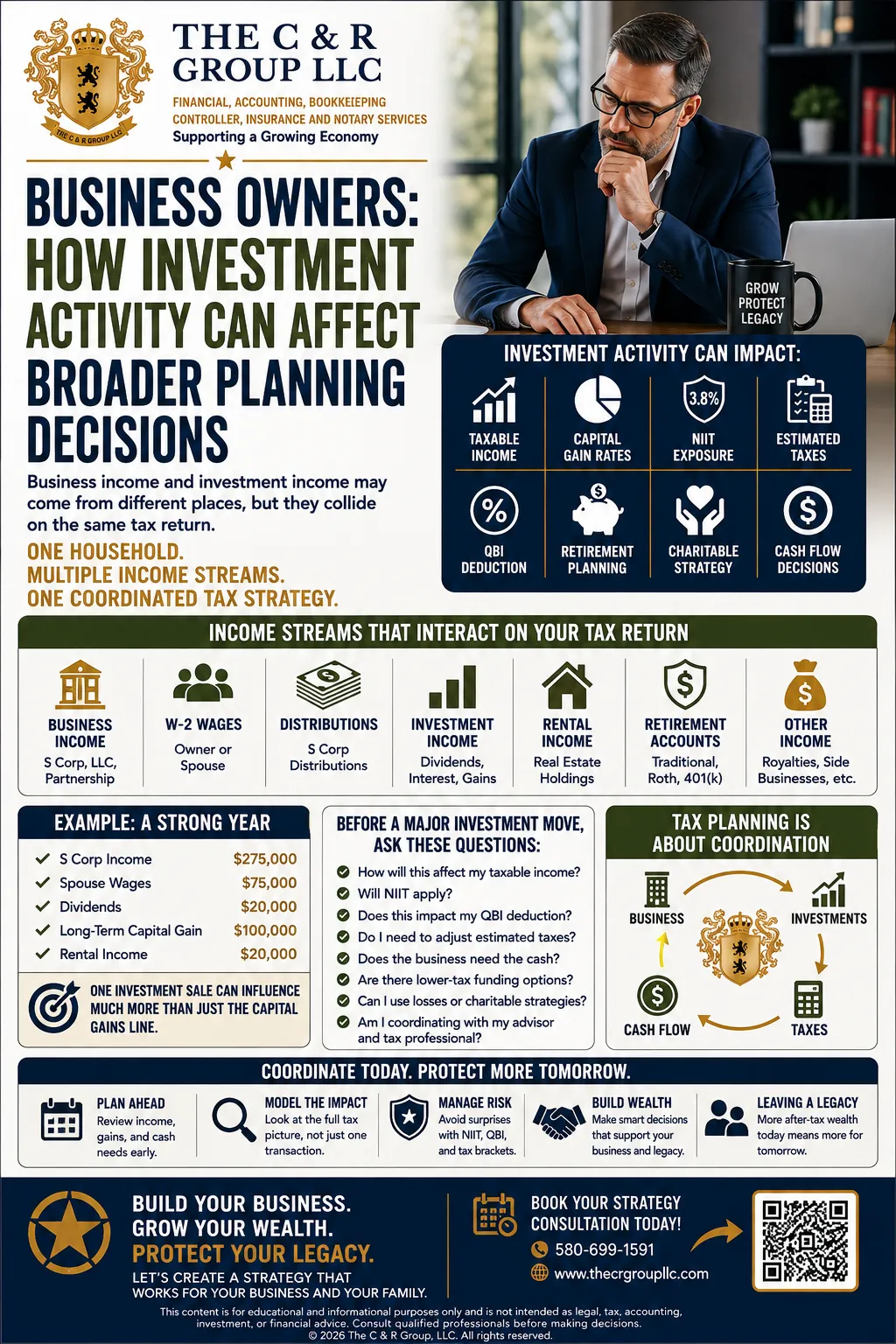
Business Owners: How Investment Activity Can Affect Broader Planning Decisions
Financial Horizons: Insights for Building Wealth and Securing Your Legacy
Business Owners: How Investment Activity Can Affect Broader Planning Decisions
By Dr. Jose G. Cardenas | Chief Tax Strategist, The C & R Group, LLC
Business owners rarely have simple financial lives.
A typical household may have:
Business income;
W-2 wages;
S corporation distributions;
Partnership income;
Retirement accounts;
Taxable brokerage accounts;
Dividends;
Capital gains;
Rental income;
Real estate;
Cash reserves.
Each item may look separate.
But when tax planning begins, they frequently converge.
That means a business owner who says:
“My investments have nothing to do with my business taxes.”
may be looking at the financial picture too narrowly.
The stock portfolio does not necessarily belong on the business tax return.
But the income and gains from that portfolio can still affect the owner's:
Individual taxable income;
Capital-gain rate;
Net Investment Income Tax exposure;
Estimated-tax requirements;
Qualified Business Income deduction;
Retirement planning;
Charitable strategy;
Cash-flow decisions.
The IRS states that the 3.8% Net Investment Income Tax may apply when a taxpayer has net investment income and modified adjusted gross income above $250,000 for married filing jointly, $125,000 for married filing separately, or $200,000 for single or head-of-household taxpayers. Net investment income can include interest, dividends, capital gains, rents, royalties, and certain other investment income.
The IRS also makes clear that capital gains, dividends, and certain investment items generally are not included in qualified business income, while the QBI deduction itself is limited in part by taxable income reduced by net capital gain.
That leads to today's central principle:
Investment activity can change the tax environment surrounding the business owner—even when the investments themselves are not part of the operating business.
The Business Owner Has One Household Tax Picture
Imagine a business owner with:
S corporation income
$220,000
Spouse wages
$90,000
Dividends
$15,000
Long-term capital gains
$80,000
Rental income
$20,000
Those dollars originate from different sources.
But they can interact when determining:
Adjusted gross income;
Taxable income;
Capital-gain rates;
NIIT;
Estimated taxes;
QBI limitations.
The business owner should therefore stop thinking in terms of:
“Business taxes over here.”
and
“Investment taxes over there.”
The better framework is:
One household. Multiple income streams. One coordinated tax strategy.
1. Investment Gains Can Raise the Owner's Overall Taxable Income
Suppose the business is having a strong year.
Then the owner sells appreciated investments.
The investment sale may add:
$100,000
of long-term capital gain.
That gain may receive preferential federal capital-gain treatment.
But it also increases the owner's taxable-income picture.
That can affect other calculations.
So the correct question is not:
“What is the capital-gain rate?”
It is:
“What happens to the rest of my tax plan when this gain is added?”
2. Capital Gains Can Affect the QBI Deduction
This interaction is often overlooked.
The IRS states that investment items such as capital gains or losses generally are not included in qualified business income. It also states that the QBI deduction is limited to the lesser of the applicable QBI components or 20% of taxable income minus net capital gain.
That means a large capital gain can affect the broader QBI calculation even though the gain itself is not business income.
Example
Assume a business owner has:
$180,000 of QBI
and also realizes:
$150,000 of net capital gain.
The capital gain is not simply added to QBI.
Instead, the QBI deduction must be calculated under the applicable limitations.
This is why business income and investment income need to be modeled together.
3. Investment Income Can Push the Household Toward NIIT
The NIIT deserves special attention for successful business owners.
The tax is:
3.8%
on the lesser of:
Net investment income; or
The amount MAGI exceeds the applicable threshold.
Thresholds:
Married Filing Jointly
$250,000
Married Filing Separately
$125,000
Single / Head of Household
$200,000
For many established business owners, ordinary business income may already place the household near or above those levels.
Then investment activity can create the additional taxable layer.
4. Active Business Income and Investment Income Are Treated Differently for NIIT
This distinction matters.
The IRS states that wages and most self-employment income generally are not included in net investment income. Active nonpassive business income generally is also outside the NIIT base.
Investment income, however, can include:
Interest;
Dividends;
Capital gains;
Certain rents;
Royalties;
Passive business income.
That means a business owner can have:
high active business income
that pushes MAGI above the NIIT threshold,
while:
investment income
becomes the amount potentially subject to the 3.8% tax.
That interaction is important.
5. Passive Business Interests Can Complicate the NIIT Analysis
A business owner may also invest in:
Limited partnerships;
Passive LLCs;
Real-estate ventures;
Other businesses.
The IRS notes that income from a trade or business can fall within NIIT when the activity is passive to the taxpayer or involves trading in financial instruments or commodities.
So:
“It comes from a business.”
does not automatically mean:
“NIIT does not apply.”
Participation matters.
Structure matters.
The actual activity matters.
6. Selling a Business Interest Can Trigger Investment-Tax Questions
Eventually, successful business owners may sell:
S corporation stock;
Partnership interests;
LLC interests.
The NIIT rules can become relevant.
IRS guidance notes that net gains from certain sales of active partnership or S corporation ownership interests can require special analysis when determining net investment income.
This can become highly technical.
The lesson for owners is straightforward:
Do not wait until the closing documents are signed to begin tax analysis on a major business-interest sale.
Transaction planning should happen before the sale.
7. A Large Portfolio Sale Can Change Estimated Taxes
Business owners already may make estimated payments because of:
Pass-through income;
Self-employment income;
Business distributions.
Then an investment gain occurs.
The IRS's 2026 Publication 505 states that estimated tax may be necessary for income including:
Self-employment;
Interest;
Dividends;
Rents;
Gains from asset sales.
That means the quarterly payment calculated earlier in the year may become obsolete.
8. Estimated Taxes Should Be Recalculated When the Financial Picture Changes
Suppose first-quarter projections assumed:
Business income
$200,000
Investment gains
$0
Then in September:
The owner realizes:
$125,000 capital gain.
That should trigger a new tax projection.
Not:
“We'll deal with it in April.”
The federal system is pay-as-you-go, and insufficient withholding or estimated payments can create penalties. Publication 505 specifically discusses estimated payments for income not subject to withholding, including capital gains and dividends.
9. Strong Business Cash Flow Can Hide Investment-Tax Obligations
Business owners often think:
“There is plenty of cash in the company.”
But company cash is not automatically personal tax cash.
This distinction becomes especially important when investment gains are generated personally.
The owner may have:
Strong business balance sheet;
Large taxable investment gain;
Limited personal liquidity.
The tax liability belongs somewhere.
Coordinate distributions and personal cash reserves before the tax payment date.
10. Do Not Automatically Take a Business Distribution to Pay Investment Taxes
Suppose an S corporation owner needs:
$50,000
to cover a tax bill partly created by personal investment gains.
Taking money out of the business may be possible.
But first ask:
Does the company need the cash?
Does the owner have sufficient basis?
Are distributions being tracked properly?
Will the withdrawal impair working capital?
Are there other sources of liquidity?
The investment tax should not accidentally weaken the operating company.
11. The Business Emergency Fund and the Investment Portfolio Serve Different Purposes
A business owner may say:
“I have $500,000 invested, so I don't need much business cash.”
That can be risky.
Investments may:
Fluctuate;
Generate taxable gains when sold;
Be earmarked for retirement;
Be poorly timed for liquidation.
Business cash reserves should generally support:
Payroll;
taxes;
debt;
operating expenses;
emergencies.
The taxable brokerage account may be part of net worth.
It should not automatically become the operating line of credit.
12. Investment Liquidity Should Be Planned Before the Business Needs Cash
Suppose the business expects:
$150,000 equipment purchase
in six months.
The owner plans to sell securities to fund it.
Do not wait until payment is due.
Review:
Unrealized gains;
losses;
holding periods;
cost basis;
tax rates;
liquidity.
The question is not simply:
“Which account has enough money?”
It is:
“Which source creates the best overall economic result?”
13. Taxable Investments Can Help Fund a Business—but Tax Cost Matters
Suppose a business owner invested:
$100,000
several years ago.
Portfolio value:
$180,000.
The owner wants:
$80,000
for expansion.
Selling investments may generate capital gains.
Alternative funding might include:
Business cash;
Financing;
Line of credit;
Phased expansion.
That does not mean borrowing is automatically better.
It means funding decisions should compare:
cost of capital
with
tax cost of liquidation.
14. Do Not Raid Retirement Accounts Without Running the Numbers
Another owner says:
“Why sell investments and pay capital gains when I can take money from my IRA?”
That may create a very different tax problem.
Traditional retirement distributions can generally create ordinary taxable income.
They may also affect:
Tax brackets;
NIIT calculations indirectly through MAGI;
Medicare premiums later in life;
Retirement security.
Different pools of wealth have different tax characteristics.
Choose funding sources strategically.
15. Business Retirement Plans and Personal Investing Should Coordinate
Business owners may contribute to:
SEP-IRA;
SIMPLE IRA;
Solo 401(k);
Employer retirement plans;
Defined-benefit or cash-balance arrangements.
Those contributions can affect taxable income and retirement wealth.
At the same time, the household may be investing substantial cash into a taxable brokerage account.
The question becomes:
Where should the next investment dollar go?
That depends on:
Liquidity;
retirement horizon;
tax rate;
business cash needs;
contribution limits;
risk.
Do not automatically fund each account by habit.
16. Business Profit Can Increase the Value of Tax-Deferred Planning
A high-profit year may make deductible retirement contributions more valuable.
At the same time, that year may also be a poor year for deliberately realizing large taxable gains.
Or perhaps the gain is unavoidable.
The point is:
Retirement contributions and investment realizations should be planned together.
One affects taxable income.
The other may consume the same tax capacity.
17. Roth Conversions Can Compete With Capital Gains
Imagine a business owner expects lower business income this year.
They consider:
$100,000 Roth conversion.
They also want to realize:
$75,000 long-term capital gain.
Both strategies may be reasonable.
But together they may push taxable income substantially higher.
That can affect:
Capital-gain brackets;
NIIT;
Other tax calculations.
Do not model the Roth conversion in one spreadsheet and the investment sale in another.
Combine them.
18. Charitable Giving Can Coordinate With Appreciated Investments
Business owners frequently support:
Churches;
Universities;
nonprofits;
Community organizations.
Suppose the owner plans to give:
$50,000.
They also hold highly appreciated securities.
Before selling investments and donating cash, review whether donating appreciated property directly to a qualified charity may fit the broader strategy, subject to applicable charitable rules.
This can potentially coordinate:
Philanthropy;
Capital gains;
Deduction planning.
The giving decision and investment decision should speak to each other.
19. A High-Income Business Year Can Change the Value of Charitable Timing
Suppose business income is unusually high.
Charitable giving may provide more planning value in that year than in a low-income year, depending on:
Itemized deductions;
Applicable AGI limitations;
Charitable carryforwards;
Type of property donated.
Again:
Business income influences investment and charitable planning.
This is why integrated planning matters.
20. Capital Losses Can Help Offset Investment Gains
A business owner realizes:
$100,000 capital gain
from one investment.
Another portfolio holding has:
$30,000 unrealized loss.
Tax-loss harvesting may deserve review.
If the investment strategy still supports selling the loss position, the loss may help offset gains under the capital-loss rules.
But investment suitability comes first.
Do not sell a strong holding solely to manufacture a tax result.
21. Business Losses and Capital Losses Are Not the Same Thing
This distinction is important.
A:
$30,000 business loss
does not necessarily function the same way as:
$30,000 capital loss.
Different rules apply.
Capital-loss limitations can restrict how net capital losses offset ordinary income.
Meanwhile, business losses can be affected by:
Basis;
At-risk rules;
Passive activity rules;
Excess business loss provisions.
Do not combine every negative number mentally into:
“It all offsets.”
Tax categories matter.
22. Cost Basis Should Be Part of Liquidity Planning
Suppose an owner needs to sell:
$100,000 of investments.
Portfolio contains:
Holding A
Value:
$100,000
Basis:
$95,000
Holding B
Value:
$100,000
Basis:
$40,000
Same liquidity.
Very different gain.
That does not mean Holding A should automatically be sold.
But basis should be part of the decision.
23. Specific-Lot Selection Can Improve Flexibility
Business owners often accumulate the same investment over years.
Different shares may have different purchase prices.
When selling part of the position, specific-lot identification may create flexibility around:
Gain size;
Holding period;
Loss realization.
This is another reason not to execute large sales without reviewing tax lots first.
24. Concentrated Stock Positions Can Become a Business-Risk Problem Too
Entrepreneurs already have substantial wealth tied to:
one business.
Then some also maintain large concentrations in:
Employer stock;
One technology company;
One industry.
That can create concentrated risk across both:
business wealth
and
investment wealth.
Tax costs from diversification matter.
But taxes should not prevent prudent risk management.
A portfolio tax strategy should support diversification.
25. Business Owners Often Need More Liquidity Than Employees
An employee may have:
Stable paycheck;
Employer benefits.
Business owners may need cash for:
Payroll;
Taxes;
Equipment;
Opportunities;
Downturns.
That means their investment strategy should account for:
business liquidity needs.
Too much household wealth locked into volatile or illiquid investments can create forced sales at bad times.
26. Forced Investment Sales Are Usually Poor Tax Planning
The owner suddenly needs:
$75,000
for payroll.
They sell whatever investments are liquid.
That may generate:
Short-term gains;
Long-term gains;
Losses;
Bad market timing.
Planning adequate business reserves can reduce the probability that personal investments need to be liquidated under pressure.
Cash reserves create tax flexibility.
27. Investment Income Can Affect the Business Owner's Marginal Decisions
Suppose the owner is deciding whether to:
Buy equipment;
Increase retirement contributions;
Make a charitable gift;
Take a bonus;
Realize capital gains.
Each decision changes the projected tax return.
That is why the best planning question is:
“What combination creates the strongest after-tax outcome while still meeting the business and household goals?”
Not:
“Which deduction is biggest?”
28. Investment Income May Affect Estimated Payments Even When the Business Has Withholding
An S corporation shareholder may receive wages with federal withholding.
That does not guarantee the withholding is sufficient.
Investment activity can add:
Dividends;
Capital gains;
NIIT.
The IRS specifically notes that taxpayers may need to increase withholding or estimated payments because of NIIT exposure.
Review the full year.
29. Tax Planning Before Year-End Creates More Options
Before December 31, a business owner may still have opportunities to review:
Retirement contributions;
Gain realization;
Loss harvesting;
Charitable giving;
Estimated payments;
Business purchases;
Cash reserves.
After year-end:
Many facts are locked.
The portfolio sales happened.
Income was earned.
Expenses occurred.
The value of tax planning is having options before the clock runs out.
30. The Investment Adviser and Tax Strategist Should Not Operate in Isolation
This is perhaps the biggest planning lesson.
Investment adviser says:
“We should sell.”
Tax professional says in April:
“That created a large tax bill.”
That is not coordination.
The better sequence:
Investment question
Should we sell?
Tax question
What does the sale create?
Cash-flow question
What do we need the proceeds for?
Business question
Does the company need capital?
Household question
How does this fit the broader plan?
Then decide.
Illustrative Case Study: The Business Owner With a Strong Year
Assume Daniel owns a profitable consulting company taxed as an S corporation.
Business income
$275,000
Spouse wages
$75,000
Taxable dividends
$20,000
Planned long-term capital gain
$100,000
Daniel wants the investment proceeds to help fund:
New business equipment;
Personal investment diversification.
Initial Thinking
Daniel says:
“It’s a long-term capital gain, so I’ll just pay the capital-gains tax.”
That is incomplete.
The household should review:
Capital-gain rate;
NIIT exposure;
QBI interaction;
Estimated payments;
Business liquidity;
Alternative funding.
Step 1: Project Household Income
Before the investment sale, the household already has substantial income.
Adding:
$100,000 capital gain
may move the household further into:
Higher capital-gain exposure;
NIIT territory.
The IRS's NIIT threshold for married filing jointly is $250,000 MAGI.
Daniel's household is already beyond that threshold before the proposed investment gain.
That means the investment sale deserves NIIT modeling.
Step 2: Review QBI
The capital gain itself generally is not QBI.
And the QBI deduction is subject to the taxable-income-minus-net-capital-gain limitation.
Daniel therefore needs the QBI calculation updated with the proposed transaction included.
Step 3: Review Funding Need
Daniel needs:
$60,000
for equipment.
Why sell:
$100,000
of investments?
Maybe the portfolio sale can be smaller.
Maybe business cash can cover part.
Maybe financing makes sense.
Maybe the full sale still makes sense.
But now:
investment liquidation
is matched to:
actual capital need.
Step 4: Review Tax Lots
Daniel owns several lots of the same investments.
Some have:
High basis;
Low basis.
Selecting which shares are sold can change the gain realized.
Again:
Tax does not control the investment decision.
But tax lots should not be ignored.
Step 5: Update Estimated Taxes
The IRS states that estimated tax applies to income such as capital gains and dividends when withholding is insufficient.
Daniel updates:
W-2 withholding;
Estimated payments;
Tax reserve.
Now the tax bill does not become an April surprise.
The Better Outcome
Daniel may ultimately execute the same investment sale.
But now it was coordinated with:
Business cash flow;
Household income;
QBI;
NIIT;
Estimated tax.
That is broader planning.
Business Owner Investment Coordination Checklist
BUSINESS
Project annual business income.
Review business cash reserve.
Identify upcoming capital needs.
Review business distributions.
INVESTMENTS
Project dividends.
Project interest.
Review unrealized gains.
Review unrealized losses.
Review holding periods.
Review tax lots.
TAX
Project taxable income.
Review capital-gain rate.
Review NIIT.
Review QBI.
Review estimated payments.
Review state tax.
RETIREMENT
Review retirement-plan contributions.
Review Roth conversions.
Review taxable-account contributions.
CASH FLOW
Determine business capital needs.
Determine household cash needs.
Avoid forced sales.
Fund tax reserves.
CHARITABLE
Review planned giving.
Review appreciated-property opportunities.
Coordinate timing.
The Business Owner Investment Dashboard
BUSINESS INCOME
Projected business income:
$________
Owner wages:
$________
Distributions:
$________
INVESTMENT INCOME
Interest:
$________
Dividends:
$________
Realized gains:
$________
Projected additional gains:
$________
TAX
Projected taxable income:
$________
NIIT exposure:
Yes / No / Review
Estimated tax due:
$________
Tax reserve:
$________
QBI
Projected QBI:
$________
QBI deduction estimate:
$________
Capital-gain limitation reviewed:
Yes / No
CASH NEEDS
Business capital needed:
$________
Household cash needed:
$________
Planned investment liquidation:
$________
AI-Search Quick Answers
Does investment income count as qualified business income?
Generally no. The IRS excludes investment items such as capital gains or losses, most dividends, and interest not properly allocable to a trade or business from QBI.
Can capital gains affect the QBI deduction?
Yes. The QBI deduction is limited in part to 20% of taxable income minus net capital gain, so significant capital gains can affect the broader calculation.
What is the Net Investment Income Tax?
The NIIT is a 3.8% tax on the lesser of net investment income or the amount MAGI exceeds the statutory threshold.
What are the NIIT thresholds?
The thresholds are $250,000 for married filing jointly, $125,000 for married filing separately, and $200,000 for single or head-of-household taxpayers.
Does active business income itself generally count as net investment income?
Generally, wages and active nonpassive business income are not included in net investment income. However, passive business income may be included under the applicable rules.
Can investment gains increase estimated-tax requirements?
Yes. IRS Publication 505 states that estimated tax can apply to capital gains, dividends, interest, rents, and self-employment income when sufficient tax is not otherwise paid through withholding.
Can an S corporation shareholder need additional estimated payments because of investments?
Yes. Wage withholding from the S corporation may not be enough to cover the shareholder's total tax liability when pass-through income, investment gains, dividends, or NIIT are added.
Should business owners sell investments to fund business growth?
Possibly, but the decision should compare capital-gain tax, portfolio risk, business cash flow, financing costs, liquidity, and the expected business return.
30 Questions Business Owners Should Ask Before a Major Investment Transaction
What is projected business income?
What are projected owner wages?
What distributions are expected?
What dividends will I receive?
What interest income will I receive?
What gains have already been realized?
Is the proposed gain short-term or long-term?
What is my basis?
Which tax lots are available?
What is my projected taxable income?
Does NIIT apply?
What amount may be exposed to NIIT?
Does the gain affect my QBI calculation?
Is my QBI deduction already limited?
Will additional withholding be needed?
Will estimated taxes need adjustment?
What state tax applies?
Why am I selling the investment?
Does the business actually need the cash?
How much cash does the business need?
Could business cash fund part of the need?
Is financing economically reasonable?
Would selling retirement assets create a worse tax result?
Are capital losses available?
Does charitable giving deserve review?
Are retirement contributions still being optimized?
Is a Roth conversion planned?
Could several strategies compete for the same tax bracket?
Have my investment and tax professionals coordinated?
Am I making this decision based on one account—or on the entire financial picture?
That final question is the coordination test.
What to Do Next
Before the next major portfolio sale, complete a Business Owner Investment Impact Review.
STEP 1 — BUSINESS
Project:
Income;
distributions;
capital needs;
cash reserves.
STEP 2 — INVESTMENTS
Identify:
Gain;
loss;
holding period;
basis;
tax lots.
STEP 3 — TAX
Model:
Capital-gain tax;
NIIT;
QBI;
estimated payments;
state tax.
STEP 4 — CASH FLOW
Determine:
How much cash is actually needed;
Which source should provide it.
STEP 5 — COORDINATE
Review:
Retirement;
charitable giving;
business investments;
taxable investments;
household needs.
Only then execute the transaction.
The goal is not to make every decision complicated.
It is to avoid making a simple investment decision that creates an unnecessarily complicated tax result.
Final Thought
Business owners already understand interconnected systems.
Sales affect cash.
Cash affects hiring.
Hiring affects margins.
Margins affect expansion.
Expansion affects financing.
Taxes work the same way.
Business income affects taxable income.
Taxable income affects investment-tax rates.
Investment gains can affect NIIT.
Capital gains can affect QBI limitations.
Investment sales can affect estimated payments.
Personal liquidity decisions can affect business cash.
Retirement contributions can compete with other tax strategies.
None of these decisions exists completely alone.
That is why successful business owners should stop viewing investments as:
“The money outside the business.”
It is all part of the household balance sheet.
The better objective is to coordinate:
Business wealth.
Investment wealth.
Retirement wealth.
Tax exposure.
Cash flow.
Because the goal is not simply to build a profitable business.
And it is not simply to build a strong investment portfolio.
The goal is to build after-tax household wealth that can survive, grow, and eventually transfer to the next generation.
Build the business.
Build the portfolio.
Coordinate the taxes.
Protect the cash flow.
And make every major financial decision with the complete picture in view.
Book Your Strategy Consultation
If you are a business owner with taxable investments, retirement accounts, capital gains, business distributions, or growing household wealth, schedule a strategy consultation to review how those pieces work together.
We can review:
Capital gains;
Dividends;
NIIT;
QBI;
Estimated taxes;
Business distributions;
Retirement contributions;
Investment liquidation;
Charitable planning;
Business cash needs;
After-tax wealth strategy.
Booking link:
https://api.leadconnectorhq.com/widget/booking/T4UHUjCijCtIB3rwoTDI
Phone: 580-699-1591
Booking your appointment now:

ABOUT THE AUTHOR
Dr. Jose G. Cardenas is a retired U.S. Army Finance Officer and the Chief Tax Strategist at The C & R Group, LLC. With a Doctorate in Business Administration and over 20 years of experience in tax planning and financial strategy, Dr. Cardenas helps individuals and business owners legally reduce taxes, strengthen cash flow, and build lasting wealth and legacy. Learn more at www.thecrgroupllc.com
DISCLOSURE
This article is for educational and informational purposes only and is not intended to serve as personalized legal, tax, or investment advice. Tax laws and regulations change over time and may vary by jurisdiction. You should consult with a qualified tax professional regarding your specific circumstances before implementing any strategy discussed here. Dr. Jose G. Cardenas, DBA, provides tax advisory services through The C & R Group, LLC. Insurance and investment strategies may be offered through his role as a licensed financial professional affiliated with Experior Financial Group.