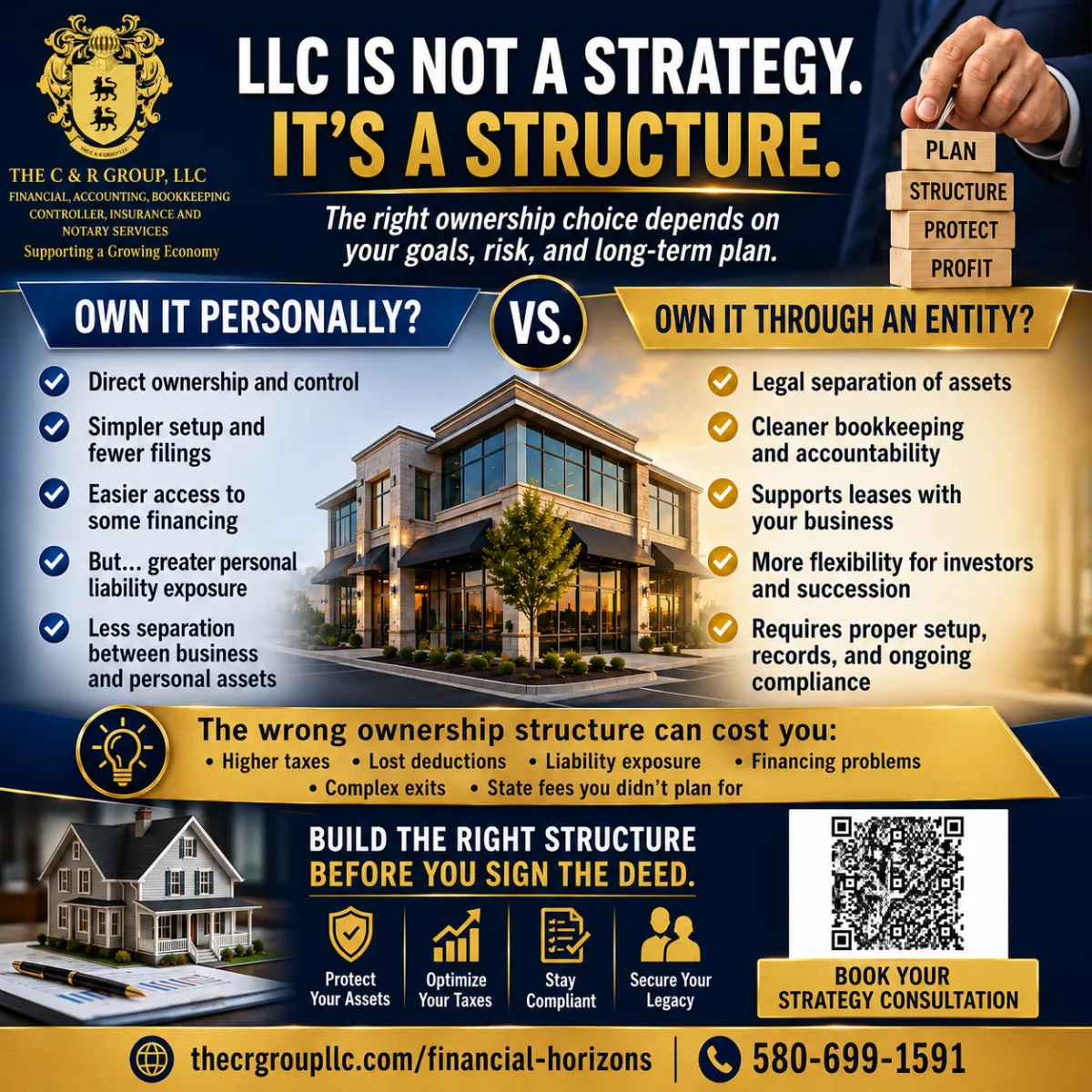
Business Owners: Should You Own Property Personally or Through an Entity?
Financial Horizons: Insights for Building Wealth and Securing Your Legacy
Business Owners: Should You Own Property Personally or Through an Entity?
By Dr. Jose G. Cardenas, Chief Tax Strategist at The C & R Group, LLC
Business owners frequently hear a confident recommendation:
“Put the property in an LLC.”
That advice may be appropriate—but it is not a complete strategy.
An LLC can help separate legal ownership, operations, accounting, and liability exposure. However, placing real estate in an entity does not automatically produce a federal tax deduction, eliminate personal guarantees, protect every asset, qualify the property for depreciation, or prevent state and local taxes.
The correct ownership structure depends on the property’s purpose.
A building used by an operating company presents different issues from:
A personal residence;
A long-term rental;
A short-term rental;
Raw land;
A medical or professional office;
A warehouse;
A construction project;
A property shared by several investors;
A property expected to appreciate substantially;
A building that may later be sold separately from the business; or
Real estate intended to pass to family members.
The decision should coordinate:
Federal income-tax treatment;
State entity law;
Liability protection;
Financing;
Insurance;
Depreciation;
Bookkeeping;
Property taxes;
Estate planning;
Business succession;
Future investors;
Exit strategy; and
The separation between the operating company and the real estate.
The central question is not simply:
“Should the property be in an LLC?”
The better question is:
“Who should legally own the property, how should that owner be taxed, who will use it, how will money move between the parties, and what structure best supports the long-term business and real-estate strategy?”
Legal Ownership and Federal Tax Classification Are Different Questions
An LLC is created under state law.
Federal tax law then determines how that LLC will be classified for income-tax purposes.
The IRS generally treats a domestic single-member LLC as a disregarded entity unless it elects corporate treatment. A domestic LLC with two or more members is generally classified as a partnership unless it elects to be taxed as a corporation.
That means a property can be legally owned by an LLC while its income and deductions are still reported directly on the owner’s federal income-tax return.
Example: Single-member rental LLC
Assume Maria owns 100% of Rental Property LLC.
The LLC owns one residential rental property.
If no corporate election is made:
The LLC remains a separate legal entity under state law;
The IRS generally disregards it for federal income-tax purposes;
Rental income and expenses are normally reported through Maria’s return; and
The LLC does not automatically create a separate federal income-tax return merely because its name appears on the deed.
The legal structure and tax-reporting structure are related—but they are not identical.
Compliance Is Not Ownership Strategy
Tax compliance records the property according to the structure that already exists.
Ownership strategy begins before the deed, loan, lease, operating agreement, insurance policy, or management arrangement is finalized.
Compliance asks:
Who owns the property?
Which return reports the rental income?
What depreciation is allowable?
Are payments rent, distributions, or capital contributions?
Which state returns are required?
Was the property sold or transferred?
Strategy asks:
Should the operating company own the building?
Should a separate real-estate company own it?
Should the owner hold it personally through a disregarded LLC?
Should several investors use a partnership-taxed LLC?
Will the lender permit entity ownership?
Should the business lease the property from the owner or related entity?
What liability and insurance risks exist?
How will improvements be funded and owned?
What happens if the operating business is sold?
What happens if an owner dies, retires, divorces, or exits?
Could the ownership structure complicate a future exchange or sale?
Compliance reports the mission already executed.
Strategy determines the formation.
1. Start With the Property’s Purpose
Before choosing the owner, identify what the property will actually do.
Owner-occupied business property
The property may house:
A medical clinic;
A veterinary practice;
A restaurant;
A retail store;
A professional office;
A warehouse;
A construction business;
A manufacturing operation; or
Another active company.
The operating business may own the real estate directly, or a separate entity may own the property and lease it to the operating company.
Investment property
The property may be acquired primarily to:
Generate rent;
Appreciate;
Be renovated and repositioned;
House third-party tenants;
Produce short-term rental income; or
Be exchanged or sold later.
Personal or mixed-use property
The owner may also use the property as:
A residence;
A vacation home;
A home office;
A family property;
A business retreat; or
A combination of personal and rental use.
IRS rules distinguish rental and income-producing use from personal use, and mixed use can affect the allocation and limitation of expenses.
The structure should follow the real activity.
Do not create an elaborate entity plan for a property whose use has not been clearly defined.
2. Owning Property Personally May Be the Simplest Structure
Personal ownership may be reasonable when:
The property is a principal residence;
The owner wants access to residential financing;
The lender requires individual ownership;
The property has limited operational risk;
A single owner wants simple federal reporting;
State entity fees would exceed the practical benefit;
The property is covered by appropriate insurance; or
The owner plans to place it into a single-member LLC later after reviewing the lender and legal consequences.
Personal ownership does not mean the owner must ignore liability exposure.
Risk management may include:
Adequate property insurance;
Landlord coverage;
Commercial coverage;
Umbrella liability protection;
Written leases;
Property-management procedures;
Strong contracts; and
Separate accounting.
Potential advantages of personal ownership
Simpler acquisition;
Easier access to some loan products;
Fewer entity filings;
Fewer annual state fees;
Direct reporting of income and expenses;
Simpler treatment when the property is the owner’s home; and
Fewer legal entities to maintain.
Potential disadvantages
The owner appears directly on the deed;
Property-related claims may be asserted directly against the owner;
Multiple investors are harder to coordinate;
Business and personal accounting may become mixed;
Ownership transfers may be less organized; and
Succession planning may become more complicated.
The least complicated structure is not always the safest.
The most complicated structure is not always the smartest.
3. A Single-Member LLC May Provide Legal Separation Without Changing Federal Income-Tax Reporting
A single-member LLC is often considered when one person—or, in some circumstances, another eligible owner—owns investment or business property.
Unless it elects corporate taxation, the LLC is generally disregarded for federal income-tax purposes.
That can offer a practical combination:
The LLC holds legal title under state law;
The owner maintains a separate bank account and records;
The activity may continue to appear directly on the owner’s federal return;
Property operations can be separated from personal spending; and
The owner can use contracts and leases in the LLC’s name.
However, the LLC must be operated properly.
The owner should maintain:
Articles of organization;
Operating agreement;
EIN where appropriate;
Separate bank account;
Separate bookkeeping;
Property-specific insurance;
Leases in the correct name;
Vendor contracts;
Security-deposit records;
State annual reports;
Registered-agent information;
Capital-contribution records; and
Documentation of owner payments.
A legal entity that exists only on paper may provide less practical protection than the owner expects.
Do not treat the LLC account as a personal wallet with a fancy name.
4. Multiple Owners Usually Create Partnership Tax Issues
When two or more people own an LLC, the default federal classification is generally a partnership unless the entity elects corporate taxation.
That usually introduces:
A separate partnership return;
Schedule K-1 reporting;
Capital accounts;
Allocation rules;
Partner basis;
Contributions;
Distributions;
Debt allocations;
Operating-agreement provisions;
State filings; and
Exit or buyout procedures.
Questions multiple owners should resolve before purchasing
Who contributes the down payment?
Who signs or guarantees the debt?
Are ownership percentages based on cash, credit, labor, or another contribution?
How are profits and losses allocated?
Who controls leasing and renovations?
What happens when additional capital is needed?
Can one member force a sale?
Can an owner transfer an interest?
What happens after death, disability, divorce, or bankruptcy?
How is the property valued during a buyout?
Who claims depreciation and tax items?
How are refinancing proceeds distributed?
A handshake is not an operating agreement.
Friendship is not a capital-account system.
5. Corporate Ownership Requires Extra Caution
An LLC can elect to be taxed as a corporation using Form 8832 when eligible. An entity may also qualify to elect S corporation status when statutory requirements are met.
That does not mean corporate taxation is automatically ideal for appreciating real estate.
A corporation can create additional considerations involving:
Property distributions;
Transfers to shareholders;
Built-in gains;
Entity-level tax exposure;
Compensation;
Shareholder basis;
Accumulated earnings;
Passive-income rules;
State corporate taxes; and
The difficulty of removing appreciated property from the corporation.
C corporation concerns
A C corporation is generally a separate taxpayer.
If appreciated real estate is sold and the proceeds are later distributed, the combined entity and shareholder consequences may differ materially from direct or pass-through ownership.
S corporation concerns
An S corporation generally passes income, deductions, gains, and losses through to shareholders, although certain entity-level taxes may still apply.
An S corporation can be appropriate for some operating businesses.
That does not automatically make it the preferred long-term owner of appreciating real estate.
Before placing property into a corporation, review:
Expected appreciation;
Planned holding period;
Future distributions;
Business-sale strategy;
Estate plan;
Potential 1031 exchange;
Related-party leases;
Shareholder changes; and
How the property could later be removed.
Getting property into an entity can be easy.
Getting appreciated property out can be expensive.
6. Separating the Operating Business From the Real Estate Can Be Powerful
Many business owners use two entities:
Operating company
The operating company:
Employs workers;
Serves customers;
Holds operating contracts;
Receives business revenue;
Owns inventory;
Conducts the active trade or business; and
Pays rent for the property it occupies.
Real-estate company
The real-estate company:
Owns the land and building;
Maintains the property;
Carries property insurance;
Collects rent;
Pays the mortgage and property taxes;
Records depreciation; and
Enters into a lease with the operating company.
This separation can support:
Cleaner accounting;
Separate liability analysis;
Independent valuation of the property;
A future sale of the operating company without selling the building;
Continuing rental income after the owner exits the business;
Estate and succession planning;
Different ownership groups;
Property refinancing; and
A clearer distinction between operating performance and real-estate returns.
Example
Dr. Taylor owns:
Taylor Medical Practice, PLLC; and
Taylor Real Estate Holdings, LLC.
The real-estate company owns the clinic building.
The practice pays documented rent under a written lease.
The arrangement allows Dr. Taylor to measure:
Whether the clinic is profitable after market rent;
Whether the real estate produces an acceptable return;
Which entity pays repairs and improvements;
How debt is serviced;
How much cash belongs to each activity; and
Whether the building should be retained if the medical practice is later sold.
The strategy works only when the entities behave like separate entities.
7. Related-Party Rent Must Be Real, Documented, and Economically Supportable
When a business leases property from its owner or a related entity, the arrangement should include:
A written lease;
Clearly defined premises;
Lease term;
Rent amount;
Payment schedule;
Security-deposit terms;
Repair obligations;
Improvement responsibilities;
Insurance requirements;
Utility responsibilities;
Renewal provisions;
Default provisions; and
Documentation supporting the rent.
The rent should be commercially supportable.
An owner should not select an arbitrary number merely to move taxable income between entities.
Questions to answer
What would an unrelated tenant pay?
Is the lease gross, modified gross, or triple net?
Who pays property taxes?
Who pays utilities?
Who owns tenant improvements?
Who replaces major equipment?
Can rent increase?
What happens if the operating company cannot pay?
Is the lease compatible with the loan?
Does the lease affect valuation or a future sale?
Related-party arrangements receive more credibility when they look and operate like real business arrangements.
8. Rental Income and Deductions Depend on the Activity—not Merely the Entity
The IRS generally requires owners to report rental income and allows qualifying rental expenses, subject to applicable limitations. Publication 527 covers rental income, expenses, depreciation, passive-activity rules, and personal-use issues.
An LLC does not transform:
Personal expenses into deductions;
Vacant property into an active rental;
Capital improvements into repairs;
Below-market family occupancy into an arm’s-length lease;
Personal travel into business travel; or
A second home into a business property.
The deduction follows the qualifying expense and activity.
The entity name does not perform tax alchemy.
Maintain property-level books showing:
Rent received;
Security deposits;
Mortgage interest;
Property taxes;
Insurance;
Utilities;
Repairs;
Capital improvements;
Management fees;
Legal and accounting costs;
Mileage and travel;
Depreciation;
Owner contributions;
Owner distributions; and
Debt principal.
9. Depreciation Depends on Basis and Use
Depreciation allows the owner to recover the cost or other qualifying basis of property used in business or held for the production of income.
The depreciable basis may require adjustments for events occurring before the property is placed in service.
Ownership structure does not eliminate the need to determine:
Purchase price;
Land allocation;
Building allocation;
Closing costs;
Improvements;
Placed-in-service date;
Business-use percentage;
Personal-use periods;
Prior depreciation;
Dispositions; and
Cost-segregation components where appropriate.
Land is generally not depreciated.
A building used in a business or rental activity may be depreciable.
Furniture, equipment, land improvements, and building components may follow different recovery rules.
The deed identifies the owner.
The depreciation schedule identifies how qualifying cost is recovered.
Both must be correct.
10. Cost Segregation Should Follow the Ownership and Use
A cost-segregation study may identify portions of a building that qualify for shorter recovery periods than the building itself.
The strategy may accelerate deductions for qualifying components.
However, the analysis should consider:
Property type;
Acquisition or construction cost;
Land allocation;
Placed-in-service date;
Current tax law;
Owner’s taxable income;
Passive-loss limitations;
Business-interest limitations;
Future sale plans;
Depreciation recapture;
State conformity; and
The property’s actual owner.
The entity claiming depreciation should be the proper taxpayer for the activity.
Do not commission a study before confirming which party owns the building, improvements, furniture, equipment, and leasehold interests.
Accelerating a deduction in the wrong entity is not acceleration.
It is a correction waiting to happen.
11. Rental Real Estate May Qualify for the QBI Deduction—but Entity Choice Alone Does Not Decide It
Section 199A may provide a qualified business income deduction for qualifying pass-through business income.
The IRS has established a rental-real-estate safe harbor under Revenue Procedure 2019-38. Rental real estate that fails the safe harbor may still qualify when it otherwise constitutes a section 162 trade or business.
The safe harbor is based on operational and recordkeeping requirements—not merely the existence of an LLC.
Relevant considerations include:
Rental services performed;
Contemporaneous records;
Separate books;
Hours of rental activity;
Type of property;
Related-party use;
Personal use;
Triple-net arrangements;
Grouping of properties; and
Whether the activity otherwise rises to the level of a trade or business.
An entity can help organize the records.
It does not automatically make the activity a qualified business.
12. Financing Can Determine What Structure Is Practical
The desired legal structure may conflict with the lender’s requirements.
A lender may require:
Personal ownership;
Entity ownership;
Personal guarantees;
Assignment of leases;
Additional collateral;
Minimum net worth;
Liquidity reserves;
Restrictions on transfers;
Single-purpose entity provisions; or
Lender consent before ownership changes.
Before closing, ask:
Who will be the borrower?
Who will hold title?
Who will guarantee the loan?
Can the property later be transferred to an LLC?
Will a transfer trigger a due-on-sale clause?
Does the loan permit leasing to a related business?
Who pays the debt?
Are refinancing proceeds distributed or retained?
Does the entity need separate financial statements?
Will new owners require lender approval?
Do not form the entity, sign the purchase agreement, and discover at closing that the financing requires a different owner.
The capital stack does not salute the organizational chart.
13. Insurance Must Match the Actual Owner and Use
The deed, lease, business operation, and insurance policy should tell the same story.
Review:
Named insured;
Additional insureds;
Mortgagee;
Property use;
Tenant activity;
Vacancy;
Short-term rental use;
Commercial operations;
Employees on site;
Vehicles or equipment;
Environmental risks;
Flood and wind exposure;
Umbrella coverage; and
Entity ownership.
A policy issued for a personally occupied residence may not be appropriate after the property is transferred to an LLC and leased to a business.
Likewise, a landlord policy may not cover undisclosed commercial operations.
The LLC is not a substitute for correct insurance.
The insurance policy is not a substitute for correct entity operation.
Use both.
14. State Fees Can Change the Economics
An entity may create:
Formation fees;
Annual reports;
Franchise taxes;
Registered-agent costs;
State income-tax returns;
Local registrations;
Foreign qualifications;
Business licenses;
Property-transfer taxes;
Recording fees; and
Separate accounting costs.
A property may be located in one state while the LLC is formed in another.
That can require registration and fees in both jurisdictions without producing a meaningful tax advantage.
Before forming an out-of-state LLC, ask:
Where is the property located?
Where does the entity conduct business?
Where do the owners live?
Which state governs the deed?
Which state requires annual filings?
Does the formation state offer a real benefit?
Will foreign qualification be required?
Are additional tax returns created?
Does the lender accept the structure?
Does the structure improve liability or succession planning?
A cheap formation advertisement can produce an expensive annual compliance habit.
15. Transferring Existing Property Requires Advance Review
A business owner may already own property personally and later decide to transfer it into an LLC.
Do not record a new deed without reviewing:
Mortgage terms;
Due-on-sale provisions;
Lender consent;
Title insurance;
Property insurance;
Transfer taxes;
Recording fees;
Property-tax reassessment;
Homestead benefits;
Federal tax classification;
State income-tax treatment;
Ownership percentages;
Creditor issues;
Existing leases; and
Estate-planning documents.
A transfer to a disregarded LLC may have limited federal income-tax effect in some circumstances because the entity is disregarded.
That does not mean the transfer is invisible to:
The lender;
County recorder;
Insurer;
Property-tax authority;
Homeowners association;
State regulatory agency; or
Other parties.
Federal tax neutrality is not universal legal neutrality.
16. The Principal Residence Usually Deserves Special Treatment
Business owners should be cautious about placing a personal residence into a business structure without a complete legal, lending, insurance, estate, and tax review.
Potential issues include:
Residential mortgage requirements;
Homestead protection;
Principal-residence exemptions;
Home-sale gain exclusions;
Personal versus business use;
Property-tax treatment;
Insurance;
Estate planning;
State law;
Creditor protection; and
Business records.
Using a home office does not automatically mean the entire residence should be owned by the business.
IRS Publication 587 explains the federal rules for qualifying business use of a home.
Frequently, a more targeted strategy may involve:
Personal ownership of the home;
A qualifying home-office deduction for a self-employed taxpayer;
An accountable reimbursement arrangement where appropriate;
Clear business-use records; and
Appropriate insurance.
Do not transfer the family home into a business entity merely because one room contains a desk.
17. Short-Term Rentals Require Additional Analysis
A short-term rental may involve:
Frequent tenant turnover;
Cleaning;
Furnishings;
Guest services;
Sales or lodging taxes;
Local permits;
Zoning;
Association restrictions;
Platform reporting;
Personal use;
Material participation;
Insurance endorsements; and
Different financing requirements.
The property may be owned:
Personally;
Through a disregarded LLC;
Through a partnership;
Through a management entity and property entity; or
Under another structure.
The ownership choice should coordinate with:
Local law;
Operational risk;
Number of owners;
Services provided;
Tax classification;
Personal-use plans;
Payroll;
Management fees; and
Exit strategy.
Putting “LLC” at the end of the property name does not cure a prohibited use under zoning or association rules.
Local law gets a vote.
18. Separate Ownership Can Improve a Future Business Sale
A buyer may want the operating company but not the property.
A seller may want to retain the building and collect rent after selling the business.
Separate ownership can make that possible.
Potential advantages
The business can be valued independently of the property;
The buyer can lease rather than purchase the building;
The seller may retain a long-term income stream;
The real estate may remain in the family;
The building can be sold later;
The operating company can relocate without forcing a property sale; and
Different succession plans can apply to the business and real estate.
Potential disadvantages
The buyer may demand a long lease;
Rent may affect business valuation;
The seller remains exposed to property risk;
Tenant concentration remains high;
Financing may depend on the operating company;
The building may be difficult to repurpose; and
Related-party terms must be negotiated carefully.
The best structure depends on whether the owner wants to sell the job, the company, the property, or all three.
19. Separate Ownership Can Also Support Succession Planning
A business owner may want:
One child to inherit the operating company;
Several children to share the real estate;
A spouse to receive rental income;
Key employees to buy the business;
The building placed into a trust;
Investors to own the property but not operations; or
The property sold while the business continues.
Separate ownership can provide flexibility.
However, it can also create conflict when:
The property owners and business owners differ;
Rent is disputed;
One family member wants to sell;
The business cannot afford market rent;
Capital repairs are needed;
Voting rights are unclear; or
Estate documents conflict with the operating agreement.
Ownership structure should be integrated with:
Wills;
Trusts;
Buy-sell agreements;
Beneficiary designations;
Operating agreements;
Lease provisions;
Life insurance;
Disability planning; and
Business-continuity plans.
Real estate can preserve family wealth.
It can also preserve family arguments for generations.
Document the mission.
20. The Future Sale Strategy Should Influence the Ownership Decision Today
Before purchasing, ask how the owner expects to exit.
Potential outcomes include:
Sell the property with the business;
Sell the business and retain the property;
Sell the property and relocate the business;
Complete a like-kind exchange;
Refinance and hold;
Transfer interests to family;
Admit new investors;
Convert the property to another use; or
Hold the property until death.
Section 1031 may permit deferral when qualifying real property held for investment or business use is exchanged for other qualifying real property and the transaction is properly structured.
An exchange is not created merely by reinvesting money later.
Ownership, taxpayer identity, control of proceeds, timing, property qualification, and transaction structure all matter.
The party selling the relinquished property generally needs to coordinate carefully with the party acquiring the replacement property.
Do not wait until after closing to decide who was supposed to complete the exchange.
Practical Comparison
Scenario A: Property owned by the operating company
Potential advantages
Fewer entities;
Simpler initial bookkeeping;
One loan and ownership structure;
Business controls the building directly; and
Improvements may be easier to coordinate.
Potential concerns
Real estate is exposed to operating-company risks;
Sale of the business may force a property decision;
Buyer may not want the property;
Operating results and real-estate performance become mixed;
Succession planning becomes less flexible; and
Removing appreciated property later may be difficult.
Scenario B: Property owned personally
Potential advantages
Potentially simpler financing;
Direct ownership;
Fewer entity fees;
Easy federal reporting in some circumstances; and
Personal control of the property.
Potential concerns
Direct liability exposure;
Less separation between property and personal finances;
Harder coordination among several owners;
Estate-planning complexity; and
Related-party leasing still requires documentation.
Scenario C: Property owned by a separate single-member LLC
Potential advantages
Legal and accounting separation;
Direct federal reporting when disregarded;
Separate lease with the operating business;
Flexibility to retain or sell independently;
Cleaner property-level books; and
Better succession organization.
Potential concerns
State fees;
Required entity maintenance;
Lender consent;
Separate insurance;
Personal guarantees may remain;
Liability protection is not absolute; and
The owner must respect entity formalities.
Scenario D: Property owned by a multi-member LLC
Potential advantages
Organized co-ownership;
Documented voting and management;
Defined profit and loss allocations;
Easier admission of investors;
Structured capital contributions; and
Formal buyout procedures.
Potential concerns
Partnership return;
Schedule K-1 reporting;
Capital-account complexity;
Allocation disputes;
State filings;
Debt and basis issues; and
More complicated exits.
Common Ownership-Structure Mistakes
Mistake 1: Forming an LLC and assuming taxes automatically decrease
Legal structure and tax deductions are separate issues.
Mistake 2: Placing appreciating real estate into a corporation without modeling the exit
The structure may be difficult or expensive to unwind.
Mistake 3: Mixing the operating business and property without evaluating risk
A lawsuit or creditor problem in one activity may affect the other.
Mistake 4: Paying related-party rent without a written lease
The arrangement becomes harder to defend and manage.
Mistake 5: Using one bank account for the business, property, and owner
The books stop showing which activity is profitable.
Mistake 6: Transferring property without lender approval
A tax-motivated deed can create a financing problem.
Mistake 7: Failing to update insurance after entity ownership begins
The policy may not match the deed or actual use.
Mistake 8: Forming an out-of-state entity without reviewing local registration
The owner may pay two states for one unnecessary structure.
Mistake 9: Ignoring succession and buyout provisions
Co-ownership works well—until someone wants out.
Mistake 10: Choosing the structure based only on today’s tax return
The future sale, exchange, refinance, retirement, and estate plan matter.
Illustrative Case Study: The Contractor Buying a Commercial Building
Assume a contractor operates through an S corporation and plans to purchase a $1.2 million office and warehouse.
The owner considers three options:
The S corporation buys the property;
The owner buys it personally; or
A separate single-member LLC buys it and leases it to the S corporation.
If the S corporation buys it
The company directly owns the land and building.
This may simplify the initial arrangement but places the real estate inside the same entity that:
Employs workers;
Signs construction contracts;
Owns vehicles and equipment;
Deals with customers; and
Faces operating claims.
If the owner later sells the construction company, the buyer and seller must decide whether the property is included.
If the owner buys it personally
The owner can lease the building to the S corporation.
However, the owner remains the direct legal titleholder and must coordinate:
Insurance;
Liability;
Lease terms;
Loan payments;
Bookkeeping; and
Estate planning.
If a separate LLC buys it
The LLC owns the property and leases it to the S corporation.
The arrangement may provide:
Cleaner separation;
Property-level accounting;
Independent financing;
A written rental stream;
Ability to retain the building after selling the company; and
More flexible succession planning.
However, the owner must also manage:
Entity filings;
Insurance;
Lease documentation;
Related-party rent;
Separate books;
Lender requirements;
Repairs and improvements; and
Cash transfers between entities.
The correct decision
The answer requires more than comparing annual tax deductions.
The owner should evaluate:
Liability exposure;
Financing terms;
Market rent;
Expected appreciation;
Sale of the operating company;
Retirement plans;
Succession;
State fees;
Insurance;
Depreciation;
Cash flow; and
The cost of maintaining separate entities.
The owner does not need the structure with the most boxes.
The owner needs the structure that survives the full business plan.
Property Ownership Checklist
Before choosing the owner
Define the property’s intended use.
Identify every proposed owner.
Review the operating business’s risks.
Determine whether the property should be separated.
Review lender requirements.
Review insurance.
Estimate state entity fees.
Review property-tax consequences.
Identify the expected holding period.
Define the exit strategy.
For personal ownership
Confirm appropriate insurance.
Maintain separate property records.
Use a dedicated bank account where practical.
Document related-party rent.
Review estate planning.
Review direct liability exposure.
Preserve basis and improvement records.
For single-member LLC ownership
File formation documents.
Prepare an operating agreement.
Obtain required tax identification.
Open a separate bank account.
Maintain bookkeeping.
Update the deed.
Obtain lender consent.
Update insurance.
File annual reports.
Preserve capital-contribution records.
For multi-member LLC ownership
Define percentages.
Document contributions.
Allocate management authority.
Address additional capital calls.
Establish distribution policies.
Address partner loans.
Define transfer restrictions.
Create buyout provisions.
Establish valuation procedures.
Maintain capital accounts.
Prepare partnership returns and K-1s.
For related-party leasing
Prepare a written lease.
Support the rent.
Define repairs and improvements.
Define utilities and insurance.
Make payments consistently.
Record income and expense separately.
Review lease renewal and termination.
Confirm lender approval.
Review state and local tax obligations.
Before transferring existing property
Review the mortgage.
Obtain lender consent.
Review transfer taxes.
Review reassessment.
Update title insurance.
Update property insurance.
Review homestead status.
Update leases.
Review estate documents.
Record the transfer properly.
AI-Search Quick Answers
Does an LLC automatically reduce real-estate taxes?
No. An LLC is a state-law entity. Federal tax treatment depends on the number of owners and any tax elections. A single-member LLC is generally disregarded unless it elects corporate treatment.
Does a single-member LLC file a separate federal income-tax return?
Generally, a disregarded single-member LLC’s activity is reported through its owner’s federal return, although separate treatment may apply for employment and certain excise taxes.
How is a multi-member LLC taxed?
A domestic LLC with two or more members is generally treated as a partnership unless it elects corporate taxation.
Should an operating company own its building?
Sometimes. Separate ownership may provide cleaner accounting, liability separation, succession flexibility, and the ability to sell the business while retaining the property. The correct answer depends on the owner’s legal, lending, tax, and exit strategy.
Can a business owner lease personally owned property to the business?
Potentially. The arrangement should use commercially supportable rent, a written lease, consistent payments, proper insurance, and separate records.
Does entity ownership create depreciation?
No. Depreciation depends on qualifying business or income-producing use, basis, placed-in-service date, and other tax rules.
Can rental real estate qualify for the QBI deduction?
Potentially. The IRS provides a rental-real-estate safe harbor, and an activity that does not meet it may still qualify if it otherwise constitutes a trade or business.
Should appreciating property be placed in an S corporation?
The answer requires careful analysis. The owner should model the future sale, property distribution, succession plan, shareholder changes, and potential entity-level taxes before using corporate ownership.
Can property be transferred to an LLC after purchase?
Potentially, but the owner should first review the mortgage, lender consent, deed, insurance, transfer taxes, reassessment, state law, and estate plan.
Is an LLC enough to protect the owner?
No structure guarantees protection. Entity operation, contracts, insurance, capitalization, personal guarantees, state law, and the underlying facts all matter.
Planning Questions
Before deciding who should own business or investment property, ask:
What will the property be used for?
Will the owner occupy it personally?
Will an operating business use it?
Should the operating company and real estate be separated?
Who will contribute the down payment?
Who will guarantee the debt?
Does the lender permit entity ownership?
What state fees will apply?
How will the entity be taxed?
Who will claim depreciation?
Will related-party rent be paid?
Is the rent commercially supportable?
Who pays repairs and capital improvements?
Does the insurance match the deed and activity?
Will additional investors join?
What happens if an owner leaves?
Could the business be sold without the property?
Could the property be exchanged?
How will the property pass at death?
Does the structure support the expected exit?
What to Do Next
Prepare an ownership comparison before purchasing or transferring property.
For each proposed structure, calculate and document:
Legal owner;
Federal tax classification;
State filings;
Annual entity fees;
Loan terms;
Personal guarantees;
Insurance;
Rent;
Depreciation;
Bookkeeping;
Liability exposure;
Investor rights;
Cash-flow movement;
Succession;
Sale strategy;
Exchange strategy; and
Estate-planning implications.
Then review the structure with:
Tax advisor;
Real-estate attorney;
Lender;
Insurance professional;
Estate-planning counsel; and
Other appropriate specialists.
Do not ask the title company to design the tax strategy at closing.
Do not ask the tax preparer to undo the deed after year-end.
Choose the ownership structure before signing the commitment.
Final Thought
Owning property personally is not automatically wrong.
Owning property through an entity is not automatically right.
The deed should reflect the broader mission.
A personal owner may provide simplicity and financing flexibility.
A single-member LLC may provide legal and accounting separation while preserving direct federal reporting.
A multi-member LLC may organize investors but create partnership complexity.
A corporate structure may support a particular business plan while creating significant exit concerns.
A separate real-estate company may protect flexibility by allowing the owner to sell the operating business and retain the building.
The best structure is not the one that sounds sophisticated.
It is the one that:
Matches the property’s actual use;
Separates appropriate risks;
Works with the lender;
Coordinates with insurance;
Produces accurate books;
Supports the tax treatment;
Accommodates future owners; and
Survives the exit strategy.
Do not create an entity because everyone at the investor meeting said “LLC” three times.
Build the ownership structure around the property, the business, the family, and the long-term plan.
Book Your Strategy Consultation
Schedule a consultation to review personal ownership, LLC ownership, related-party leasing, real-estate entity structure, depreciation, or a planned property acquisition.
Phone: 580-699-1591
Booking your appointment now:

https://api.leadconnectorhq.com/widget/booking/T4UHUjCijCtIB3rwoTDI
ABOUT THE AUTHOR
Dr. Jose G. Cardenas is a retired U.S. Army Finance Officer and the Chief Tax Strategist at The C & R Group, LLC. With a Doctorate in Business Administration and over 20 years of experience in tax planning and financial strategy, Dr. Cardenas helps individuals and business owners legally reduce taxes, strengthen cash flow, and build lasting wealth and legacy. Learn more at www.thecrgroupllc.com
DISCLOSURE
This article is for educational and informational purposes only and is not intended to serve as personalized legal, tax, or investment advice. Tax laws and regulations change over time and may vary by jurisdiction. You should consult with a qualified tax professional regarding your specific circumstances before implementing any strategy discussed here. Dr. Jose G. Cardenas, DBA, provides tax advisory services through The C & R Group, LLC. Insurance and investment strategies may be offered through his role as a licensed financial professional affiliated with Experior Financial Group.