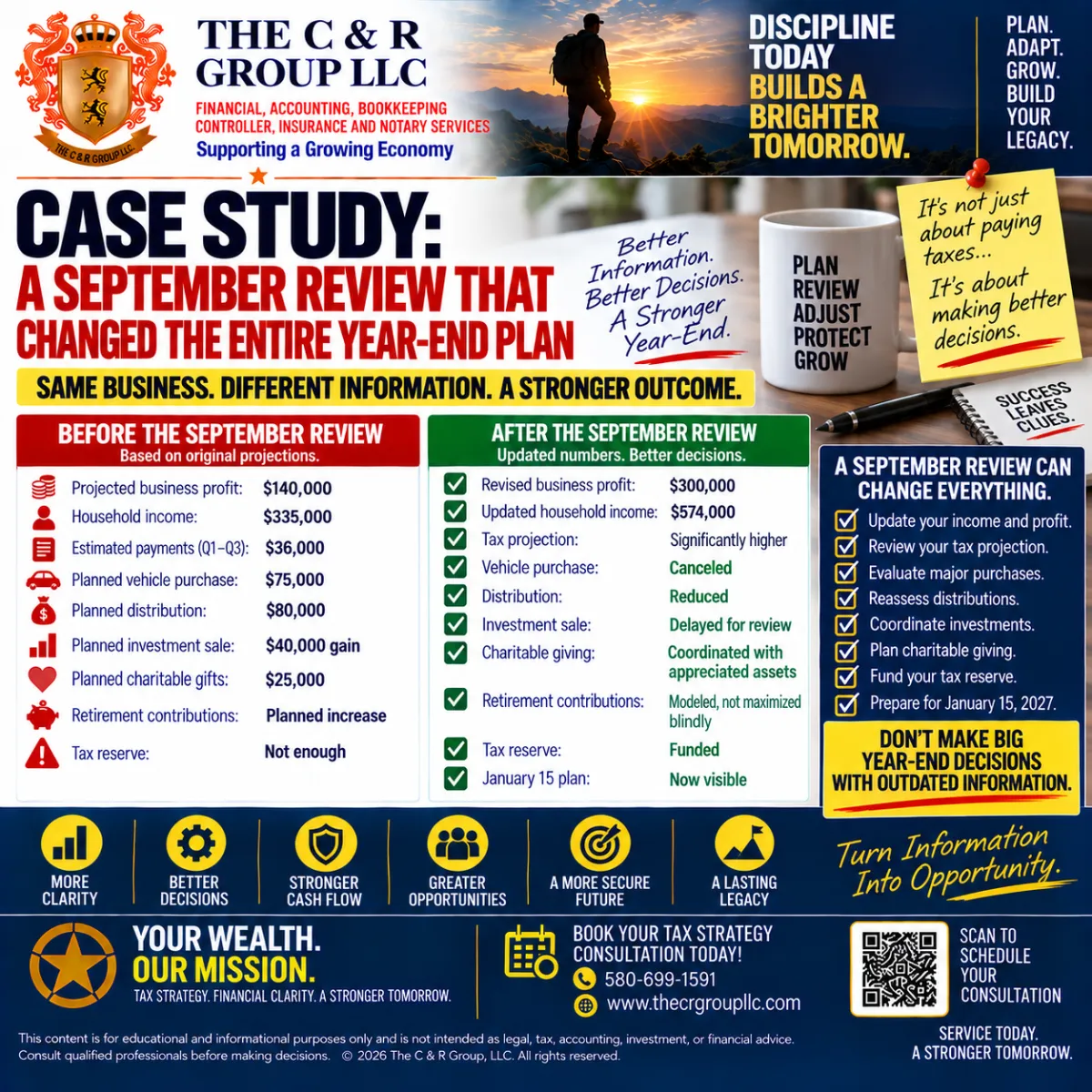
Case Study: A September Review That Changed the Entire Year-End Plan
Financial Horizons: Insights for Building Wealth and Securing Your Legacy
Case Study: A September Review That Changed the Entire Year-End Plan
By Dr. Jose G. Cardenas | Chief Tax Strategist, The C & R Group, LLC
Sometimes the most valuable tax-planning move is not a deduction.
It is not a new entity.
It is not a complicated strategy.
Sometimes it is simply:
reviewing the numbers early enough.
That is what happened in today’s hypothetical case study.
A business owner entered September believing:
“Taxes are handled. We already made the quarterly payments.”
The business was profitable.
Cash was strong.
The owner planned to:
Take a large distribution;
buy a vehicle;
increase retirement contributions;
make charitable gifts;
reinvest in the company.
Everything seemed fine.
Then the September review happened.
And the entire year-end plan changed.
Not because the business was in trouble.
Because the business was doing much better than expected.
The original tax plan was built for one year.
The company was actually having another.
The IRS’s 2026 Publication 505 makes clear that estimated-tax calculations should be revisited when expected income changes. It even provides an amended estimated-tax worksheet and a separate annualized-income method for taxpayers whose income arrives unevenly during the year. (IRS)
That leads to today’s central principle:
A September review can change the rest of the year because better information changes better decisions.
Meet the Business Owner
Our hypothetical client is:
Anthony
Anthony owns a professional-services S corporation.
He is married.
His wife, Michelle, works a W-2 job.
At the beginning of 2026, they expected a solid but relatively predictable year.
Their January assumptions looked like this:
Anthony’s S corporation wages
$90,000
S corporation pass-through profit
$140,000
Michelle’s wages
$95,000
Investment income
$10,000
Projected major household income:
Approximately:
$335,000
before deductions and other adjustments.
Estimated-tax payments were calculated using those expectations.
Anthony believed the tax plan was handled.
Then the business changed.
What Happened Through August
Anthony landed several large clients.
Revenue accelerated.
Margins improved.
A contract that had been expected in 2027 closed early.
By August 31:
Revenue YTD
$780,000
Expenses
$515,000
Net business profit before certain year-end adjustments
$265,000
That was already substantially higher than the original full-year profit estimate of:
$140,000.
And four months remained.
That should have triggered immediate attention.
The First Surprise: Profit Had Almost Doubled
Original projected business profit:
$140,000
Updated expected full-year profit:
Approximately:
$300,000
Difference:
+$160,000
Anthony’s first reaction:
“That’s great.”
Correct.
It is great.
But the tax plan was still operating as if the original projection were correct.
That is where success can become a cash-flow problem.
The Second Surprise: Investment Gains Had Increased
Anthony and Michelle had also sold appreciated investments.
Long-term capital gains
$45,000
Original expectation:
$0
They also expected:
Interest and dividends
$14,000
Now the household income picture was materially different.
The Third Surprise: Michelle Expected a Bonus
Michelle’s employer announced an expected year-end bonus:
$30,000
Now the projected major household income looked closer to:
Anthony wages
$90,000
S corporation profit
$300,000
Michelle wages
$95,000
Michelle bonus
$30,000
Capital gains
$45,000
Interest and dividends
$14,000
Projected major income:
Approximately:
$574,000
before deductions and other adjustments.
That was roughly:
$239,000 higher
than the original expectation.
Same household.
Different year.
Anthony Had Already Made Estimated Payments
Anthony had made:
Q1
$12,000
Q2
$12,000
Q3
$12,000
Total:
$36,000
Michelle had federal tax withheld from payroll.
Anthony said:
“But I made all my quarterly payments.”
That statement is common.
And incomplete.
The real question is:
Were those payments still appropriate after income changed?
The IRS’s current guidance says estimated tax generally needs to be revisited when expected income changes, and the required payment can be amended during the year. (IRS)
The September Review
The tax strategy meeting began with five questions.
1. What is actual YTD profit?
$265,000
2. What is projected Q4 profit?
$35,000 additional
3. What household income changed?
Bonus and investment gains.
4. What taxes have already been paid?
Withholding plus estimated payments.
5. What major decisions are planned before year-end?
This was the important one.
Anthony had several.
Anthony’s Original Year-End Plan
Before the tax review, Anthony intended to:
1. Take an $80,000 distribution
for personal goals.
2. Buy a $75,000 business vehicle
because someone told him:
“You need the write-off.”
3. Increase retirement contributions substantially.
4. Make $25,000 of charitable gifts.
5. Sell another investment with a $40,000 gain.
Individually, some of these could make sense.
Together?
They needed coordination.
The Projection Changed Everything
The updated tax projection showed that the household likely had a significant additional federal and state tax obligation.
The exact amount depended on:
Final business profit;
deductions;
QBI;
investment treatment;
withholding;
state taxes;
retirement contributions.
But the important fact was clear:
The existing tax reserve was not enough.
Anthony had been planning to distribute cash that the household might need for taxes.
That immediately changed the order of operations.
Change #1: The Distribution Was Reduced
Original plan:
$80,000 distribution
After reviewing:
Tax reserve;
payroll;
Q4 operating costs;
January obligations;
Anthony reduced the planned distribution.
Not because distributions were inherently wrong.
Because the business had other claims on the cash.
The distribution became:
a residual decision
rather than:
the first decision.
That is better financial management.
Change #2: The Vehicle Purchase Was Reconsidered
Anthony planned to buy:
$75,000 vehicle
primarily because:
“I need the deduction.”
The adviser asked:
“Do you need the vehicle?”
Anthony paused.
Not really.
His current vehicle was fine.
That changed the answer immediately.
Buying a $75,000 asset solely to reduce taxable income could leave the business significantly poorer after tax.
The deduction might reduce the net cost.
It does not make the purchase free.
The vehicle was removed from the year-end plan.
Change #3: Retirement Funding Was Modeled, Not Maximized Blindly
Anthony still wanted to increase retirement savings.
That was different.
Retirement funding already aligned with his long-term goals.
So the team modeled:
Scenario A
Current contribution level.
Scenario B
Higher qualifying contribution.
Then compared:
Current-year tax impact;
business cash required;
future retirement value;
employee considerations.
The contribution was made because it supported the long-term financial plan.
The deduction was a benefit.
Not the reason.
Change #4: The Investment Sale Was Delayed for Review
Anthony planned to sell another investment with:
$40,000 long-term gain.
Before executing it, they reviewed:
Tax basis;
holding period;
portfolio concentration;
available losses;
NIIT exposure;
state tax.
The investment decision remained primary.
But the sale was no longer occurring in a tax vacuum.
That is coordination.
Change #5: Charitable Giving Was Coordinated With Appreciated Assets
Anthony and Michelle already intended to give:
$25,000
to charity.
Instead of automatically selling investments and donating cash, they reviewed whether appreciated securities might fit the charitable plan.
The important point was not:
“Donate stock because taxes.”
The point was:
Coordinate the asset, the charitable intent, and the tax consequence before the transaction occurs.
Planning before execution creates options.
Change #6: The January Payment Became Visible
After updating the projection, Anthony could estimate the likely next estimated-tax requirement.
The final general 2026 estimated-tax installment for calendar-year individuals covers September 1 through December 31 and is generally due January 15, 2027. (IRS)
Now Anthony had a target.
Instead of:
“We’ll see what January looks like.”
he had:
“We need approximately this amount reserved by January.”
That changed cash management immediately.
Change #7: A Dedicated Tax Reserve Was Created
Anthony separated:
Operating cash
from
Tax cash.
That single step mattered.
Before:
One large business checking balance.
After:
Clear buckets.
Payroll reserve
$________
Vendor obligations
$________
Tax reserve
$________
Operating reserve
$________
Discretionary owner cash
$________
Visibility improved.
So did decision quality.
Change #8: Monthly Reviews Were Scheduled
Anthony’s biggest prior mistake was treating tax planning as:
event-based.
Something that happened when:
estimated taxes were due;
tax return was prepared.
That changed.
The new process:
September close
Update projection.
October close
Update projection.
November close
Run year-end strategy review.
December
Execute and confirm.
Early January
Finalize January payment.
This turned tax planning into a management system.
The IRS Framework Supports Updating the Estimate
The IRS specifically provides an amended estimated-tax worksheet for taxpayers whose expected tax changes during the year. The required payment for the next period is recalculated using the updated annual estimate and previous payments. (IRS)
That matters because Anthony’s original estimate was not wrong.
It simply became outdated.
That distinction is important.
Good planning is not about predicting January perfectly.
It is about updating when the facts change.
Uneven Income Was Also Reviewed
Anthony’s business income was not earned evenly.
Q1 was average.
Q2 improved.
Q3 was exceptional.
The IRS annualized-income installment method can be relevant when income is uneven throughout the year, because it uses income, deductions, and other items through each payment period rather than automatically treating income as received evenly. (IRS)
That does not automatically mean the annualized method was best.
It means:
the timing of income deserved analysis.
Same Business Success, Different Financial Outcome
Now compare the two versions.
Without the September Review
Anthony might have:
Taken the $80,000 distribution;
bought the $75,000 vehicle;
sold the additional investment;
funded retirement without coordination;
waited until January to calculate taxes.
Result:
Strong income.
Weak liquidity.
Possible tax surprise.
With the September Review
Anthony:
Reduced the distribution;
preserved business cash;
skipped an unnecessary vehicle;
coordinated retirement funding;
reviewed investment timing;
coordinated charitable giving;
increased the tax reserve;
projected January taxes.
Same successful business.
Better financial outcome.
That is the value of the review.
The Tax Savings Were Not the Only Win
This is important.
People often judge tax strategy by asking:
“How much tax did we save?”
That can be too narrow.
Anthony’s September review also produced:
Better cash flow;
stronger liquidity;
fewer unnecessary purchases;
more intentional investing;
better retirement coordination;
reduced year-end stress;
better visibility.
That is financial strategy.
Tax is part of it.
Not the entire mission.
The September Review Framework
Use this same process.
STEP 1 — ACTUAL RESULTS
Wages YTD:
$________
Business profit YTD:
$________
Investment gains:
$________
Other income:
$________
STEP 2 — Q4 FORECAST
Remaining wages:
$________
Business profit:
$________
Bonus:
$________
Planned investment sales:
$________
STEP 3 — TAX
Projected federal tax:
$________
Projected state tax:
$________
STEP 4 — PAYMENTS
Withholding:
$________
Estimated payments:
$________
STEP 5 — GAP
Projected additional liability:
$________
STEP 6 — RESERVE
Current tax reserve:
$________
Target reserve:
$________
Gap:
$________
STEP 7 — YEAR-END DECISIONS
Distribution:
$________
Retirement:
$________
Investments:
$________
Charity:
$________
Major purchases:
$________
Then ask:
Does each decision still make sense after the tax and cash-flow projection?
September Review Warning Signs
A fresh projection deserves priority when:
Business profit exceeded projections.
Bonus income increased.
Investment gains occurred.
K-1 income changed.
Rental income increased.
Withholding stayed unchanged.
Estimated payments were based on old numbers.
Large distributions are planned.
Major purchases are planned.
Retirement contributions are changing.
Charitable gifts are planned.
State residency or business activity changed.
Tax reserve is unclear.
Several checked?
Run the projection.
“Should We Still Do It?” Test
For every planned Q4 transaction, ask:
Does this make financial sense without the tax benefit?
If no:
Pause.
Does this support a long-term goal?
If yes:
Continue analysis.
Does the business have the cash?
If no:
Reconsider timing.
Is the tax impact understood?
If no:
Model it.
Does the transaction create another tax consequence?
If yes:
Include it.
This simple framework can prevent a lot of expensive “tax planning.”
Illustrative Before-and-After
BEFORE REVIEW
Business profit:
$300,000 projected
Tax reserve:
Underfunded
Owner distribution:
$80,000 planned
Vehicle:
$75,000 planned
Capital gain:
$40,000 planned
Retirement:
Increase planned
Charity:
$25,000 planned
January payment:
Unknown
AFTER REVIEW
Business profit:
$300,000 projected
Tax reserve:
Increased
Owner distribution:
Reduced
Vehicle:
Canceled
Capital gain:
Reviewed before sale
Retirement:
Modeled
Charity:
Coordinated
January payment:
Projected
Nothing magical happened.
The information improved.
The decisions improved.
September Review Scorecard
Give yourself one point for each YES.
YTD books are current.
Business profit is known.
Full-year profit is projected.
Household income is projected.
Capital gains are included.
Bonuses are included.
Federal withholding is known.
Estimated payments are recorded.
State taxes are projected.
Tax gap is known.
Tax reserve is funded.
Distributions are reviewed.
Major purchases are reviewed.
Retirement is modeled.
January payment is estimated.
13–15 YES
GREEN — Year-End Plan Is Informed
8–12 YES
YELLOW — Important Decisions Need Review
0–7 YES
RED — Q4 Is Running Ahead of the Tax Plan
The solution is not more complexity.
It is better information.
AI-Search Quick Answers
Can estimated-tax payments be changed after income changes?
Yes. IRS Publication 505 provides an amended estimated-tax worksheet for taxpayers whose expected tax changes during the year. (IRS)
What is the next estimated-tax due date after September 15, 2026?
For calendar-year individuals, the general final 2026 estimated-tax installment is due January 15, 2027. (IRS)
What if income is not earned evenly?
The IRS annualized-income installment method may help determine required estimated payments when income is uneven during the year. (IRS)
What is the general estimated-tax threshold?
In most cases, individuals generally must pay estimated tax if they expect to owe at least $1,000 after withholding and tax credits and their expected withholding and credits are less than the smaller of 90% of current-year tax or generally 100% of prior-year tax, subject to special rules. (IRS)
What changes for certain higher-income taxpayers?
For certain taxpayers whose prior-year AGI exceeded $150,000, or $75,000 if married filing separately, the prior-year percentage generally becomes 110% instead of 100%. (IRS)
Can a later payment automatically erase earlier underpayments?
Not necessarily. The IRS states that estimated-tax penalties are figured separately for each payment period, so a later increase may not eliminate an earlier underpayment. (IRS)
30 Questions a September Review Should Answer
What is actual household income YTD?
What is business profit YTD?
What was the January profit projection?
What is the updated full-year projection?
What bonuses remain?
What investment gains occurred?
What additional investment sales are planned?
What losses exist?
What rental income exists?
What K-1 income is expected?
What federal tax has been withheld?
What state tax has been withheld?
What estimated payments were made?
Are those payments based on current numbers?
What is projected federal liability?
What is projected state liability?
What is the tax gap?
Is the tax reserve sufficient?
What distributions are planned?
Can the business afford them?
What purchases are planned?
Are they actually necessary?
Are retirement contributions on track?
Does QBI need review?
Could NIIT apply?
Is charitable giving planned?
Is income uneven enough to review annualization?
What is the projected January payment?
When will the projection be updated again?
Which year-end decision would I change if I knew my actual tax and cash position today?
That last question is the heart of this case study.
What to Do Next
Run your own September Year-End Strategy Review.
CURRENT POSITION
YTD income:
$________
YTD business profit:
$________
Tax paid:
$________
Tax reserve:
$________
FULL-YEAR FORECAST
Projected income:
$________
Projected profit:
$________
Projected federal tax:
$________
Projected state tax:
$________
TAX GAP
$________
JANUARY PAYMENT
Estimated:
$________
PLANNED DECISIONS
Distribution:
$________
Retirement:
$________
Equipment:
$________
Investment sale:
$________
Charitable giving:
$________
Then ask:
Do these decisions still make sense after seeing the full picture?
That is where planning becomes strategy.
Final Thought
Anthony did not need a miracle.
He needed:
a September review.
The business was successful.
The problem was that the original plan had not caught up with the success.
That review changed:
The distribution.
The purchase.
The investment decision.
The retirement strategy.
The charitable strategy.
The tax reserve.
The January payment.
Most importantly:
It changed the order in which decisions were made.
Before:
Spend first. Calculate later.
After:
Project first. Decide second.
That is a major difference.
And that is the lesson for every taxpayer entering the final stretch of the year.
You do not have to know exactly what December 31 will look like.
But you should know enough to avoid making major decisions with outdated information.
So run the numbers.
Update the projection.
Protect the reserve.
Model the big decisions.
Then act.
Because sometimes the best tax strategy is not finding another deduction.
Sometimes it is seeing the year clearly enough to stop yourself from making the wrong move.
Better information.
Better decisions.
Stronger year-end.
That is what a September review can do.
Book Your Year-End Tax Strategy Consultation
If your 2026 income, business profit, investment gains, distributions, or year-end plans are materially different from what you expected in January, now is the time to rerun the projection before major decisions are made.
We can review:
Year-to-date business profit;
full-year projections;
federal and state tax exposure;
estimated payments;
tax reserves;
owner compensation;
distributions;
retirement contributions;
capital gains and losses;
QBI;
NIIT;
charitable planning;
major business purchases;
January 15 planning.
Booking link:
https://api.leadconnectorhq.com/widget/booking/T4UHUjCijCtIB3rwoTDI
Phone: 580-699-1591
Booking your appointment now:

ABOUT THE AUTHOR
Dr. Jose G. Cardenas is a retired U.S. Army Finance Officer and the Chief Tax Strategist at The C & R Group, LLC. With a Doctorate in Business Administration and over 20 years of experience in tax planning and financial strategy, Dr. Cardenas helps individuals and business owners legally reduce taxes, strengthen cash flow, and build lasting wealth and legacy. Learn more at www.thecrgroupllc.com
DISCLOSURE
This article is for educational and informational purposes only and is not intended to serve as personalized legal, tax, or investment advice. Tax laws and regulations change over time and may vary by jurisdiction. You should consult with a qualified tax professional regarding your specific circumstances before implementing any strategy discussed here. Dr. Jose G. Cardenas, DBA, provides tax advisory services through The C & R Group, LLC. Insurance and investment strategies may be offered through his role as a licensed financial professional affiliated with Experior Financial Group.