Post-Extension Improvement Checklist
Financial Horizons: Insights for Building Wealth and Securing Your Legacy
Post-Extension Improvement Checklist
By Dr. Jose G. Cardenas | Chief Tax Strategist, The C & R Group, LLC
The extended return is filed.
The pressure is off.
Now comes the part that determines whether next filing season gets better.
Most taxpayers move on quickly once the return is submitted. The problem is that the same weaknesses that made filing difficult can remain in place:
late books,
poor payment tracking,
unclear basis,
unexpected gains,
weak withholding,
or an underfunded tax reserve.
If nothing changes, next year can look exactly like this year.
That is why the post-extension period matters.
You do not need another massive checklist.
You need a short list of improvements that actually get done.
The goal is simple: keep the lesson, fix the process, and make next filing season easier.
Start With What Went Wrong
Before making any changes, identify the biggest problem from the return you just filed.
Was the tax bill larger than expected?
Were records missing?
Were business books behind?
Did capital gains or K-1 income create a surprise?
Did you struggle to verify estimated payments?
Did you realize too late that the household had not reserved enough cash for taxes?
Do not write down twenty problems.
Find the one or two issues that created the most stress or cost.
Those are your priorities.
If bookkeeping caused the problem, fix bookkeeping first.
If the tax reserve was the problem, build the reserve.
If withholding was the problem, review withholding.
If the projection was outdated, schedule regular updates.
Improvement begins with focus.
Make Sure 2026 Is Not Repeating 2025
The completed return tells you what happened last year.
Now compare it with the year you are currently having.
If business profit grew faster than expected last year, what does 2026 look like?
If capital gains created additional tax, what gains have already occurred this year?
If K-1 income was underestimated, do you have a current estimate?
If withholding was too low, has anything changed?
This comparison does not need to be complicated.
You are looking for one thing:
Is the same tax problem forming again?
If the answer is yes, you still have time to respond.
That may mean updating withholding, increasing estimated payments, setting aside more cash, or delaying a discretionary distribution until the tax picture is clearer.
The return should become a warning system, not just a historical record.
Fix the Financial System Behind the Return
A tax return is only as good as the financial information feeding it.
If the system behind the return is weak, filing season becomes harder than it needs to be.
For business owners, that means keeping the books current enough to understand profit during the year.
For households, it means knowing what income sources exist and how much tax has already been paid.
For investors, it means tracking gains rather than discovering them months later.
For owners of pass-through entities, it means requesting K-1 estimates before year-end when possible.
For everyone, it means keeping tax money separate from money that is truly available to spend.
The goal is not perfection.
The goal is visibility.
If you can answer:
What did we earn?
What have we paid?
What do we still expect to owe?
Do we have the cash reserved?
then you are already in a much stronger position.
A Quick Example
Consider Brian and Lisa.
Their extended 2025 return was finally completed in October.
The biggest problems were clear.
Brian’s business books were late.
Lisa’s withholding was lower than expected after changing jobs.
They also had investment gains that were not included in the original tax projection.
Their final tax bill was larger than planned, and their tax reserve was not sufficient.
Instead of putting the return away and hoping next year would be easier, they made three changes.
Brian began closing the business books monthly.
Lisa reviewed her withholding.
Together, they began tracking investment gains and funding a dedicated tax reserve.
By late 2026, they had a much clearer idea of what the household might owe.
The tax liability did not disappear.
The surprise did.
That is what a better system accomplishes.
Your Five Post-Extension Improvements
Keep the list short enough to execute:
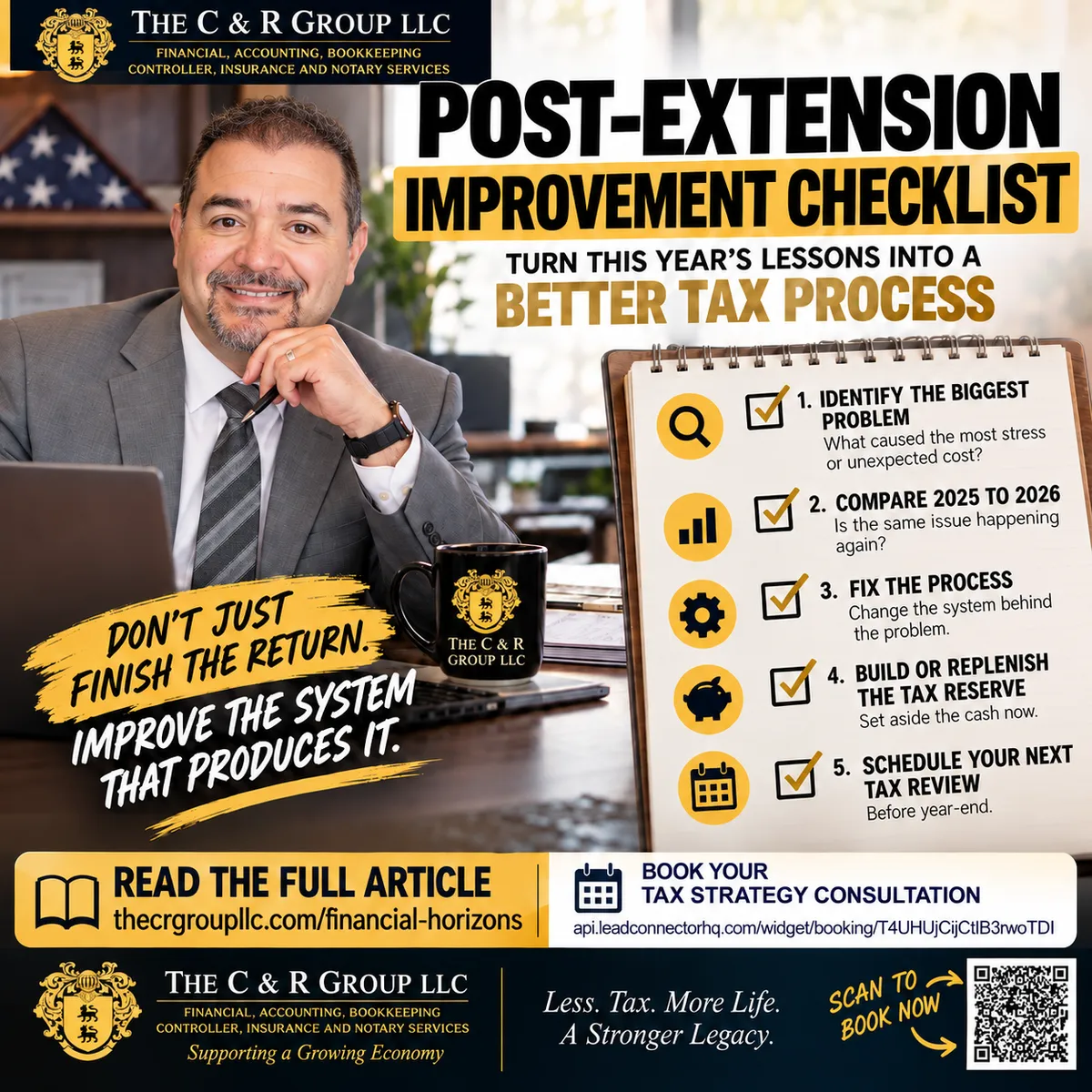
Identify the biggest problem from the return you just filed.
Compare 2025 with your current 2026 income and tax picture.
Fix the process that caused the problem.
Build or replenish the tax reserve.
Schedule your next tax review before year-end.
That is enough.
You do not need fifty action items.
You need five that get completed.
Final Thought
The weeks after an extended return is filed are some of the best weeks of the year to improve your tax process.
The pain is still fresh.
The problems are still visible.
And the current year is not over.
Use that window.
Fix the books.
Correct the withholding.
Track the payments.
Update the projection.
Fund the reserve.
Then enter the next filing season with better information and fewer surprises.
Do not just finish the return. Improve the system that produces it.
That is how a difficult filing season becomes a better financial process.
Book Your Post-Extension Tax Strategy Consultation
If your 2025 return exposed late bookkeeping, weak withholding, unexpected gains, K-1 issues, unclear tax payments, or an insufficient tax reserve, now is the time to improve the process before year-end.
We can review your current household income, business profit, withholding, estimated payments, investment gains, K-1 estimates, projected tax exposure, and tax reserve.
Booking link:
https://api.leadconnectorhq.com/widget/booking/T4UHUjCijCtIB3rwoTDI
Phone: 580-699-1591
Booking your appointment now:

ABOUT THE AUTHOR
Dr. Jose G. Cardenas is a retired U.S. Army Finance Officer and the Chief Tax Strategist at The C & R Group, LLC. With a Doctorate in Business Administration and over 20 years of experience in tax planning and financial strategy, Dr. Cardenas helps individuals and business owners legally reduce taxes, strengthen cash flow, and build lasting wealth and legacy. Learn more at www.thecrgroupllc.com
DISCLOSURE
This article is for educational and informational purposes only and is not intended to serve as personalized legal, tax, or investment advice. Tax laws and regulations change over time and may vary by jurisdiction. You should consult with a qualified tax professional regarding your specific circumstances before implementing any strategy discussed here. Dr. Jose G. Cardenas, DBA, provides tax advisory services through The C & R Group, LLC. Insurance and investment strategies may be offered through his role as a licensed financial professional affiliated with Experior Financial Group.