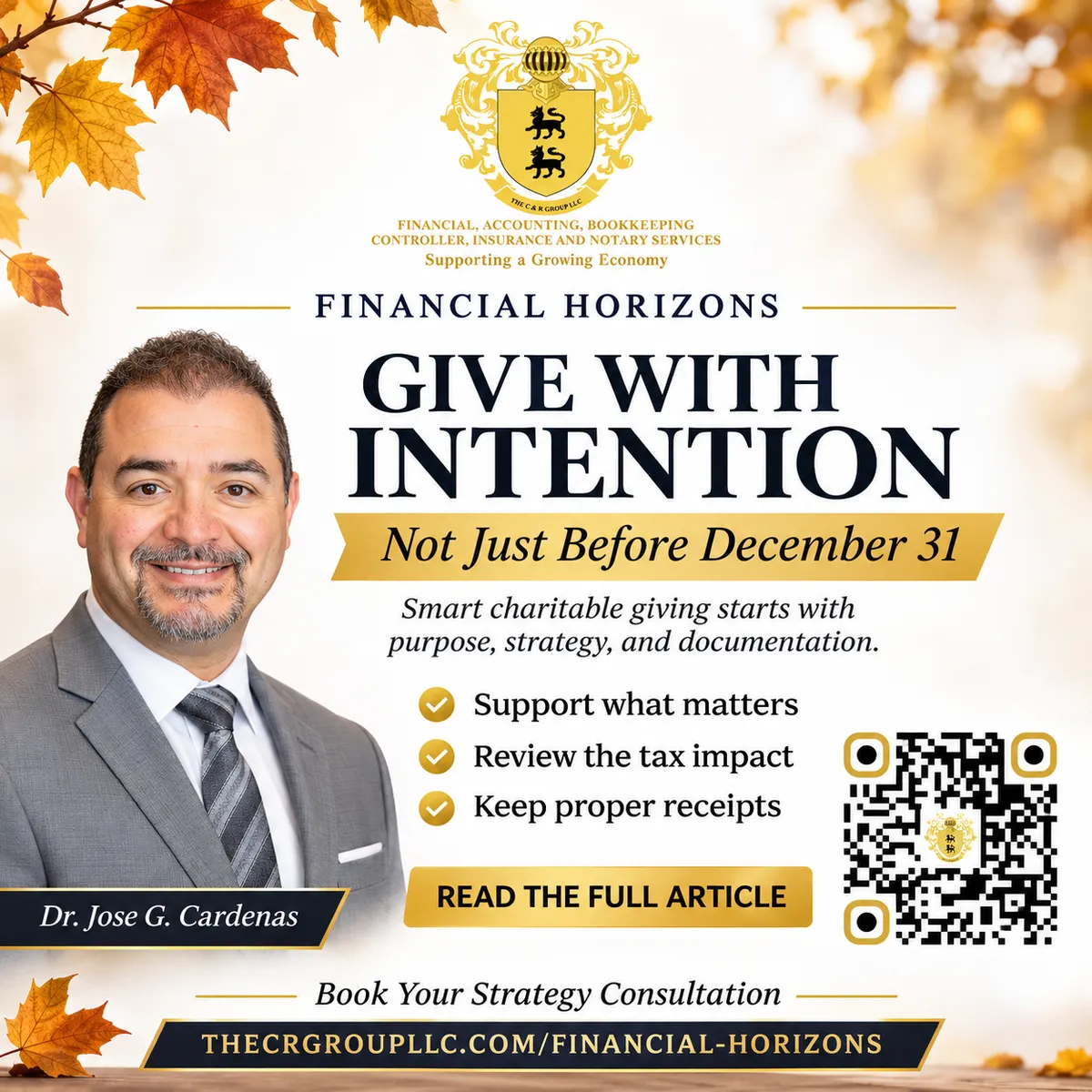
Give With Intention, Not Just Before December 31
Financial Horizons: Insights for Building Wealth and Securing Your Legacy
Give With Intention, Not Just Before December 31
By Dr. Jose G. Cardenas | Chief Tax Strategist, The C & R Group, LLC
Every November and December, charitable giving suddenly gets attention.
Emails arrive.
Fundraisers appear.
Churches, schools, veterans organizations, food banks, hospitals, and community organizations remind us that year-end is approaching.
And many households respond with generosity.
That is a good thing.
But from a financial-planning perspective, there is an important difference between giving before December 31 and giving with intention.
A rushed donation may still help a worthy organization.
A strategic donation can potentially do more.
It can support a cause you care about, fit your household cash flow, coordinate with your tax strategy, and strengthen the legacy you are trying to build.
The goal should not be to give because the calendar is closing. Give because the gift fits your values—and then make the financial strategy support that decision.
Start With Why You Are Giving
Tax deductions should never be the primary reason for generosity.
If you would not support the organization without the tax benefit, slow down.
Start with the mission.
Who do you want to help?
What organizations reflect your values?
Do you want to support veterans?
Education?
Your church?
Medical research?
A local community organization?
Once you know why you are giving, then we can ask the tax question:
What is the most efficient way to make the gift?
That order matters.
Generosity first.
Tax strategy second.
2026 Changed the Charitable-Deduction Conversation
There is an important change this year.
Beginning with tax year 2026, taxpayers who do not itemize may be able to deduct up to $1,000 of qualifying cash contributions, or up to $2,000 for married couples filing jointly, when gifts are made to certain qualified organizations.
That means charitable tax planning is no longer relevant only to households that itemize.
But that does not mean every gift automatically qualifies.
Gifts to individuals are not deductible, and donations generally must be made to an eligible organization. The IRS provides a Tax Exempt Organization Search tool for checking whether an organization can receive deductible contributions.
This is where intentional giving begins to matter.
Know where the money is going before assuming what the tax result will be.
Itemizers Have a New Rule Too
For taxpayers who itemize deductions, 2026 introduced another important change.
The IRS explains that charitable contributions claimed as itemized deductions are now subject to a 0.5% of adjusted gross income floor. In general, the portion of charitable contributions that falls below that floor is not deductible for 2026.
That creates another planning question.
Suppose your AGI is:
$300,000.
A 0.5% floor equals:
$1,500.
The tax value of your charitable giving may therefore look different than it did under previous rules.
That does not mean you should give less.
It means the deduction should be modeled rather than assumed.
Cash Is Not Always the Only Way to Give
When people think about charitable giving, they usually think:
Write a check.
That may be perfectly appropriate.
But households with investments may have other options worth reviewing.
For example, donating appreciated property to a qualified charitable organization can have different tax consequences than selling the property first and then donating the cash.
The IRS generally allows qualifying property donations to be valued at fair market value, although special limitations and adjustment rules can apply when property has appreciated.
That makes appreciated investments worth discussing before automatically writing a year-end check.
Suppose you own stock that has increased substantially in value.
You already intend to make a meaningful charitable gift.
Instead of automatically selling the investment, recognizing the gain, and donating cash, you could ask whether donating the appreciated asset directly makes more sense.
That is not always the answer.
But it is a question worth asking.
Donor-Advised Funds Can Separate Giving From Grant Timing
Some households know they want to make a significant charitable commitment this year but have not yet decided which organizations should ultimately receive all the money.
A donor-advised fund may be one option to evaluate.
A donor-advised fund is generally maintained by a sponsoring charitable organization. Once a donor contributes assets to the fund, the sponsoring organization has legal control over those assets, while the donor generally retains advisory privileges over future distributions.
That can allow a taxpayer to make a charitable contribution during one year while recommending grants to charities over time.
But donor-advised funds have specific rules, and the donor no longer owns the contributed assets.
This is not a temporary parking place for money you may want back later.
Use it only when the charitable intent is genuine.
Documentation Is Part of the Strategy
A generous gift can still become a poor tax-planning result if the documentation is missing.
For any monetary charitable contribution, taxpayers generally need appropriate written records.
And for a contribution of $250 or more, the donor generally must obtain a written acknowledgment from the charitable organization. The acknowledgment needs to be obtained by the applicable filing deadline rules and should indicate, among other things, whether the organization provided goods or services in exchange for the contribution.
Noncash gifts can require additional documentation.
For certain donated property valued above $5,000, a qualified appraisal and Form 8283 may be required, with exceptions for certain property such as publicly traded securities.
Do not wait until tax season to reconstruct the gift.
Document it when you give.
A Quick Example
Consider Daniel and Rebecca.
They normally give approximately:
$12,000 per year
to several charities.
This year they also have appreciated investments they have owned for years.
Their first idea is simple:
Sell $20,000 of stock in December and donate some of the cash.
Instead, they stop and review the full picture.
They ask:
Which organizations do we actually want to support?
Are they qualified charities?
What happens if we donate appreciated investments instead of cash?
Will we itemize?
How does the new 2026 charitable floor affect the deduction?
Do we have the proper documentation?
Their charitable intention never changed.
They were going to give either way.
What changed was how deliberately they gave.
That is the difference between year-end giving and charitable planning.
Do Not Spend $1 Just to Save a Fraction of $1
This principle applies to charitable deductions just as it applies to business expenses.
If you give $10,000 to charity, you do not receive $10,000 back in tax savings.
You gave away $10,000.
The tax deduction, when available, may reduce part of the tax cost.
That is why generosity should begin with values rather than deduction hunting.
Give because you believe in the mission.
Then structure the gift intelligently.
That keeps charitable planning in the right order.
Your Five Year-End Giving Questions
Before making significant charitable gifts this year, ask:
Which organizations do we genuinely want to support?
Are the organizations eligible to receive tax-deductible contributions?
Should we give cash, appreciated property, or use another charitable vehicle?
How do the 2026 deduction rules affect our household?
Do we already have the documentation needed to support the gift?
Those five questions can make year-end generosity far more intentional.
Final Thought
December 31 creates urgency.
It should not create your values.
Charitable planning works best when the household decides what matters first.
Then it considers:
timing,
tax treatment,
assets,
documentation,
and cash flow.
Do not give simply because the calendar says the year is ending. Give because the mission matters—and make the strategy worthy of the generosity.
That is intentional giving.
Book Your Year-End Tax Strategy Consultation
If charitable giving is part of your year-end plan, now is the time to review how your donations fit with your 2026 income, deductions, investments, cash flow, and broader tax strategy.
We can help you identify the tax questions that should be addressed before significant year-end gifts are completed.
Booking link:
https://api.leadconnectorhq.com/widget/booking/T4UHUjCijCtIB3rwoTDI
Phone: 580-699-1591
Booking your appointment now:

ABOUT THE AUTHOR
Dr. Jose G. Cardenas is a retired U.S. Army Finance Officer and the Chief Tax Strategist at The C & R Group, LLC. With a Doctorate in Business Administration and over 20 years of experience in tax planning and financial strategy, Dr. Cardenas helps individuals and business owners legally reduce taxes, strengthen cash flow, and build lasting wealth and legacy. Learn more at www.thecrgroupllc.com
DISCLOSURE
This article is for educational and informational purposes only and is not intended to serve as personalized legal, tax, or investment advice. Tax laws and regulations change over time and may vary by jurisdiction. You should consult with a qualified tax professional regarding your specific circumstances before implementing any strategy discussed here. Dr. Jose G. Cardenas, DBA, provides tax advisory services through The C & R Group, LLC. Insurance and investment strategies may be offered through his role as a licensed financial professional affiliated with Experior Financial Group.