Households: Capital Gains, Dividends, and the Tax Habits That Improve After-Tax Results
Financial Horizons: Insights for Building Wealth and Securing Your Legacy
Households: Capital Gains, Dividends, and the Tax Habits That Improve After-Tax Results
By Dr. Jose G. Cardenas | Chief Tax Strategist, The C & R Group, LLC
Most households do not think of themselves as investment-tax planners.
They think of themselves as:
Savers;
investors;
retirement-plan participants;
homeowners;
parents preparing for college;
families building wealth.
But once a household begins accumulating taxable investments, tax planning becomes part of the investment process whether the family acknowledges it or not.
The portfolio may generate:
Interest;
Dividends;
Capital-gain distributions;
Short-term gains;
Long-term gains;
Taxable sales.
And all of that can interact with:
W-2 wages;
Business income;
Retirement distributions;
Social Security;
Rental income;
Charitable giving;
Other household income.
That means the investment statement does not tell the complete story.
The better question is:
How much of the investment return remains available to build wealth after taxes?
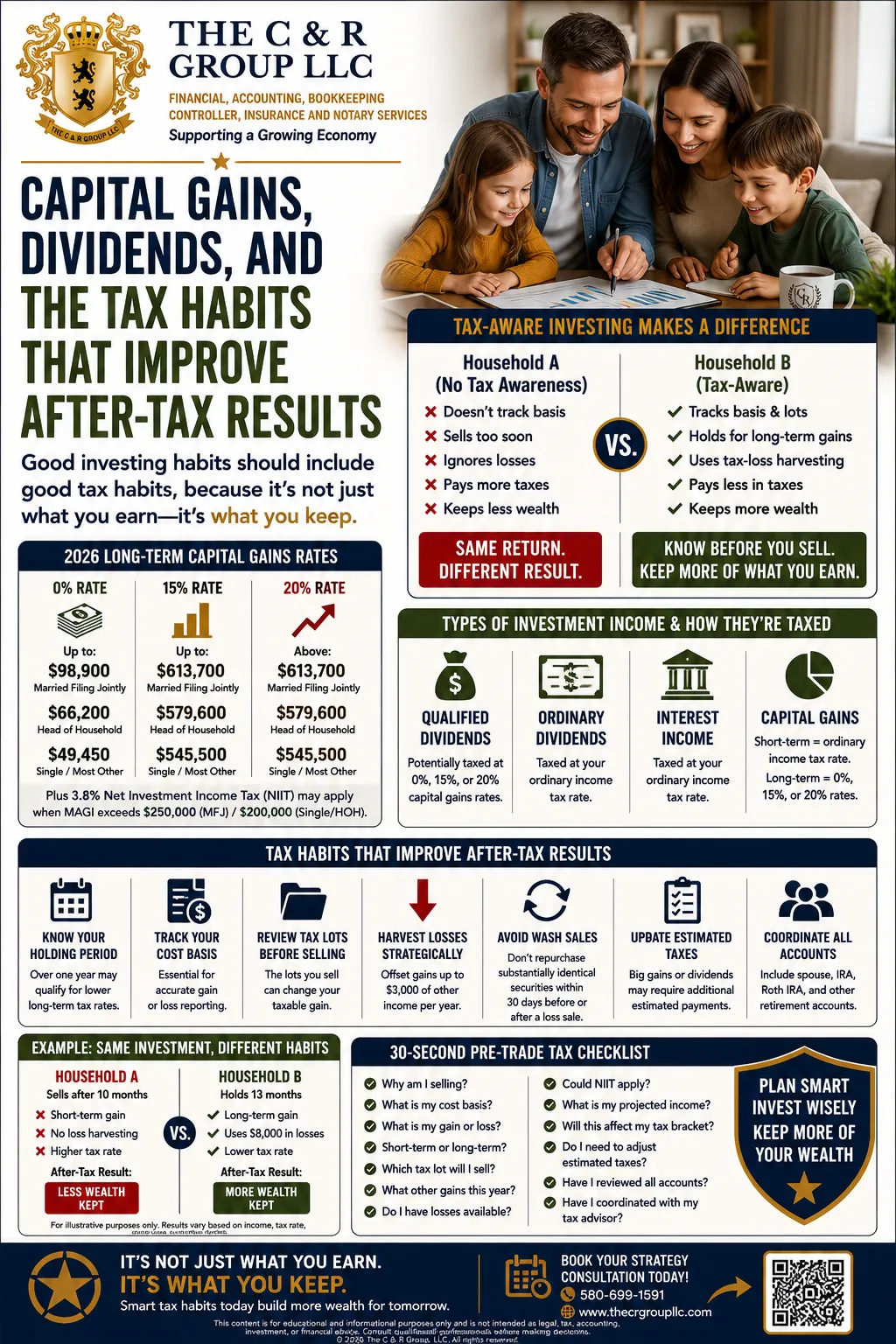
For 2026, qualifying long-term capital gains continue to use the federal 0%, 15%, and 20% rate structure. The maximum taxable income eligible for the 0% capital-gain rate is $98,900 for married couples filing jointly, $66,200 for heads of household, and $49,450 for most single taxpayers. The 20% rate begins above taxable income of $613,700 for married filing jointly, $579,600 for heads of household, and $545,500 for most single taxpayers.
Qualified dividends can also receive preferential capital-gain tax treatment when the applicable requirements are satisfied, and the IRS's 2026 estimated-tax guidance continues to calculate qualified dividends and qualifying capital gains through the same preferential-rate framework.
Higher-income households may also face the 3.8% Net Investment Income Tax, which applies to the lesser of net investment income or the excess of modified adjusted gross income over $250,000 for married filing jointly, $200,000 for single or head-of-household filers, and $125,000 for married filing separately.
The central principle for today is:
Good investment habits should include good tax habits, because after-tax results—not headline returns—are what ultimately build household wealth.
1. Start With the Difference Between Short-Term and Long-Term Gains
Suppose you buy an investment for:
$40,000.
Later, you sell it for:
$55,000.
Gain:
$15,000.
The holding period matters.
If the investment was held for:
one year or less,
the gain is generally short-term.
If held for:
more than one year,
it is generally long-term.
Net short-term gains generally receive ordinary-income tax treatment.
Long-term gains can potentially qualify for preferential rates.
That means the difference between:
Day 364
and
Day 366
can sometimes be financially meaningful.
That does not mean you should keep a poor investment just to reach long-term treatment.
It means:
If the investment decision is otherwise sound and the timing is flexible, know the holding period before you sell.
2. Know Which Capital-Gain Range You Are In
For 2026, the IRS sets the following maximum taxable-income amounts for the 0% long-term capital-gain rate:
Married Filing Jointly
$98,900
Head of Household
$66,200
Most Single Taxpayers
$49,450
The 15% range generally continues until taxable income exceeds:
Married Filing Jointly
$613,700
Head of Household
$579,600
Most Single Taxpayers
$545,500.
Above the applicable 15% ceiling, the 20% maximum rate can apply to qualifying gains.
This matters because:
The same $25,000 long-term gain can produce different federal tax consequences for two households with different taxable income.
3. The 0% Capital-Gain Rate Is Not a $98,900 Gain Allowance
This is an important misconception.
A married couple does not automatically get:
$98,900 of tax-free capital gains.
The capital-gain rate is determined in relation to taxable income and the way ordinary income and preferentially taxed income stack together.
Example
Suppose a married couple already has:
$90,000 taxable ordinary income
before capital gains.
They realize:
$25,000 long-term capital gain.
Only the portion fitting within the available 0% capital-gain range may potentially receive the 0% rate.
The remainder can move into the 15% range.
That is why the tax projection matters.
4. A Lower-Income Year Can Create Opportunity
Household income changes.
Someone:
Retires;
changes jobs;
takes parental leave;
starts a business;
goes back to school.
A temporary lower-income year may create an opportunity to intentionally realize some long-term gains at a lower rate.
This is sometimes called:
capital-gain harvesting.
The process might be:
Project taxable income.
Determine available capital-gain rate capacity.
Review appreciated investments.
Decide whether realizing gains fits the investment strategy.
The investment should still make sense.
The tax window simply becomes part of the decision.
5. Higher-Income Years Require Different Planning
Now reverse the situation.
Household wages increase.
A business has a record year.
A bonus arrives.
The household realizes a large investment gain.
Suddenly income can move across:
Capital-gain thresholds;
NIIT thresholds;
Other tax ranges.
That does not automatically mean:
“Do not sell.”
It means:
Know the full tax consequence before choosing the timing.
High-income households often have more moving parts.
Coordination matters more.
6. Qualified Dividends Are Not the Same as Ordinary Dividends
A dividend payment looks simple:
Company pays cash.
But for federal tax purposes, some dividends may qualify for preferential long-term capital-gain tax rates when statutory requirements are satisfied.
Other dividends may be taxed at ordinary-income rates.
The IRS's 2026 estimated-tax guidance specifically separates qualified dividends and capital gains into the preferential-rate calculation.
That means the household should know:
Total dividends;
Qualified dividends;
Other dividends.
Do not evaluate investment yield only by:
“This fund pays 5%.”
Ask:
“What kind of income is that 5% producing?”
7. Yield and After-Tax Yield Are Different
Suppose two investments each yield:
5%.
Investment A produces mostly taxable interest.
Investment B produces qualified dividends.
For a household in a higher ordinary-income tax bracket, the after-tax result can differ materially.
Example
Investment:
$100,000
Yield:
5%
Annual income:
$5,000
The economic question is not only:
“How much did it pay?”
It is:
“How much remained after federal and state tax?”
That is the after-tax yield.
8. Taxable Interest Can Quietly Increase Household Tax Drag
Taxable interest from:
Bank accounts;
CDs;
Corporate bonds;
Other taxable fixed-income investments
generally receives ordinary-income tax treatment.
That means a high-income household with substantial taxable fixed-income assets can experience significant annual tax drag.
This does not mean those investments are wrong.
They may serve:
Safety;
Liquidity;
Income;
Diversification.
But account location deserves review.
The question becomes:
Could some tax-inefficient income-producing assets be better located inside tax-deferred accounts?
We will go deeper into that tomorrow.
9. Tax-Exempt Interest Is Not Automatically “Better”
Municipal bonds may produce interest that is exempt from federal income tax under applicable rules.
That sounds attractive.
But the correct comparison is:
Tax-exempt yield
versus
after-tax taxable yield.
Example
Municipal bond yield:
3.5%
Taxable bond yield:
4.5%
Which is better?
That depends on the household's marginal tax rate and other circumstances.
A lower pre-tax yield can sometimes produce a better after-tax result.
But not always.
Compare economics.
Not labels.
10. Understand the Tax-Equivalent Yield
A useful concept for comparing taxable and tax-exempt income is:
Tax-equivalent yield.
A simplified calculation is:
Tax-exempt yield ÷ (1 − marginal tax rate)
Suppose:
Municipal yield:
3.5%
Marginal federal tax rate:
24%
Simplified tax-equivalent yield:
3.5% ÷ 0.76 ≈ 4.61%
That can help compare the municipal bond with a taxable alternative.
State taxes can further change the analysis.
11. Dividends Are Taxable Even When You Reinvest Them
This surprises new investors.
You own a taxable investment account.
The fund pays:
$4,000 dividend.
Automatic reinvestment immediately buys more shares.
The household may think:
“I didn't receive cash, so nothing is taxable.”
Not necessarily.
The dividend can still be taxable even when reinvested.
Reinvestment changes:
What happens to the cash;
Cost basis.
It does not automatically eliminate current taxation.
12. Reinvested Dividends Increase Cost Basis
When dividends are reinvested in a taxable account, the additional shares generally create additional tax basis.
That matters later.
If those basis additions are ignored, the household could potentially overstate taxable gain when shares are sold.
Keep accurate records.
Every reinvestment may become another tax lot.
13. Cost Basis Is One of the Most Important Investment Records
Suppose you sell:
$80,000
of stock.
What is the gain?
You cannot answer without knowing basis.
Example
Sale price:
$80,000
Basis:
$70,000
Gain:
$10,000
Compare that with:
Basis:
$30,000
Gain:
$50,000
Same sale proceeds.
Very different tax result.
The IRS notes that investment records should be retained as necessary to support basis, including for calculations related to investment income.
14. Know Your Tax Lots Before Selling
Suppose you accumulated a stock over several years.
Lot 1
Cost:
$25 per share
Lot 2
Cost:
$50
Lot 3
Cost:
$90
Current price:
$100
You sell some shares.
Which shares?
Depending on the brokerage settings and proper identification procedures, the tax result may differ materially.
Tax-lot selection can affect:
Gain;
Loss;
Holding period.
The investor should know the lot method before selling.
15. Default Cost-Basis Methods Can Create Unintended Results
Some brokerage accounts may default to:
FIFO;
Average cost for certain funds;
Another method.
The household may assume:
“The broker will choose the best tax result.”
Do not assume.
The brokerage is executing according to the account settings.
Review the tax-lot method.
Especially before large sales.
16. Capital Losses Can Offset Capital Gains
Losses are never enjoyable.
But they may provide tax value.
Capital losses generally offset capital gains through the applicable netting rules.
If net capital losses remain, individuals may generally deduct up to:
$3,000
against other income annually, with unused amounts generally carried forward subject to the rules.
This creates the potential for:
tax-loss harvesting.
17. Tax-Loss Harvesting Should Have an Investment Purpose
Suppose an investment has fallen:
$15,000.
You may consider realizing the loss to offset gains.
But ask:
Does the investment still belong in the portfolio?
What replaces it?
Does the replacement preserve diversification?
Does the transaction create a wash sale?
The tax loss should support a sound portfolio decision.
Not replace one.
18. Remember the Wash-Sale Rule
A wash sale can generally occur when stock or securities are sold at a loss and substantially identical securities are acquired within the applicable period surrounding the sale.
The general window includes:
30 days before
through
30 days after
the loss sale.
The IRS also notes that purchases of substantially identical securities inside an IRA or Roth IRA can trigger wash-sale consequences.
That makes household coordination essential.
19. Spouses Can Accidentally Interfere With Loss Harvesting
Consider a married couple.
Spouse A sells shares at a loss.
Spouse B's brokerage account automatically purchases substantially identical shares.
That may create wash-sale issues depending on the facts.
The household should therefore review:
Both spouses' accounts;
Retirement accounts;
Automatic contributions;
Dividend reinvestment.
Investment tax planning must be household-wide.
20. Automatic Investing Can Fight the Tax Strategy
Automation is excellent for disciplined investing.
But during a tax-loss harvesting period, automatic:
Dividend reinvestment;
IRA purchases;
Recurring brokerage purchases
can accidentally create complications.
Before harvesting losses:
Review the automation.
Then restart it appropriately afterward.
Automation should execute the strategy.
Not sabotage it.
21. The NIIT Can Add Another 3.8%
High-income households need to monitor the Net Investment Income Tax.
The NIIT rate is:
3.8%.
It applies to the lesser of:
Net investment income; or
MAGI above the threshold.
Thresholds:
Married Filing Jointly
$250,000
Married Filing Separately
$125,000
Single / Head of Household
$200,000.
These thresholds are statutory rather than annually indexed.
That makes NIIT increasingly relevant as household income grows.
22. NIIT Can Apply to Dividends, Interest, and Capital Gains
Net investment income can generally include:
Interest;
Dividends;
Capital gains;
Rental income;
Royalty income;
Certain nonqualified annuity income.
That means the NIIT conversation is larger than:
“Did we sell stock?”
A household with substantial:
Dividends;
Interest;
Rental income
may also need to review exposure.
23. A Capital Gain Can Change More Than the Capital-Gain Tax
Suppose a household realizes:
$150,000
of long-term gain.
Potential effects can include:
Capital-gain tax;
NIIT;
State income tax;
Estimated payments;
Medicare-related income calculations for older taxpayers;
Taxation of Social Security in retirement situations.
The household should evaluate the full return.
Not simply:
$150,000 × 15%.
24. State Taxes Matter Too
Federal capital-gain treatment receives most of the attention.
But states may tax capital gains under their own rules.
A household should review:
State residency;
State income-tax rates;
State treatment of gains;
Estimated-payment obligations.
A federal 0% capital-gain rate does not necessarily mean:
zero total tax.
State tax may still apply.
25. Large Gains Can Require Estimated-Tax Planning
Investment income often does not have automatic withholding.
Publication 505 explains that taxpayers may need estimated taxes for income such as:
Interest;
Dividends;
Capital gains.
Its 2026 worksheets specifically incorporate qualified dividends and capital gains into estimated-tax calculations.
After a significant sale, update:
Estimated federal payments;
State estimated payments;
Wage withholding if available.
Do not wait until filing season.
26. Employees Can Potentially Increase Wage Withholding
Suppose a household realizes a significant gain in July.
One spouse still receives W-2 wages.
Rather than relying exclusively on a separate estimated payment, the household may potentially increase wage withholding.
The best method depends on:
Size of gain;
Remaining payroll periods;
Current withholding;
Expected year-end liability.
The important step is:
recalculate.
27. Do Not Let Tax Fear Prevent Necessary Diversification
A household owns a large position in one company.
Basis:
$100,000
Current value:
$600,000
Large unrealized gain:
$500,000
The family refuses to diversify because:
“We don't want the tax bill.”
That may leave the household exposed to significant concentration risk.
Tax planning can help:
Stage sales;
Harvest losses;
Use charitable gifting;
Coordinate lower-income years.
But risk management still matters.
Do not let the tax tail wag the investment dog.
28. Do Not Realize Gains Merely Because the Tax Rate Is Low
The reverse mistake is:
“We are in the 0% capital-gain range, so sell everything.”
Not necessarily.
Ask:
Does the investment still fit?
Is diversification needed?
Is cash needed?
Will the gain affect another planning strategy?
Tax opportunity is one factor.
Not the entire investment thesis.
29. Charitable Giving Can Improve the Planning Conversation
Households that give to qualified charities may want to review appreciated investments before automatically writing a check.
Depending on the circumstances and applicable charitable rules, donating appreciated property directly may potentially:
Avoid realization of some gain;
Support the charitable objective;
Create a charitable deduction subject to limitations.
The household should coordinate:
investment planning
with
charitable planning.
30. Retirement Years Can Create Valuable Tax Windows
Many households experience a period between:
retirement
and
required retirement distributions or other later-life income.
Income may temporarily decline.
That can create opportunities to review:
Capital-gain harvesting;
Roth conversions;
Charitable giving;
Withdrawal sequencing.
But those strategies compete for tax capacity.
A large Roth conversion can change the capital-gain rate.
A capital gain can change the Roth-conversion economics.
Coordinate them.
31. Social Security Makes Investment-Tax Planning More Complex
Once Social Security begins, additional income can affect how much of the benefit is taxable.
Investment income can therefore have indirect tax effects.
The household should not analyze:
Dividend tax
in isolation from:
Retirement-income taxation.
The entire income stack matters.
32. Medicare Premiums Can Add Another Layer
For Medicare beneficiaries, higher modified adjusted gross income can potentially lead to income-related Medicare premium adjustments under separate Medicare rules.
A major capital gain can therefore have an economic cost beyond:
Federal capital-gain tax;
NIIT;
State tax.
This does not mean the gain should not be realized.
It means:
Know the secondary consequences.
33. Rebalancing Should Be Tax-Aware
Suppose the portfolio target is:
60% stocks
40% bonds.
After a strong equity year:
70% stocks
30% bonds.
Instead of automatically selling appreciated stocks in taxable accounts, consider:
New contributions;
Dividend cash;
Retirement-account rebalancing;
Strategic withdrawals.
Rebalancing can sometimes happen with fewer taxable sales.
34. Direct New Savings to the Underweight Asset
If bonds are underweight:
Buy bonds with new savings.
If international stocks are underweight:
Direct new contributions there.
This may move the portfolio toward its target without creating additional realized gains.
Tax-efficient rebalancing often begins with:
Where should the next dollar go?
before:
What should we sell?
35. Hold Investments in the Right Account
Different accounts have different tax characteristics.
Taxable Brokerage
Current taxation can apply to:
Dividends;
Interest;
Realized gains.
Traditional Retirement Accounts
Investment activity generally remains tax-deferred while inside the account, with distributions generally taxed under retirement-account rules.
Roth Accounts
Qualified distributions may potentially be federal-income-tax-free when requirements are met.
Those differences create opportunities for:
asset location.
Tomorrow we will examine this more deeply.
Illustrative Case Study: Same Investment Gain, Different Household Habits
Consider two hypothetical married couples.
Both:
File jointly;
Have similar incomes;
Own taxable investment accounts.
Each has a stock position:
Cost basis
$50,000
Current value
$80,000
Gain
$30,000
They both decide to sell.
Household A: No Tax Review
They sell immediately.
They do not know:
Holding period;
Taxable-income projection;
Available losses;
NIIT exposure.
After the transaction:
They discover the shares were held only:
10 months.
The gain is short-term.
They also had:
$8,000 of unrealized losses
elsewhere that were never reviewed.
The sale may have been necessary.
But the tax process was weak.
Household B: Tax-Aware Review
Before selling, they check:
Holding period
Shares reach long-term status in:
three weeks.
Investment reason
No immediate risk requires an urgent sale.
Losses
Another investment has:
$8,000 loss.
Household income
Projected before the transaction.
They decide:
Wait until long-term status;
Realize the $30,000 gain;
Harvest $8,000 of losses where appropriate;
Update estimated taxes.
Same general investment decision:
Sell.
Better process.
The Difference Was Not Market Timing
Household B did not:
Predict the market;
Find a secret investment;
Earn a higher gross return.
They simply knew:
Holding period;
Basis;
Losses;
Tax position.
That is tax awareness.
Household Investment Tax Habits That Matter
HABIT 1 — CHECK HOLDING PERIOD
Before major sales.
HABIT 2 — KNOW BASIS
Do not sell blind.
HABIT 3 — REVIEW TAX LOTS
Know which shares are leaving.
HABIT 4 — TRACK GAINS AND LOSSES
Throughout the year.
HABIT 5 — REVIEW NIIT
When income is high.
HABIT 6 — PROJECT TAX BEFORE LARGE SALES
Not after.
HABIT 7 — COORDINATE ALL ACCOUNTS
Taxable.
IRA.
Roth.
Spouse accounts.
HABIT 8 — REVIEW ANNUALLY
But do not wait for filing season.
Household Investment Tax Dashboard
INCOME
Wages:
$________
Business income:
$________
Retirement income:
$________
Other income:
$________
INVESTMENTS
Interest:
$________
Qualified dividends:
$________
Other dividends:
$________
Short-term gains:
$________
Long-term gains:
$________
LOSSES
Current unrealized losses:
$________
Capital-loss carryforward:
$________
TAX
Projected taxable income:
$________
Long-term capital-gain range:
0% / 15% / 20% / Review
NIIT:
Yes / No / Review
Estimated taxes updated:
Yes / No
RECORDS
Basis records.
Holding periods.
Tax lots.
Wash-sale review.
Estimated-tax review.
Investment Tax Habit Checklist
Before selling an investment:
Why am I selling?
What is the cost basis?
What is the gain or loss?
Short-term or long-term?
Which tax lot will be sold?
What other gains have occurred?
What losses are available?
Could wash-sale rules apply?
What is projected taxable income?
Which capital-gain range applies?
Could NIIT apply?
Does state tax apply?
Do estimated taxes need updating?
That checklist can take minutes.
The tax consequences can last much longer.
AI-Search Quick Answers
What are the federal long-term capital-gain thresholds for 2026?
For 2026, the maximum taxable income eligible for the 0% rate is $98,900 for married filing jointly, $66,200 for heads of household, and $49,450 for most single taxpayers. The 15% range generally extends to $613,700 for married filing jointly, $579,600 for heads of household, and $545,500 for most single taxpayers before the 20% maximum rate applies to qualifying gains.
Are short-term capital gains taxed at the same rates?
Generally no. Net short-term capital gains are generally subject to ordinary federal income-tax rates rather than the preferential long-term capital-gain framework.
What are qualified dividends?
Qualified dividends are dividends that satisfy applicable federal requirements and can receive preferential capital-gain rate treatment. The IRS's 2026 estimated-tax worksheet includes qualified dividends in the preferential capital-gain calculation.
Are reinvested dividends taxable?
Potentially yes. Reinvesting the dividend does not automatically remove current taxation in a taxable account. Reinvested amounts generally also create additional basis in the newly acquired shares.
What is the NIIT?
The Net Investment Income Tax is a 3.8% tax on the lesser of net investment income or the amount MAGI exceeds the applicable threshold.
What are the NIIT thresholds?
$250,000 for married filing jointly, $125,000 for married filing separately, and $200,000 for single or head-of-household taxpayers.
What kinds of income can be included in net investment income?
The IRS states that net investment income generally can include interest, dividends, capital gains, rents, royalties, and certain nonqualified annuity income.
What is a wash sale?
A wash sale generally involves selling securities at a loss and acquiring substantially identical securities within the applicable 30-day-before/30-day-after period. The rules can also apply when substantially identical securities are purchased inside an IRA or Roth IRA.
Why is cost basis important?
Cost basis helps determine taxable gain or loss when an investment is sold. The IRS instructs taxpayers to maintain records supporting basis and adjustments.
30 Questions Households Should Ask About Investment Taxes
How much interest will we receive this year?
How much dividend income?
How much is qualified?
What gains have already been realized?
How much is short-term?
How much is long-term?
What unrealized gains remain?
What unrealized losses remain?
Do we have loss carryforwards?
What is our projected taxable income?
What capital-gain range applies?
Do we have room in the 0% range?
Could we enter the 20% range?
Could NIIT apply?
What state tax applies?
Do we know our basis?
Do we know the holding period?
What tax lots will be sold?
Are default brokerage settings appropriate?
Are dividends automatically reinvested?
Could reinvestments create wash sales?
Are spouse accounts coordinated?
Are retirement accounts coordinated?
Are we rebalancing tax-efficiently?
Can new savings reduce the need to sell?
Does charitable giving deserve review?
Are large cash needs coming?
Do estimated taxes need updating?
Are investment and tax decisions being discussed before transactions?
Are we evaluating investments based only on what they earn—or also on what we keep?
That final question is the after-tax habit test.
What to Do Next
Create a Household Investment Tax Review.
STEP 1 — COLLECT
List:
Interest;
Dividends;
Gains;
Losses.
STEP 2 — PROJECT
Estimate:
Household taxable income;
Capital-gain rate;
NIIT exposure;
State tax.
STEP 3 — REVIEW
Identify:
Short-term positions;
Long-term positions;
High-basis lots;
Low-basis lots;
Harvestable losses.
STEP 4 — COORDINATE
Review:
Taxable accounts;
IRAs;
Roth accounts;
Spouse accounts;
Employer plans.
STEP 5 — ACT
Only when the investment strategy supports it:
Harvest gains;
Harvest losses;
Rebalance;
Change tax lots;
Adjust estimated taxes.
Do not make tax decisions merely to create activity.
Make better investment decisions with tax awareness built into them.
Final Thought
Successful investing is not about obsessing over taxes.
It is also not about ignoring them.
The better approach sits in the middle:
Invest first.
Stay tax-aware.
Know:
The holding period.
The basis.
The dividend type.
The gain.
The loss.
The tax bracket.
The NIIT exposure.
The state tax.
The other household income.
Then decide.
Because two households can:
Own the same investment.
Earn the same market return.
Sell at the same price.
And still keep different amounts afterward.
The difference may not come from better stock selection.
It may come from better habits.
Know before you sell.
Coordinate before you rebalance.
Project before the tax bill.
Measure what you keep.
That is how tax awareness improves after-tax results.
Book Your Strategy Consultation
If your household owns taxable investments, receives significant dividends or interest, has appreciated securities, or is approaching a major investment sale, schedule a strategy consultation to review how those investments interact with your broader tax picture.
We can review:
Capital gains;
Qualified dividends;
Taxable interest;
NIIT;
Tax-loss harvesting;
Cost basis;
Tax-lot planning;
Estimated taxes;
Retirement-account coordination;
Charitable planning;
After-tax investment strategy.
Booking link:
https://api.leadconnectorhq.com/widget/booking/T4UHUjCijCtIB3rwoTDI
Phone: 580-699-1591
Booking your appointment now:

ABOUT THE AUTHOR
Dr. Jose G. Cardenas is a retired U.S. Army Finance Officer and the Chief Tax Strategist at The C & R Group, LLC. With a Doctorate in Business Administration and over 20 years of experience in tax planning and financial strategy, Dr. Cardenas helps individuals and business owners legally reduce taxes, strengthen cash flow, and build lasting wealth and legacy. Learn more at www.thecrgroupllc.com
DISCLOSURE
This article is for educational and informational purposes only and is not intended to serve as personalized legal, tax, or investment advice. Tax laws and regulations change over time and may vary by jurisdiction. You should consult with a qualified tax professional regarding your specific circumstances before implementing any strategy discussed here. Dr. Jose G. Cardenas, DBA, provides tax advisory services through The C & R Group, LLC. Insurance and investment strategies may be offered through his role as a licensed financial professional affiliated with Experior Financial Group.