How to Give Every Debt Payment a Purpose
Financial Horizons: Insights for Building Wealth and Securing Your Legacy
How to Give Every Debt Payment a Purpose
By Dr. Jose G. Cardenas | Chief Tax Strategist, The C & R Group, LLC
Most families make debt payments because the bill is due.
The mortgage gets paid.
The vehicle loan gets paid.
The credit cards get paid.
The student loan gets paid.
Then the process repeats next month.
That keeps the accounts current, but it does not necessarily create a financial strategy.
Every debt payment should accomplish something beyond satisfying the lender.
It should move your family toward a specific objective.
Maybe that objective is eliminating high-interest debt.
Maybe it is freeing monthly cash flow.
Maybe it is becoming mortgage-free before retirement.
Maybe it is creating room to increase retirement contributions.
Maybe it is simply reducing the financial pressure your family feels every month.
The key is knowing why you are making the payment.
Because once every debt payment has a purpose, debt stops being a collection of bills and starts becoming part of your Financial GPS.
Stop Treating Every Debt the Same
A $500 payment is not automatically equal to another $500 payment.
The numbers may look the same, but the financial impact can be very different.
One payment may be servicing a credit card with a high interest rate.
Another may be paying a low-rate mortgage.
Another may be attached to a vehicle loan that will disappear in six months.
Another may be paying down a balance that, once eliminated, frees $800 every month.
That is why debt planning should consider more than the amount owed.
For each debt, ask:
What is the interest rate?
How much is the required payment?
How long will the debt remain?
How much cash flow will be released when it disappears?
How does the debt affect retirement?
How does it affect emergency savings?
How does it affect the family's ability to build wealth?
The answers determine the payment's mission.
One debt payment may be about reducing expensive interest.
Another may be about improving monthly cash flow.
Another may be about entering retirement without a mortgage.
The payment should support a larger objective.
A Debt Payment Should Have a Next Assignment
One of the biggest missed opportunities happens when a family pays off a debt.
The loan disappears.
Everyone feels relieved.
Then the old payment quietly gets absorbed into lifestyle spending.
A family that was sending $650 each month to a vehicle loan suddenly has an extra $650.
Restaurants get a little more frequent.
A subscription gets added.
A vacation becomes more expensive.
A new purchase appears.
Six months later, the household cannot explain where the freed money went.
The debt was eliminated, but the family's financial position did not improve nearly as much as it could have.
That is why I want every debt payment to have two missions:
Its current mission.
And its next mission.
While the car payment exists, its job may be to eliminate the vehicle loan.
After the vehicle is paid off, that same $650 may be reassigned toward a credit card, mortgage, emergency reserve, retirement contribution, or another long-term goal.
You do not wait until the debt disappears to decide.
You give the future payment orders now.
That is how debt payoff begins creating momentum.
A Simple Family Example
Imagine a family has three major debts:
A credit card with a $14,000 balance and a $450 monthly payment.
A vehicle loan with a $9,000 balance and a $700 monthly payment.
A mortgage with a $260,000 balance and a $2,100 monthly payment.
They also have $600 per month in additional cash flow.
The family could spread the extra $600 across all three debts.
That would reduce balances.
But after reviewing their Financial GPS, they decide the vehicle is close enough to payoff that eliminating it first would release $700 per month.
They direct the additional $600 toward the vehicle.
Once the vehicle disappears, the family now has the original $600 plus the freed $700 payment.
That gives them $1,300 per month to redirect.
They then attack the high-interest credit card.
When that debt disappears, the $450 credit-card payment joins the $1,300.
Now $1,750 per month is available for the next mission.
The family did not get a raise.
They simply stopped allowing freed payments to disappear.
That is what purposeful debt payoff looks like.
Connect Every Payment to the Bigger Financial Mission
Debt payoff becomes much more powerful when it connects with retirement and long-term wealth planning.
Suppose your family wants to retire in 10 years.
Your mortgage has 18 years remaining.
That creates a mismatch.
Now the mortgage payment has a specific mission:
Bring the payoff date closer to the retirement date.
Or perhaps your family has high-interest credit-card debt that is consuming $900 per month.
That payment has another mission:
Eliminate expensive debt and recover $900 of monthly cash flow.
Once that cash flow is recovered, part of it may support retirement.
Part may strengthen savings.
Part may accelerate the mortgage.
For some families with strong enough cash flow, appropriate insurance needs, and a long-term planning horizon, permanent life insurance such as an indexed universal life policy may eventually fit into that broader strategy.
A properly structured IUL may build cash value and potentially provide future access to policy value through loans or withdrawals, subject to the policy's terms.
But that is not where the process starts.
The first goal is to make sure cash flow, debt, reserves, retirement, and protection are working together.
The Financial GPS comes first.
The product comes second.
Debt Freedom Is Really About Recovering Choices
The goal of debt payoff is not simply to celebrate smaller balances.
The bigger objective is to recover choices.
Every payment you eliminate gives future income more flexibility.
That may mean:
More retirement savings.
More emergency reserves.
More money for travel.
More flexibility to change careers.
More ability to help children.
More room to invest.
More capacity to build a legacy.
That is why I want families to stop thinking:
“We have to pay this debt.”
Instead, think:
“What will this payment allow us to do once we no longer owe it?”
That question changes the entire debt conversation.
Now the payment is not simply a burden.
It is a temporary assignment with a future purpose.
Five Steps to Give Every Debt Payment a Purpose
Before your next round of payments goes out, do these five things:
List every debt, balance, interest rate, and monthly payment.
Assign a reason for paying each debt aggressively or slowly.
Identify which payoff would release the most useful cash flow.
Decide now where each payment will go after that debt disappears.
Compare your debt-free dates with your retirement and family goals.
If a payment has no clear purpose, review the strategy.
Your money should know why it is moving.
Final Thought
Most families are already making debt payments.
The opportunity is to make those payments work harder.
The mortgage payment should support the retirement mission.
The credit-card payment should reduce expensive interest and restore cash flow.
The vehicle payment should eventually become money for the next priority.
And every dollar released from debt should immediately receive new orders.
Debt payoff is not about sending money away.
It is about reclaiming future income.
Give every debt payment a purpose today—and give every freed payment a mission for tomorrow.
That is how debt reduction becomes cash-flow improvement.
That is how cash-flow improvement supports retirement.
And that is how a family moves from simply paying bills to building long-term financial control.
Protect, Grow, and Transfer Wealth — The Right Way.
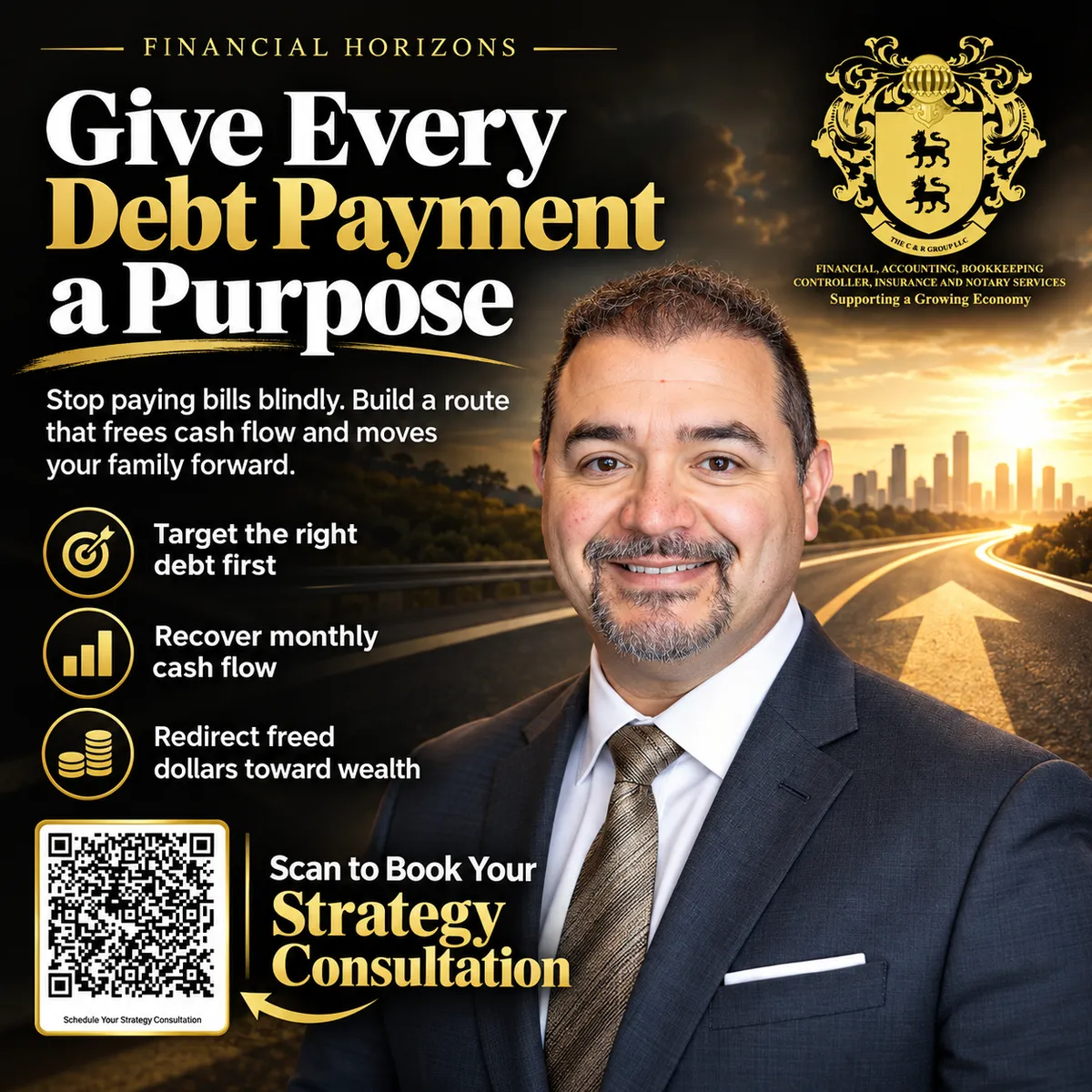
Book Your Strategy Consultation
If you are making debt payments every month but are not sure what each payment is accomplishing—or what those dollars should do once the debt disappears—let's build a clearer route.
Schedule a strategy consultation to review your debt, cash flow, retirement goals, and long-term Financial GPS.
Booking link:
https://api.leadconnectorhq.com/widget/booking/T4UHUjCijCtIB3rwoTDI
Phone: 580-699-1591
Booking your appointment now:

ABOUT THE AUTHOR
Dr. Jose G. Cardenas is a retired U.S. Army Finance Officer and the Chief Tax Strategist at The C & R Group, LLC. With a Doctorate in Business Administration and over 20 years of experience in tax planning and financial strategy, Dr. Cardenas helps individuals and business owners legally reduce taxes, strengthen cash flow, and build lasting wealth and legacy. Learn more at www.thecrgroupllc.com
DISCLOSURE
This article is for educational and informational purposes only and is not intended to serve as personalized legal, tax, or investment advice. Tax laws and regulations change over time and may vary by jurisdiction. You should consult with a qualified tax professional regarding your specific circumstances before implementing any strategy discussed here. Dr. Jose G. Cardenas, DBA, provides tax advisory services through The C & R Group, LLC. Insurance and investment strategies may be offered through his role as a licensed financial professional affiliated with Experior Financial Group.