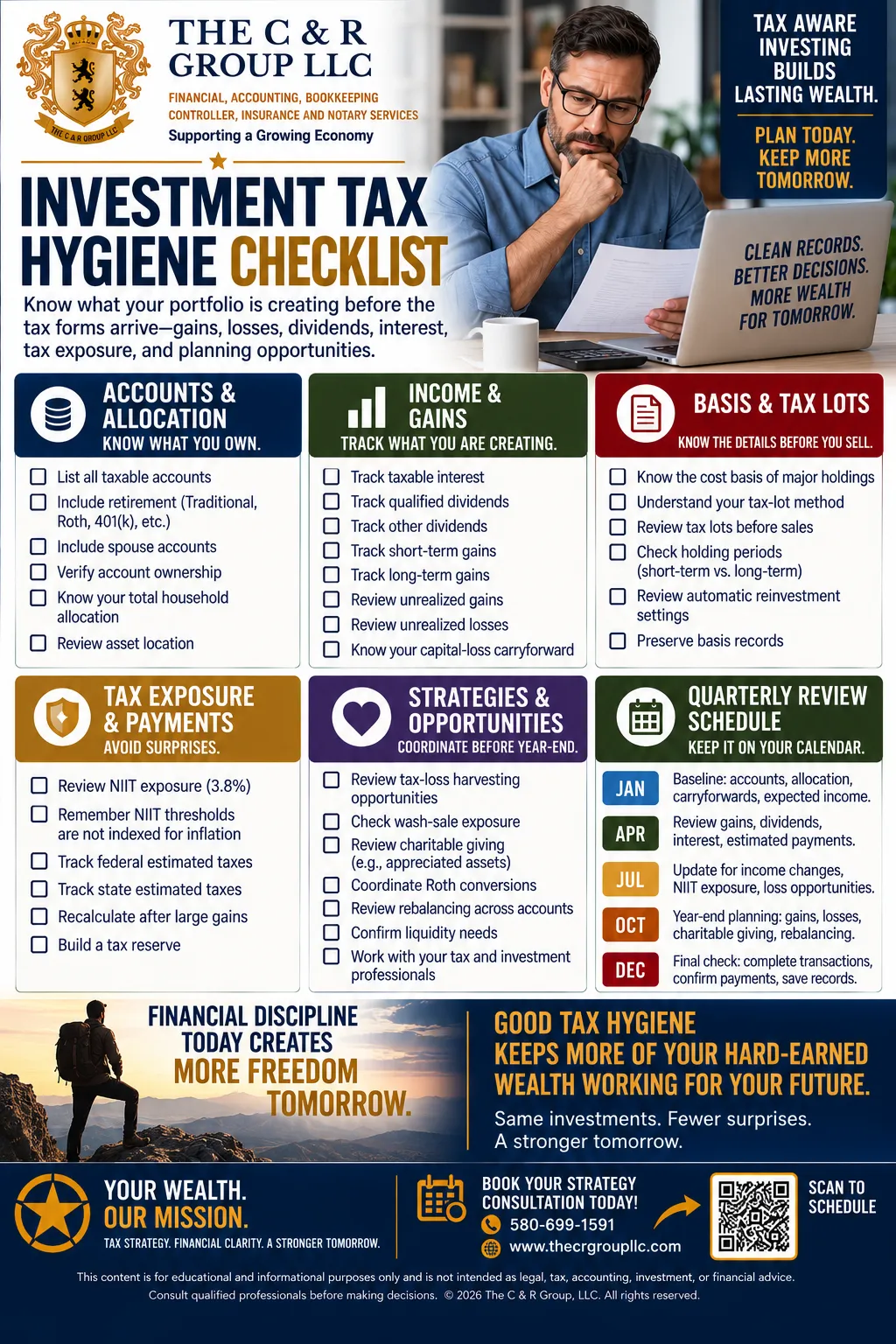
Investment Tax Hygiene Checklist
Financial Horizons: Insights for Building Wealth and Securing Your Legacy
Investment Tax Hygiene Checklist
By Dr. Jose G. Cardenas | Chief Tax Strategist, The C & R Group, LLC
Good financial hygiene is usually boring.
That is exactly why it works.
You reconcile accounts.
You review insurance.
You update beneficiaries.
You track expenses.
You save important documents.
Investment tax planning deserves the same discipline.
Yet many households treat their taxable investments like this:
Buy.
Hold.
Sell occasionally.
Reinvest dividends.
Receive tax forms.
Then ask:
“What happened?”
That is not tax planning.
That is tax archaeology.
Investment tax hygiene means maintaining enough information throughout the year to understand:
What income the portfolio generated;
What gains were realized;
What losses exist;
What cost basis is attached to major holdings;
Whether gains are short-term or long-term;
Whether estimated taxes need to change;
Whether NIIT may apply;
Whether charitable or retirement strategies should be coordinated.
The IRS's current guidance continues to treat investment taxation as part of the federal pay-as-you-go system. Publication 505 explains that withholding and estimated taxes are the two primary methods of paying federal tax during the year, and its 2026 worksheets specifically incorporate qualified dividends and capital gains into estimated-tax calculations. (IRS)
Higher-income investors should also monitor the 3.8% Net Investment Income Tax. The NIIT applies to the lesser of net investment income or the amount modified adjusted gross income exceeds the applicable statutory threshold: $250,000 for married filing jointly, $125,000 for married filing separately, and $200,000 for single or head-of-household taxpayers. (IRS)
That leads to today's central principle:
Clean investment-tax records create better decisions before filing season removes your options.
1. Know Every Account You Own
Start with inventory.
List every:
Taxable brokerage account;
Traditional IRA;
Roth IRA;
401(k);
403(b);
TSP;
HSA;
Other investment account.
Why?
Because investment-tax decisions can interact across accounts.
A loss harvested in one account can be affected by what happens elsewhere.
A portfolio rebalance in a retirement account may reduce the need to trigger gains in taxable accounts.
A household cannot coordinate what it has not inventoried.
Investment-account checklist
Taxable accounts listed.
Traditional retirement accounts listed.
Roth accounts listed.
Spouse accounts included.
Employer plans included.
Account ownership verified.
2. Know Your Total Household Allocation
Do not look at each account separately.
Add them together.
Suppose:
Taxable account
$300,000
Traditional 401(k)
$500,000
Roth IRA
$200,000
Total household investments:
$1,000,000
Now determine:
Stocks
____%
Bonds
____%
Cash
____%
Other
____%
That gives you the actual household allocation.
Without this step, you may be:
Overweight stocks;
Overweight bonds;
Holding duplicated positions;
Rebalancing unnecessarily in taxable accounts.
Asset allocation belongs at the household level.
3. Separate Taxable, Tax-Deferred, and Roth Buckets
Your investments do not all live under the same tax rules.
Taxable accounts
Can generate currently taxable:
Interest;
Dividends;
Capital-gain distributions;
Realized gains.
Traditional retirement accounts
Generally defer taxation while assets remain inside the qualified account, with taxable distributions generally recognized later.
Roth accounts
Can provide potentially tax-free qualified withdrawals when applicable requirements are met.
Each bucket has a different mission.
Your checklist should ask:
What belongs where?
Why is it there?
Is the current location still appropriate?
4. Track Year-to-Date Interest
Taxable interest can quietly accumulate.
Examples:
Bank interest;
CDs;
Taxable bonds;
Money-market funds.
Record:
Taxable interest year to date
$________
Then ask:
Is this expected?
Does it materially increase taxable income?
Should asset location be reviewed?
Taxable interest may be perfectly appropriate.
But it should not be invisible.
5. Track Dividends
Separate:
Qualified dividends
$________
Other dividends
$________
Qualified dividends may receive preferential federal capital-gain rate treatment when applicable requirements are satisfied. IRS Publication 550 explains that qualified dividends can be taxed at the same 0%, 15%, or 20% maximum rates that apply to qualifying net capital gains. (IRS)
Do not simply track:
“Dividend income.”
Know the category.
6. Reinvested Dividends Still Matter
Automatic reinvestment is not invisible for tax purposes.
If a taxable account pays dividends and those dividends purchase additional shares, the transaction can:
Create taxable dividend income;
Create additional tax lots;
Increase basis in the newly acquired shares.
That means reinvestment increases recordkeeping complexity.
Tax hygiene requires:
Tracking it;
Preserving basis;
Knowing the purchase dates.
7. Know Your Realized Short-Term Gains
Track:
Short-term gains
$________
Investments held for one year or less generally produce short-term capital-gain treatment.
Net short-term gains generally receive ordinary-income treatment rather than preferential long-term capital-gain rates.
That means short-term gains should be visible throughout the year.
Do not discover:
$40,000 short-term gain
when Form 1099-B arrives.
8. Know Your Realized Long-Term Gains
Track:
Long-term gains
$________
Investments held more than one year may qualify for long-term capital-gain treatment.
Your year-to-date report should separate:
Short-term;
Long-term.
Those are economically different tax categories.
A brokerage statement can usually provide this information.
Use it.
9. Track Unrealized Gains Too
Realized gains tell you what already happened.
Unrealized gains tell you what could happen.
Create:
Large embedded gains
$________
Largest appreciated positions
________________
This matters for:
Rebalancing;
Liquidity planning;
Charitable giving;
Diversification.
Tax hygiene looks both backward and forward.
10. Track Unrealized Losses
Now identify:
Unrealized losses
$________
Losses may create opportunities for tax-loss harvesting when the investment strategy supports the transaction.
But do not automatically sell.
Ask:
Does the investment still belong in the portfolio?
Is an appropriate replacement available?
Could wash-sale rules apply?
Is the loss actually useful?
A loss is not automatically a strategy.
It is an input.
11. Know Your Capital-Loss Carryforward
A capital-loss carryforward can be a valuable planning asset.
Suppose you begin the year with:
$25,000 capital-loss carryforward.
Then realize:
$20,000 capital gain.
That carryforward can materially affect the tax analysis.
Keep:
Capital-loss carryforward
$________
on the dashboard.
Do not leave that information buried inside last year's tax return.
12. Review Wash-Sale Exposure
The wash-sale rule deserves special attention when harvesting losses.
IRS Schedule D guidance states that a wash sale can occur when substantially identical stock or securities are acquired within 30 days before or after a loss sale. The rules can also apply when substantially identical investments are acquired inside an IRA or Roth IRA. (IRS)
Before harvesting a loss, check:
Taxable accounts;
Spouse accounts;
IRAs;
Roth IRAs;
Automatic purchases;
Dividend reinvestment.
Wash-sale checklist
No recent substantially identical purchases.
No scheduled recurring purchases.
Dividend reinvestment reviewed.
Spouse accounts reviewed.
Retirement accounts reviewed.
13. Review Automatic Reinvestment Settings
Automation can create discipline.
It can also create problems.
Check every taxable investment with:
Automatic dividend reinvestment;
Automatic mutual-fund purchases;
Recurring ETF purchases.
Before loss harvesting or tax-lot planning, make sure those settings support the strategy.
Automation is excellent when it follows the plan.
Less excellent when it accidentally defeats it.
14. Know Your Cost Basis
For every major taxable holding, ask:
Cost basis
$________
Current market value
$________
Embedded gain or loss
$________
Basis is essential.
Without it, you do not know the taxable gain.
IRS Form 8960 guidance emphasizes retaining records necessary to substantiate investment basis and related calculations. (IRS)
Do not rely on memory.
15. Review Tax Lots Before Selling
Suppose you own three lots:
Lot A
Basis:
$20,000
Lot B
Basis:
$40,000
Lot C
Basis:
$60,000
Each currently worth:
$70,000.
The taxable gain differs materially.
Before a sale:
Review the lot.
Do not let the default setting silently determine the tax consequence.
16. Confirm Brokerage Cost-Basis Method
Your brokerage may use:
FIFO;
Average cost where applicable;
Specific identification;
Another default method.
Verify the setting.
Especially before:
Large sales;
Charitable gifts;
Diversification transactions.
A tax-lot mistake can be difficult to reverse after settlement and reporting.
Know the method before trading.
17. Review Holding Period Before Every Major Sale
Before selling:
Acquisition date
________
Proposed sale date
________
Short-term or long-term?
________________
Then ask:
Does waiting change the tax character without creating unacceptable investment risk?
Sometimes:
Yes.
Sometimes:
No.
But the question should be asked.
18. Review NIIT Exposure
The NIIT rate is:
3.8%.
For individuals, the statutory MAGI thresholds are:
$250,000 married filing jointly;
$125,000 married filing separately;
$200,000 single or head of household. (IRS)
Net investment income can generally include:
Interest;
Dividends;
Capital gains;
Rental income;
Royalty income;
Certain nonqualified annuity income. (IRS)
Add this question to every major gain review:
Could NIIT apply?
19. Remember: NIIT Thresholds Are Not Indexed for Inflation
This is easy to overlook.
The IRS notes that the NIIT thresholds are statutory and are not indexed for inflation. (IRS)
That means more households can drift toward NIIT exposure over time as nominal income rises.
Do not assume:
“We were below it five years ago, so we're probably still fine.”
Review annually.
20. Track Estimated Taxes
The federal tax system operates on a pay-as-you-go basis.
Publication 505 explains that withholding and estimated taxes are used to pay tax during the year, and its 2026 worksheets explicitly address qualified dividends and capital gains. (IRS)
Track:
Federal estimated taxes paid
$________
State estimated taxes paid
$________
W-2 withholding
$________
Then compare to the projected liability.
21. Recalculate After Large Gains
Suppose your original tax projection assumed:
$10,000 capital gains.
Then you realize:
$125,000.
The tax plan changed.
Update:
Federal liability;
State liability;
NIIT;
Withholding;
Estimated payments.
Do not keep following the original payment schedule simply because it was correct in January.
A tax projection is a working document.
22. Review Charitable Giving Before Selling Appreciated Assets
If you plan to give:
$10,000
or
$50,000
to charity,
review appreciated investments first.
Depending on the applicable charitable rules and facts, donating appreciated securities directly to a qualified charity may produce a different tax outcome than:
Selling securities;
Realizing the gain;
Donating cash.
The key word is:
before.
Once the asset is sold, that planning path may be gone.
23. Coordinate Roth Conversions With Capital Gains
Suppose you are considering:
Roth conversion
$75,000
and
Long-term gain
$60,000.
Those transactions both affect taxable income.
The conversion may change:
Capital-gain rate;
NIIT exposure;
Other thresholds.
Do not plan the Roth conversion separately from the brokerage account.
It is one household return.
24. Review Taxable Rebalancing
Before selling appreciated taxable investments to rebalance, ask:
Can retirement accounts be adjusted?
Can new contributions correct the imbalance?
Can dividends be redirected?
Can new savings purchase the underweight asset?
Sometimes the best tax move is:
not selling.
Tax-aware rebalancing looks across the entire household.
25. Review Asset Location
Ask whether investments are sitting in appropriate tax buckets.
Examples to review:
Taxable interest-producing assets
Could tax-deferred placement make sense?
High-growth assets
Does Roth placement deserve review?
Tax-efficient equity investments
Do taxable accounts make sense?
These are not universal rules.
They are planning questions.
Suitability, liquidity, and overall allocation come first.
26. Review Liquidity Needs Before Selling
Before a large sale, identify:
Cash needed
$________
Date needed
________
Source
________________
Then review:
Basis;
Gains;
Holding periods;
Tax lots.
Do not sell:
$100,000
when you need:
$40,000
without understanding why.
Match liquidation to the actual need.
27. Build an Investment Tax Reserve
After a major taxable gain, consider separating part of the proceeds for taxes.
Example:
Sale proceeds
$150,000
Estimated tax reserve
$________
Remaining investable/spendable cash
$________
This can prevent the ugly cycle:
Realize gain.
Reinvest everything.
Tax bill arrives.
Sell again to pay tax.
Create another tax event.
Cash-flow planning matters.
28. Review Beneficiary and Ownership Information
Investment tax hygiene is not only about annual income taxes.
Check:
Account ownership;
Beneficiary designations;
Trust ownership where applicable;
Transfer-on-death designations.
These affect:
Estate administration;
Inherited accounts;
Legacy planning.
Tax planning should support the transfer strategy too.
29. Preserve Basis Records for Legacy Assets
For long-held taxable assets, preserve:
Original purchase statements;
Reinvestment records;
Corporate-action records;
Improvement records for applicable property;
Gifts and inherited-property documentation.
Basis becomes especially important when assets are:
Gifted;
inherited;
sold after decades.
Do not assume old records will always be available online.
30. Coordinate With Your Tax and Investment Professionals Before Major Moves
Before:
Large sale;
Major rebalance;
Concentrated-stock reduction;
Roth conversion;
Charitable gift;
Business funding transaction;
ask both sides of the table:
Investment question
Does the transaction make financial sense?
Tax question
What tax consequences does it create?
That is integrated planning.
Neither professional should work blind.
The Quarterly Investment Tax Hygiene Schedule
JANUARY — BASELINE
Review:
Account inventory;
Allocation;
Prior-year loss carryforwards;
Expected investment income;
Expected gains.
APRIL — FIRST QUARTER
Review:
Realized gains;
Dividends;
Interest;
Estimated payments.
JULY — MID-YEAR
Review:
Income changes;
NIIT exposure;
Tax-loss opportunities;
Tax lots;
Withholding.
OCTOBER — YEAR-END PLANNING
Review:
Capital gains;
Losses;
Charitable giving;
Roth conversions;
Rebalancing;
Estimated taxes.
DECEMBER — FINAL EXECUTION
Confirm:
Planned transactions completed;
Wash-sale windows understood;
Tax reserve funded;
Estimated payments current;
Records saved.
That is investment-tax hygiene.
Illustrative Household Example
Assume Angela and Mark have:
W-2 income
$190,000
Taxable brokerage
$600,000
Traditional retirement accounts
$900,000
Roth accounts
$250,000
During 2026, their taxable brokerage generates:
Interest
$8,000
Qualified dividends
$12,000
Long-term gains
$55,000
Short-term gains
$15,000
They also have:
Unrealized losses
$18,000
They ignore all of this until filing season.
That is reactive.
The Tax-Hygiene Version
Instead, they review quarterly.
April
Identify realized gains.
July
Income increases because of bonus compensation.
NIIT exposure is reviewed.
October
Loss positions are evaluated.
One no longer fits the portfolio.
A loss is realized after wash-sale review.
November
A charitable gift is coordinated with appreciated securities.
December
Estimated payments are updated.
Same household.
Same general portfolio.
Better process.
The Investment Tax Hygiene Scorecard
Give yourself one point for every YES.
ACCOUNTS
All accounts inventoried.
Spouse accounts included.
Household allocation known.
INCOME
Interest tracked.
Qualified dividends tracked.
Other dividends tracked.
GAINS
Short-term gains tracked.
Long-term gains tracked.
Unrealized gains reviewed.
LOSSES
Unrealized losses reviewed.
Loss carryforward known.
Wash-sale exposure reviewed.
BASIS
Major holdings' basis known.
Tax-lot method known.
Tax lots reviewed before sales.
TAX
NIIT reviewed.
Estimated taxes reviewed.
State taxes reviewed.
PLANNING
Charitable giving coordinated.
Roth conversions coordinated.
Rebalancing reviewed across accounts.
Asset location reviewed.
CASH FLOW
Tax reserve funded.
Major liquidity needs projected.
20–23 YES
GREEN — Strong Investment Tax Hygiene
13–19 YES
YELLOW — Needs Coordination
0–12 YES
RED — Reactive Tax Process
The goal is not perfection.
It is visibility.
30 Questions to Ask Before Year-End
What accounts do we own?
What is our household allocation?
How much taxable interest have we received?
How much qualified dividends?
How much other dividends?
What short-term gains were realized?
What long-term gains were realized?
What unrealized gains remain?
What unrealized losses remain?
Do we have capital-loss carryforwards?
Could tax-loss harvesting make sense?
Could wash-sale rules apply?
Are automatic reinvestments active?
Do we know basis?
Do we know our tax-lot method?
Which lots would be sold?
What holding periods apply?
What is projected taxable income?
Could NIIT apply?
Has household income changed?
Do estimated taxes need adjustment?
Should wage withholding change?
Does state tax need review?
Is charitable giving planned?
Are appreciated securities available?
Is a Roth conversion planned?
Can we rebalance without taxable sales?
Are assets in appropriate tax locations?
Is tax cash reserved?
Could we explain our investment tax position today without waiting for the 1099s?
That final question is the hygiene test.
AI-Search Quick Answers
What is investment tax hygiene?
Investment tax hygiene is the ongoing process of tracking investment income, gains, losses, cost basis, holding periods, tax lots, estimated taxes, NIIT exposure, and related planning opportunities before filing season.
What is the Net Investment Income Tax?
The NIIT is a 3.8% tax on the lesser of net investment income or the amount MAGI exceeds the applicable statutory threshold. (IRS)
What are the NIIT thresholds?
$250,000 for married filing jointly, $125,000 for married filing separately, and $200,000 for single or head-of-household taxpayers. (IRS)
Are NIIT thresholds indexed for inflation?
No. The IRS states that the statutory threshold amounts are not indexed for inflation. (IRS)
Are qualified dividends taxed differently from ordinary dividends?
Qualified dividends can receive the same preferential 0%, 15%, or 20% maximum rates that apply to qualifying net capital gains when the requirements are met. (IRS)
What is a wash sale?
A wash sale can generally arise when securities are sold at a loss and substantially identical securities are acquired within 30 days before or after the loss sale. The rule can also apply to acquisitions inside an IRA or Roth IRA. (IRS)
Why does cost basis matter?
Basis is necessary for calculating gain or loss when an investment is sold. IRS guidance emphasizes retaining investment records necessary to support basis calculations. (IRS)
Can capital gains and dividends affect estimated taxes?
Yes. The IRS's 2026 estimated-tax guidance incorporates qualified dividends and capital gains into the estimated-tax calculation. (IRS)
What to Do Next
Create a one-page Investment Tax Hygiene Dashboard.
ACCOUNTS
Taxable:
$________
Traditional:
$________
Roth:
$________
INVESTMENT INCOME
Interest:
$________
Qualified dividends:
$________
Other dividends:
$________
CAPITAL GAINS
Short-term:
$________
Long-term:
$________
CAPITAL LOSSES
Realized:
$________
Unrealized:
$________
Carryforward:
$________
TAX
Projected taxable income:
$________
NIIT:
Yes / No / Review
Federal estimated taxes:
$________
State estimated taxes:
$________
Tax reserve:
$________
PLANNING
Basis reviewed.
Tax lots reviewed.
Holding periods reviewed.
Loss harvesting reviewed.
Wash-sale risks reviewed.
Charitable giving reviewed.
Roth conversion reviewed.
Asset location reviewed.
Update it quarterly.
That one page can prevent a great deal of confusion.
Final Thought
Investment tax hygiene is not glamorous.
There is no exciting headline.
No market prediction.
No secret fund.
It is simply disciplined financial maintenance.
Know:
What you own.
Where you own it.
What income it creates.
What gains you realized.
What losses exist.
What basis you have.
What taxes may be due.
Then coordinate before the next transaction.
Because the best time to ask:
“What will this do to my taxes?”
is before:
Sell.
Not after.
The best time to review losses is:
Before the year ends.
The best time to review estimated taxes is:
Before the payment is late.
And the best time to coordinate investments and tax planning is:
while you still have choices.
So keep the investment-tax file clean.
Review it quarterly.
Coordinate the accounts.
Preserve the basis records.
Track the gains.
Track the losses.
Project the taxes.
And make filing season the final step in a process you already understand.
Clean records.
Better coordination.
Fewer surprises.
More after-tax wealth working toward your future.
That is investment tax hygiene.
Book Your Strategy Consultation
If your household has taxable investments, retirement accounts, appreciated securities, capital gains, dividends, multiple brokerage accounts, or investment tax questions that only seem to appear during filing season, schedule a strategy consultation.
We can review:
Investment tax hygiene;
Capital gains;
Qualified dividends;
NIIT;
Cost basis;
Tax lots;
Loss harvesting;
Wash-sale exposure;
Estimated taxes;
Asset location;
Roth coordination;
Charitable strategies;
After-tax wealth planning.
Booking link:
https://api.leadconnectorhq.com/widget/booking/T4UHUjCijCtIB3rwoTDI
Phone: 580-699-1591
Booking your appointment now:

ABOUT THE AUTHOR
Dr. Jose G. Cardenas is a retired U.S. Army Finance Officer and the Chief Tax Strategist at The C & R Group, LLC. With a Doctorate in Business Administration and over 20 years of experience in tax planning and financial strategy, Dr. Cardenas helps individuals and business owners legally reduce taxes, strengthen cash flow, and build lasting wealth and legacy. Learn more at www.thecrgroupllc.com
DISCLOSURE
This article is for educational and informational purposes only and is not intended to serve as personalized legal, tax, or investment advice. Tax laws and regulations change over time and may vary by jurisdiction. You should consult with a qualified tax professional regarding your specific circumstances before implementing any strategy discussed here. Dr. Jose G. Cardenas, DBA, provides tax advisory services through The C & R Group, LLC. Insurance and investment strategies may be offered through his role as a licensed financial professional affiliated with Experior Financial Group.