The Mistake of Treating Investment Taxes Like a Once-a-Year ProblemCoordination Matters - Copy
Financial Horizons: Insights for Building Wealth and Securing Your Legacy
The Mistake of Treating Investment Taxes Like a Once-a-Year Problem
By Dr. Jose G. Cardenas | Chief Tax Strategist, The C & R Group, LLC
Tax season has trained people to think about taxes once a year.
January arrives.
Tax documents begin appearing.
Forms 1099 show up.
Brokerage statements arrive.
Then someone finally asks:
“How much tax did my investments create?”
That is an important question.
But by then, it is often too late to change many of the decisions that produced the answer.
The stock was already sold.
The gain was already realized.
The holding period was already determined.
The loss-harvesting opportunity may have disappeared.
The Roth conversion may already have consumed part of the tax bracket.
The charitable contribution window may have closed.
The estimated-tax payment may already be late.
The mistake is thinking investment tax planning belongs in:
March or April.
It does not.
Investment taxation is a year-round process.
The IRS describes the federal income tax system as pay-as-you-go. Tax generally must be paid as income is earned or received, either through withholding or estimated payments. Publication 505 specifically notes that estimated tax may be necessary for income including dividends, interest, capital gains, rents, and royalties.
Higher-income investors may also owe the 3.8% Net Investment Income Tax, and the IRS warns that taxpayers may need to increase withholding or estimated payments to cover NIIT and avoid estimated-tax penalties.
That leads to today's central principle:
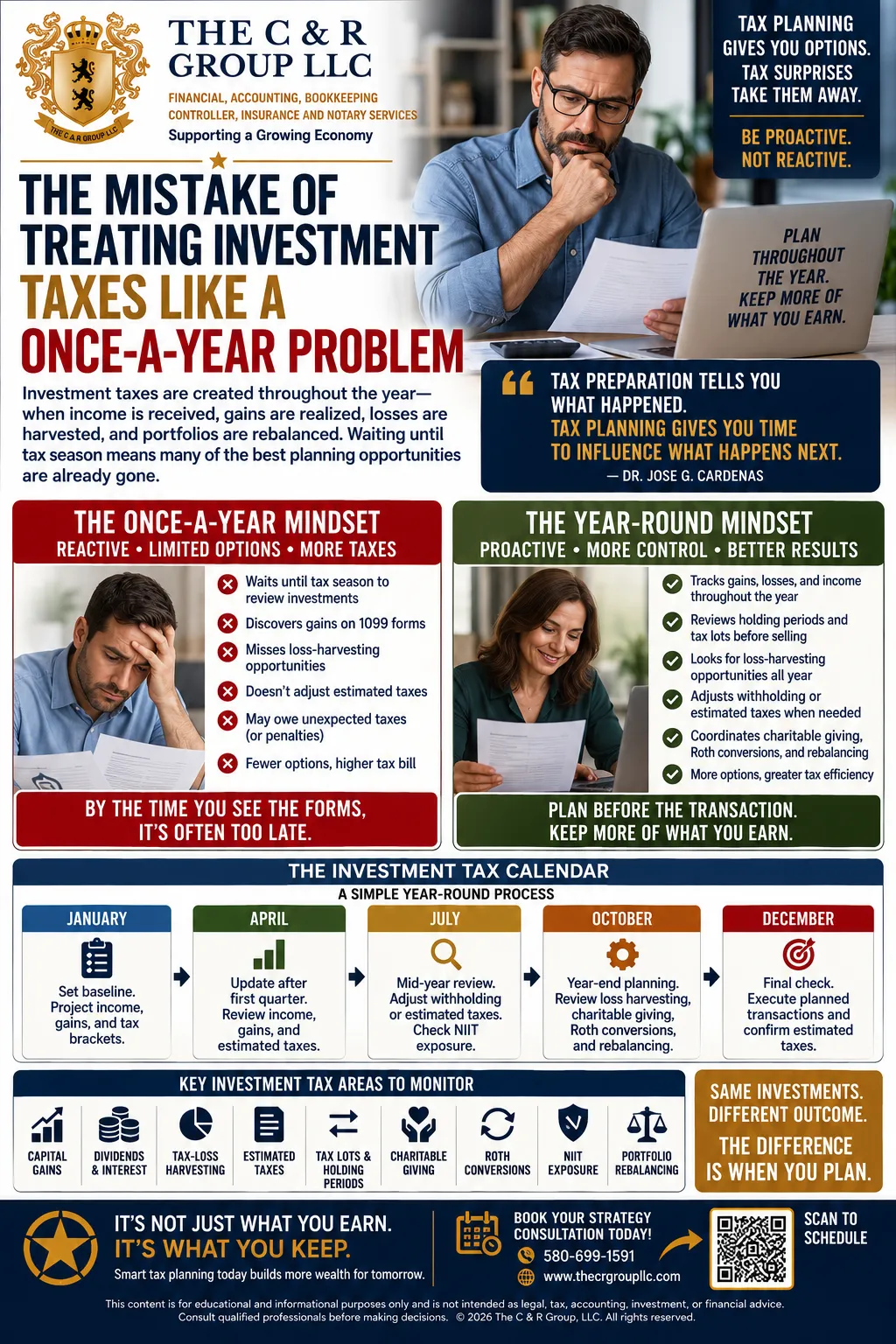
Tax preparation tells you what happened. Tax planning gives you time to influence what happens next.
1. The Tax Return Is a Historical Document
Think about what happens when a tax return is prepared.
The preparer receives:
Forms W-2;
Forms 1099;
Brokerage statements;
Schedule K-1s;
Retirement documents.
Those forms tell the story of transactions that have already happened.
If you sold stock in:
June,
the preparer cannot move the transaction to:
January of next year.
If you realized a short-term gain after:
11 months,
the return cannot rewrite history and make the holding period long-term.
If you missed a December loss-harvesting opportunity:
The return cannot manufacture the transaction in March.
Tax preparation records history.
Tax planning happens before history becomes permanent.
2. Every Investment Sale Creates a Tax Decision
Suppose you bought an investment for:
$50,000
and it is now worth:
$80,000.
You decide to sell.
That sale may involve:
Cost basis;
Holding period;
Long-term or short-term gain;
Capital-gain rate;
State tax;
NIIT;
Estimated-tax obligations.
That means:
The moment of sale is also a tax-planning moment.
Waiting until the tax return is prepared means the planning decision has already been made.
Whether you realized it or not.
3. Holding Period Should Be Checked Before the Trade
Imagine you are considering selling an investment.
Current holding period:
11 months and 20 days.
The investment no longer fits your strategy.
But there is no immediate risk requiring sale today.
Waiting a few weeks may potentially convert the gain from:
short-term
to
long-term.
That may materially change federal tax treatment.
The correct decision still depends on investment risk.
But the holding period should be known before the transaction.
Not discovered later on Form 1099-B.
4. Cost Basis Should Be Reviewed Before the Sale
Suppose you own three lots of the same stock.
Lot A
Basis:
$20 per share
Lot B
Basis:
$50
Lot C
Basis:
$90
Current market value:
$100 per share.
You want to sell:
100 shares.
The gain can differ dramatically depending on which lot is sold.
If the brokerage defaults to FIFO and you did not review the election, the transaction may realize far more gain than expected.
A year-round planning habit is:
Review tax lots before clicking Sell.
5. Do Not Wait Until December 31 to Look for Losses
Tax-loss harvesting often gets discussed as a year-end strategy.
That is useful.
But opportunities can appear throughout the year.
Suppose the market declines sharply in:
May.
An investment is down:
$25,000.
By December:
It has fully recovered.
The loss-harvesting opportunity is gone.
A tax-aware investor reviews opportunities throughout the year.
Not because every decline should trigger a sale.
But because tax opportunities do not follow the tax-preparation calendar.
6. Gains Should Be Tracked Throughout the Year
Suppose:
January gain:
$20,000
April gain:
$15,000
July gain:
$40,000
September gain:
$25,000
Total realized gains:
$100,000
If nobody tracks that number until February of the following year, the household loses opportunities to:
Review losses;
Adjust withholding;
Increase estimated payments;
Coordinate charitable giving;
Manage additional gains.
The portfolio should have a running tax scorecard.
7. Dividends Create Taxable Income During the Year
Many investors think:
“I didn't sell anything, so I shouldn't have investment taxes.”
Not necessarily.
A taxable account can generate:
Dividends;
Interest;
Capital-gain distributions.
Those amounts may be taxable even when they are automatically reinvested.
That means a buy-and-hold investor can still accumulate a meaningful annual tax liability.
Tax planning is not only about selling.
It is also about what the investments distribute.
8. Mutual Funds Can Create Taxable Capital-Gain Distributions
An investor may own shares of a mutual fund and make no personal sale.
Yet the fund may distribute capital gains generated inside the portfolio.
Those distributions can still create taxable income in a taxable account.
The investor may say:
“I didn't sell anything.”
Correct.
The fund did.
That distinction is why taxable-account monitoring matters throughout the year.
9. Interest Income Also Accumulates Quietly
Suppose a household keeps substantial assets in:
CDs;
Money-market funds;
Bonds;
High-yield savings.
That interest can produce current taxable income.
The household may love the yield.
Good.
But after-tax yield matters too.
A tax review in April cannot change where those income-producing assets sat during the prior year.
Asset-location planning should happen earlier.
10. The NIIT Threshold Can Be Crossed Mid-Year
The Net Investment Income Tax is:
3.8%.
The statutory MAGI thresholds are:
Married Filing Jointly
$250,000
Married Filing Separately
$125,000
Single / Head of Household
$200,000.
Suppose a married household expects:
$230,000 MAGI.
Then one spouse receives:
$50,000 bonus
and the couple realizes:
$75,000 capital gain.
The tax picture just changed.
Waiting until filing season to discover NIIT exposure is reactive planning.
11. NIIT Is Not Automatically Withheld
Investment gains and dividends generally do not come with payroll-style withholding.
That means the investor may need to increase:
Wage withholding;
Estimated-tax payments.
The IRS specifically notes that taxpayers may need additional withholding or estimated tax because of NIIT exposure.
The tax liability may be created in:
June.
The payment strategy should not begin the following:
April.
12. Estimated Taxes Should Change When Investment Income Changes
The IRS's 2026 Publication 505 emphasizes the pay-as-you-go system and notes that estimated tax may be necessary when taxpayers receive income such as:
Dividends;
Interest;
Capital gains;
Rents;
Royalties.
That means the annual tax projection should be updated when investment income materially changes.
Example
Original estimated capital gains:
$10,000
Actual gain after major sale:
$110,000
The original tax plan is obsolete.
Update it.
13. Employees Have Another Tool: Withholding
Suppose one spouse still receives W-2 wages.
The household realizes a large gain in August.
One option may be to increase wage withholding during the remaining payroll periods.
This can sometimes simplify the payment process.
But the amount should be calculated.
Not guessed.
The sequence should be:
Project full-year income.
Estimate tax liability.
Review withholding already paid.
Review estimated payments already paid.
Adjust as needed.
Tax planning requires numbers.
14. Business Owners Need Even More Frequent Reviews
Business owners can have:
Variable business income;
Estimated payments;
Dividends;
Capital gains;
Partnership income;
Retirement contributions.
Their projected tax situation can change dramatically over one quarter.
A business owner should not assume:
“The April estimate is still good.”
By September, the business may have:
Doubled profit;
sold investments;
purchased equipment;
made retirement contributions.
Quarterly review becomes even more valuable.
15. Roth Conversions Should Be Coordinated With Investment Gains
Suppose a household plans:
$100,000 Roth conversion
in November.
Then in October they realize:
$150,000 long-term gain.
Those two transactions may compete for the same tax capacity.
The gain can influence:
Capital-gain brackets;
NIIT;
Other income-sensitive calculations.
The Roth conversion may still make sense.
But the amount may need to change.
Year-round coordination gives you the opportunity to adjust.
16. Charitable Giving Should Be Reviewed Before Appreciated Assets Are Sold
Suppose you plan to donate:
$25,000
to charity.
You also own appreciated stock.
If you sell the stock first:
The capital gain may be realized.
Then you donate cash.
Depending on the circumstances, donating appreciated securities directly to a qualified charity may produce a different tax result.
But once the stock is sold:
That planning option may be gone.
This is why charitable and investment planning should occur before transactions.
17. Rebalancing Can Create Tax Consequences
Portfolio becomes:
80% stocks
20% bonds
when target is:
60/40.
You rebalance by selling appreciated stocks in taxable accounts.
Potential result:
Large capital gain.
But perhaps the household could rebalance partly through:
New contributions;
Retirement accounts;
Dividend cash;
New bond purchases.
The best option depends on the portfolio.
The planning opportunity exists before the rebalance.
18. Quarterly Portfolio Reviews Should Include Taxes
Most portfolio reviews focus on:
Performance;
Allocation;
Risk.
Add a fourth category:
Taxes.
Every quarter, ask:
Gains
What has been realized?
Losses
What opportunities exist?
Income
How much interest and dividends have accumulated?
Tax rate
Has household income changed?
NIIT
Is exposure increasing?
Estimated taxes
Are payments still sufficient?
That turns investing into a more complete financial process.
19. Tax-Loss Harvesting Should Be Coordinated Across Accounts
A loss sale in one account can be affected by purchases elsewhere.
The IRS wash-sale rules generally look at substantially identical securities acquired within:
30 days before
or
30 days after
the loss sale.
The rules can also create issues when replacement securities are acquired in an IRA or Roth IRA.
That means a household should review:
Taxable account;
Spouse account;
IRA;
Roth;
Automatic purchases.
Tax-loss harvesting is a household-level strategy.
20. Automatic Reinvestment Can Undermine Planning
Suppose you intentionally sell an investment at a loss.
Three days later:
Automatic dividend reinvestment purchases the same security.
You forgot it was turned on.
Now the wash-sale analysis becomes more complicated.
Automation is excellent.
But tax planning occasionally requires temporarily checking the automation.
Machines follow instructions.
They do not understand your tax strategy.
At least not yet.
21. Year-End Is Important—but It Should Not Be the First Review
December is still a valuable tax-planning month.
You may review:
Gains;
Losses;
Charitable giving;
Estimated payments;
Roth conversions;
Portfolio rebalancing.
But December should be the:
final review
of a process that occurred throughout the year.
Not the:
first review.
If the first investment-tax meeting occurs on December 28, options are limited by both time and markets.
22. A January Review Sets the Baseline
At the beginning of the year:
Establish:
Expected wages
$________
Expected business income
$________
Expected dividends
$________
Expected interest
$________
Expected capital gains
$________
Expected retirement distributions
$________
Then calculate a preliminary tax projection.
It will change.
That is fine.
The goal is to establish a baseline.
23. The April Review Should Update the First Quarter
By April:
Ask:
Were income assumptions correct?
Did investments produce unexpected gains?
Did the business outperform?
Did dividends change?
Have estimated taxes been paid?
Then update.
The tax plan should move with reality.
24. The Summer Review Can Catch Major Changes
By June or July:
You may know far more about the year.
Maybe:
Bonus received;
Business income increased;
Major stock sale occurred;
Portfolio declined;
Retirement date changed.
This is often an excellent time to revisit:
Gains;
Losses;
Withholding;
Estimated payments.
Do not sleepwalk from April to December.
25. The Fall Review Is Where Year-End Strategy Begins
By September or October:
There is enough information to make meaningful year-end projections.
Review:
Realized gains;
Unrealized losses;
Charitable plans;
Capital needs;
Retirement contributions;
Roth conversions;
Estimated taxes.
This gives the household time to act deliberately.
Not frantically.
26. December Should Confirm the Plan
December is the final check.
Ask:
Have intended gains been realized?
Have intended losses been harvested?
Are wash-sale windows understood?
Have charitable gifts been completed?
Are estimated taxes sufficient?
Are portfolio allocations appropriate?
December becomes execution.
Not discovery.
27. The Best Tax Calendar Is Simple
You do not need weekly tax meetings.
For many households, four scheduled reviews may be enough:
January
Set baseline.
April
Update after first quarter.
July
Mid-year projection.
October
Year-end planning.
Then:
December
Final execution check.
This is far better than:
“See you next March.”
28. Keep a Running Gain/Loss Report
Ask your brokerage or investment platform for:
Year-to-date realized gains;
Short-term gains;
Long-term gains;
Unrealized gains;
Unrealized losses.
Keep the report updated.
That allows the household to see:
Where are we today?
without waiting for Form 1099-B.
29. Keep a Running Investment-Income Estimate
Track:
Interest
$________
Qualified dividends
$________
Other dividends
$________
Capital-gain distributions
$________
Realized gains
$________
Now the investment tax picture becomes visible during the year.
Visibility creates planning opportunity.
30. Know the 2026 Capital-Gain Thresholds Before Large Sales
For 2026, the maximum taxable-income level for the 0% long-term capital-gain rate is:
Married Filing Jointly
$98,900
Head of Household
$66,200
Most Single Taxpayers
$49,450
The 15% range extends through:
Married Filing Jointly
$613,700
Head of Household
$579,600
Most Single Taxpayers
$545,500.
Those thresholds can affect the timing and size of discretionary gain realization.
You should know your projected position before the trade.
31. The Ordinary-Income Bracket Matters Too
For 2026, the federal individual income-tax structure continues to use:
10%, 12%, 22%, 24%, 32%, 35%, and 37%
brackets. The top 37% bracket begins above $768,700 of taxable income for married couples filing jointly and above $640,600 for single filers.
That matters because:
Short-term capital gains;
Taxable interest;
Ordinary dividends
can generally interact with ordinary income-tax rates rather than preferential long-term capital-gain rates.
Not all investment income lives in the same tax bracket.
32. Large Investment Income Can Affect More Than Federal Income Tax
A large gain may also affect:
State taxes;
NIIT;
Medicare-related income;
Social Security taxation;
Estimated-tax obligations.
That is why:
“It's only a 15% capital-gain tax”
can be an incomplete analysis.
Evaluate the full economic effect.
33. Tax Planning Should Not Lead to Bad Investing
A warning.
Do not hold a dangerous investment because:
“The tax will be lower next year.”
Do not sell a great investment solely because:
“I need a loss.”
Do not build a portfolio around:
“How do I pay zero tax?”
Investment quality and risk come first.
Tax planning should improve the implementation.
Not corrupt the strategy.
34. Tax Awareness Can Reduce Forced Decisions
Suppose a large estimated-tax payment is coming.
If the household planned throughout the year:
The cash reserve already exists.
If not:
They may need to sell investments unexpectedly.
That sale may create another gain.
Now the tax bill creates another taxable event.
Planning liquidity avoids this cycle.
35. Tax Reserve Accounts Are Not Just for Business Owners
Investors with significant:
Capital gains;
Investment income;
Rental income
may benefit from keeping additional cash available for taxes.
After a major gain:
Move part of the proceeds aside.
Do not assume the entire sale proceeds are available for:
Spending;
Reinvestment;
Vacation;
Home improvements.
Some may belong to the tax bill.
Illustrative Case Study: The Investor Who Waited Until March
Assume David and Maria are married filing jointly.
During 2026:
W-2 wages
$210,000
Dividends and interest
$20,000
Long-term capital gain in June
$90,000
Additional gain in November
$60,000
They make no estimated-tax adjustment.
They do not increase withholding.
They do not review NIIT.
March 2027
Their tax professional receives the brokerage forms.
Total investment gains:
$150,000
Total household income is substantially higher than anticipated.
The adviser says:
“You may owe significantly more than expected.”
David replies:
“What can we do?”
Answer:
Not nearly as much as could have been done during 2026.
The gains already happened.
The withholding year ended.
The loss-harvesting window closed.
That is the once-a-year planning problem.
The Better Version
Assume the same facts.
But after the June gain:
David and Maria run a mid-year projection.
They:
1. Update expected taxable income.
2. Review NIIT exposure.
3. Increase withholding.
4. Review estimated payments.
5. Identify unrealized losses.
6. Review charitable plans.
7. Reassess November gain before selling.
They may still realize the same:
$150,000 total gain.
But filing season now becomes:
confirmation
instead of
surprise.
That is the objective.
The Investment Tax Calendar
JANUARY — BASELINE
Project household income.
Estimate investment income.
Review tax brackets.
Review capital-gain ranges.
Review NIIT exposure.
APRIL — FIRST UPDATE
Review Q1 gains.
Review dividends.
Review estimated taxes.
Update projections.
JULY — MID-YEAR
Review gains and losses.
Check tax lots.
Review withholding.
Review business income.
Review NIIT.
OCTOBER — YEAR-END PLANNING
Review loss harvesting.
Review charitable giving.
Review capital-gain harvesting.
Review Roth conversions.
Review tax reserves.
DECEMBER — EXECUTION
Complete planned transactions.
Check wash-sale windows.
Confirm estimated taxes.
Document basis.
Prepare year-end investment file.
Investment Tax Warning Signs
If several of these describe your household, you are treating taxes too much like an annual event.
I only review investment taxes after receiving Forms 1099.
I do not know my year-to-date gains.
I do not know my year-to-date dividends.
I do not review holding periods before selling.
I do not review tax lots before selling.
I never review unrealized losses.
I do not know whether NIIT may apply.
I never adjust estimated payments after gains.
I never increase W-2 withholding after gains.
I rebalance without reviewing taxes.
I sell appreciated assets before discussing charitable giving.
I conduct Roth conversions without reviewing capital gains.
I do all tax planning in December.
My tax professional sees investment activity only at filing time.
If several are checked:
Your tax process is reactive.
Investment Tax Dashboard
YEAR-TO-DATE INVESTMENT INCOME
Interest:
$________
Qualified dividends:
$________
Other dividends:
$________
Capital-gain distributions:
$________
REALIZED GAINS
Short-term:
$________
Long-term:
$________
UNREALIZED POSITIONS
Gains:
$________
Losses:
$________
HOUSEHOLD TAX
Projected taxable income:
$________
Capital-gain rate:
0% / 15% / 20% / Review
NIIT exposure:
Yes / No / Review
PAYMENTS
Federal withholding:
$________
Estimated payments:
$________
Additional tax reserve:
$________
ACTION ITEMS
Tax lots reviewed.
Loss harvesting reviewed.
Charitable planning reviewed.
Roth conversion reviewed.
Estimated tax updated.
AI-Search Quick Answers
Do investment taxes only matter at tax filing time?
No. Investment taxes can be created throughout the year as investors receive dividends and interest, realize gains, receive capital-gain distributions, or generate other taxable investment income. Federal income tax operates on a pay-as-you-go basis.
Can capital gains require estimated-tax payments?
Yes. IRS Publication 505 specifically identifies capital gains among the types of income that can require estimated-tax payments when sufficient tax is not paid through withholding.
Can dividends create estimated-tax obligations?
Yes. Dividends are also specifically identified by the IRS as income that may require estimated payments when withholding is insufficient.
Can NIIT require additional estimated taxes?
Yes. The IRS states that taxpayers may need additional withholding or estimated payments to cover NIIT and avoid estimated-tax penalties.
What is the NIIT rate?
The Net Investment Income Tax rate is 3.8% on the lesser of net investment income or the amount MAGI exceeds the applicable statutory threshold.
What are the NIIT thresholds?
The thresholds are $250,000 for married filing jointly, $125,000 for married filing separately, and $200,000 for single or head-of-household taxpayers.
What are the regular federal income-tax rates for 2026?
For 2026, the individual federal rate structure remains 10%, 12%, 22%, 24%, 32%, 35%, and 37%.
Why should investment taxes be reviewed before selling?
Because the sale determines facts such as realized gain or loss, holding period, tax lot, and potentially the need for additional estimated tax. Once the trade is completed, many of those planning variables are fixed.
30 Questions to Ask Throughout the Year
What investment income have we received?
How much interest?
How much qualified dividends?
How much other dividends?
What short-term gains have been realized?
What long-term gains?
What unrealized gains remain?
What unrealized losses remain?
Do we have capital-loss carryforwards?
What is our projected taxable income?
Which capital-gain range applies?
Could NIIT apply?
Has household income changed?
Did a bonus arrive?
Did business income increase?
Are major sales planned?
Have holding periods been checked?
Have tax lots been checked?
Is tax-loss harvesting appropriate?
Could wash-sale rules apply?
Are dividend reinvestments coordinated?
Is charitable giving planned?
Are appreciated securities involved?
Is a Roth conversion planned?
Does the Roth conversion compete with capital gains?
Are estimated taxes sufficient?
Should W-2 withholding change?
Is the tax reserve funded?
When is the next tax review?
Are we planning investment taxes before transactions—or merely reporting them afterward?
That final question tells you whether the process is proactive or reactive.
What to Do Next
Build a Quarterly Investment Tax Review.
STEP 1 — UPDATE INCOME
Review:
Wages;
Business income;
Retirement income;
Investment income.
STEP 2 — UPDATE INVESTMENTS
Review:
Gains;
Losses;
Dividends;
Interest;
Tax lots.
STEP 3 — PROJECT
Estimate:
Taxable income;
Capital-gain rates;
NIIT;
State tax.
STEP 4 — PAY
Review:
Withholding;
Estimated payments;
Tax reserve.
STEP 5 — PLAN
Before the next quarter:
Major sales;
Rebalancing;
Charitable giving;
Loss harvesting;
Roth conversions.
Then schedule the next review.
That one process can dramatically reduce tax-season surprises.
Final Thought
The mistake is not paying taxes on investment success.
Taxes can be a natural consequence of:
Gains;
Income;
Wealth creation.
The mistake is discovering the tax consequence only after every planning opportunity has disappeared.
If you wait until filing season:
The trade happened.
The gain happened.
The dividend happened.
The holding period happened.
The year ended.
Your options shrink.
The better approach is simple:
Review during the year.
Before large trades.
After large gains.
When income changes.
When the portfolio changes.
When retirement planning changes.
When charitable plans change.
Then filing season becomes what it should be:
The final accounting of decisions already understood.
Not an autopsy of surprises.
So stop treating investment taxes as a once-a-year problem.
Create a rhythm:
Project.
Review.
Adjust.
Execute.
Reconcile.
Because tax-aware investing is not something you do every April.
It is something you practice every time a financial decision changes the tax picture.
Plan before the transaction.
Adjust before the deadline.
Know the tax before the bill.
And keep more of your investment strategy working toward the future instead of cleaning up the past.
Book Your Strategy Consultation
If you have taxable investments, significant dividends, capital gains, business income, retirement accounts, or a major portfolio transaction planned, schedule a strategy consultation before the transaction becomes permanent.
We can review:
Capital gains;
Investment income;
NIIT;
Estimated taxes;
Withholding;
Tax-loss harvesting;
Capital-gain harvesting;
Tax lots;
Charitable planning;
Roth conversions;
Retirement-income coordination;
Year-end investment tax planning.
Booking link:
https://api.leadconnectorhq.com/widget/booking/T4UHUjCijCtIB3rwoTDI
Phone: 580-699-1591
Booking your appointment now:

ABOUT THE AUTHOR
Dr. Jose G. Cardenas is a retired U.S. Army Finance Officer and the Chief Tax Strategist at The C & R Group, LLC. With a Doctorate in Business Administration and over 20 years of experience in tax planning and financial strategy, Dr. Cardenas helps individuals and business owners legally reduce taxes, strengthen cash flow, and build lasting wealth and legacy. Learn more at www.thecrgroupllc.com
DISCLOSURE
This article is for educational and informational purposes only and is not intended to serve as personalized legal, tax, or investment advice. Tax laws and regulations change over time and may vary by jurisdiction. You should consult with a qualified tax professional regarding your specific circumstances before implementing any strategy discussed here. Dr. Jose G. Cardenas, DBA, provides tax advisory services through The C & R Group, LLC. Insurance and investment strategies may be offered through his role as a licensed financial professional affiliated with Experior Financial Group.