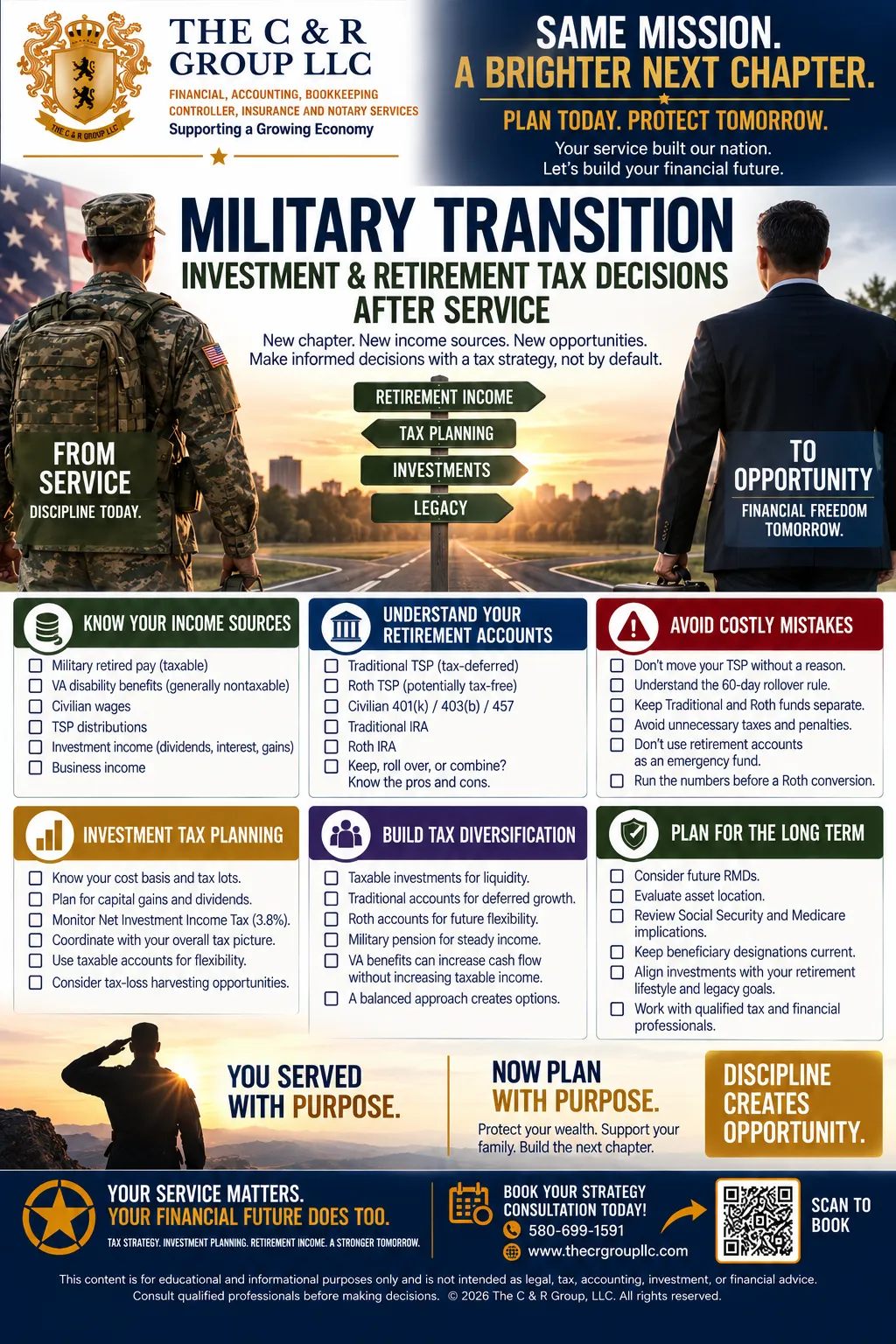
Investment and Retirement Tax Decisions After Service
Financial Horizons: Military Transition Tax Summary
Investment and Retirement Tax Decisions After Service
By Dr. Jose G. Cardenas | Chief Tax Strategist, The C & R Group, LLC
Leaving military service changes more than where you work.
It can change:
How you receive income;
Where you invest;
How you save for retirement;
Which accounts you control;
How your investments are taxed;
How much flexibility you have over future withdrawals.
For years, your financial life may have centered around:
Military pay;
TSP;
BRS contributions;
Military retirement;
VA benefits;
Automatic payroll deductions.
Then transition arrives.
Suddenly you may have:
Traditional TSP;
Roth TSP;
A civilian 401(k);
IRA accounts;
Taxable investments;
Military retired pay;
VA disability compensation;
Civilian wages;
Business income.
That is not simply:
“More accounts.”
It is a new tax-planning environment.
And one of the biggest mistakes transitioning service members can make is moving retirement money, selling investments, or consolidating accounts without first understanding the tax consequences.
The IRS confirms that military retirement based on age or length of service is generally taxable pension income, while qualifying VA disability and certain other VA benefits generally are excluded from federal taxable income. (IRS)
Traditional retirement accounts generally defer taxation until distributions occur, while Roth accounts can provide different tax treatment when applicable requirements are satisfied. (IRS)
That leads to today's central principle:
Your military transition is not the time to move retirement money by habit. Every account should have a mission, and every major transaction should have a tax reason behind it.
1. Start With a Complete Retirement Inventory
Before moving anything, list everything.
Military
Traditional TSP;
Roth TSP;
Military retired pay;
Survivor Benefit Plan considerations.
Civilian
401(k);
403(b);
457;
Pension;
IRA;
Roth IRA.
Personal Investments
Taxable brokerage;
CDs;
Savings;
Bonds;
Mutual funds;
ETFs;
Real estate.
Then identify:
Current balance
$________
Tax treatment
Traditional / Roth / Taxable
Purpose
________________
You cannot coordinate what you cannot see.
2. Traditional TSP and Roth TSP Are Different Tax Buckets
Many service members build both.
That can be valuable.
Traditional TSP
Contributions generally receive pretax treatment, and withdrawals are generally taxable when distributed under applicable rules.
Roth TSP
Contributions are made with after-tax dollars, while qualified distributions can receive favorable tax treatment.
That means:
Traditional TSP = tax deferred.
Roth TSP = potentially tax-free qualified withdrawals.
Those are not interchangeable buckets.
A transition plan should preserve the distinction.
3. Do Not Automatically Roll the TSP Into an IRA
Leaving military service does not automatically mean:
“Move the TSP.”
Possible choices may include:
Leaving money in TSP;
Rolling eligible amounts to an IRA;
Rolling eligible amounts into a new employer plan;
Using some combination depending on the plan rules.
The IRS generally permits eligible retirement-plan distributions to be rolled into another qualified plan or IRA, and direct rollovers generally avoid current taxation on the transferred amount. (IRS)
The correct question is not:
“Can I roll it over?”
It is:
“Why am I rolling it over?”
4. Know What You Could Lose by Leaving TSP
Before moving money, compare:
Investment costs;
Available funds;
Creditor protections;
Withdrawal options;
Access rules;
Administrative simplicity;
Future employer-plan options.
An IRA may provide:
More investment choices;
More account flexibility.
TSP may provide:
Simplicity;
Institutional pricing;
Familiar investment options.
The answer is not universal.
Evaluate the actual trade-offs.
5. Do Not Trigger Tax Accidentally During a Rollover
One of the cleanest ways to move eligible retirement money is often a:
direct rollover.
The IRS explains that when a retirement-plan distribution is transferred directly to another eligible retirement plan or IRA, taxes generally are not withheld from the transferred amount. (IRS)
Contrast that with receiving the money personally.
Now:
Withholding may apply;
A 60-day deadline generally matters;
You may need outside funds to replace withholding if you want to roll over the full amount.
That creates unnecessary complexity.
If the goal is:
move retirement money
rather than:
spend retirement money,
a direct transfer deserves serious consideration.
6. The 60-Day Rollover Rule Is Not a Casual Deadline
If an eligible retirement distribution is paid directly to you, the IRS generally allows 60 days to complete a rollover to another eligible account. (IRS)
Miss that deadline without qualifying relief?
You may convert:
retirement transfer
into
taxable distribution.
That is a very expensive paperwork mistake.
Do not let a six-figure retirement decision depend on:
“I think I have another couple of weeks.”
Know the deadline.
7. Separate Pretax and Roth Money Correctly
Suppose your TSP contains:
Traditional balance
$350,000
Roth balance
$100,000
Do not casually treat:
$450,000
as one tax bucket.
Pretax and Roth money can have different rollover destinations and different future tax treatment.
The transition paperwork should preserve those characteristics.
Otherwise, a consolidation decision can create unintended tax consequences.
8. Retirement Consolidation Is Not Always Optimization
People like clean financial dashboards.
So they think:
“I'll put everything into one account.”
That may simplify administration.
But simplification should not destroy:
Tax diversification;
Unique plan benefits;
Withdrawal flexibility.
Sometimes:
fewer accounts
is better.
Sometimes:
different accounts serving different missions
is better.
The goal is not aesthetic minimalism.
The goal is financial flexibility.
9. Military Retired Pay Changes the Retirement Tax Equation
Military retired pay based on length of service generally is taxable pension income for federal purposes. (IRS)
That means a military retiree may already enter civilian life with:
taxable retirement income.
Now add:
Civilian wages;
Traditional IRA distributions;
Capital gains;
Dividends.
The household tax brackets can fill faster than expected.
That matters when deciding how much additional wealth should accumulate inside:
traditional tax-deferred accounts.
10. VA Disability Compensation Is Different
Qualifying VA disability compensation generally is excluded from federal taxable income. (IRS)
That distinction creates planning value.
Suppose a retired service member receives:
Military retired pay
$45,000
VA disability compensation
$30,000
Those two cash flows do not necessarily receive the same federal tax treatment.
Do not build a retirement-income projection using:
Total cash received
without identifying:
Taxable cash versus nontaxable cash.
11. Cash Flow and Taxable Income Are Not the Same Thing
This may be one of the most important post-service concepts.
Suppose household cash flow is:
$120,000
But portions come from:
VA disability;
Roth withdrawals;
Taxable pension;
Brokerage withdrawals.
The tax return may not show:
$120,000 of taxable income.
Conversely, you might receive:
less cash
while recognizing substantial taxable income from:
Roth conversions;
Capital gains.
Retirement planning needs two projections:
Cash-flow projection
and
Taxable-income projection.
They are not identical.
12. A Civilian 401(k) Creates Another Tax Bucket Decision
A new civilian employer may offer:
Traditional 401(k);
Roth 401(k);
Employer match.
Now the veteran has to determine:
Where should new contributions go?
That decision may depend on:
Current marginal tax bracket;
Military retired pay;
Spouse income;
Expected future tax rates;
Existing Traditional TSP balance;
Existing Roth balance.
Someone with a very large Traditional TSP may value building:
more Roth exposure.
Someone in a high current bracket may value:
more current deduction.
Run the numbers.
13. Capture the Employer Match First
Tax strategy should not blind you to basic economics.
If the civilian employer provides a match:
Review the requirements.
Leaving employer contributions on the table because you were obsessing over:
Traditional versus Roth
is the financial equivalent of stepping over dollars to pick up tax pennies.
Capture valuable benefits where appropriate.
Then refine the tax bucket.
14. Build Tax Diversification After Service
Imagine retirement wealth eventually looks like this:
Traditional accounts
$1,200,000
Roth accounts
$400,000
Taxable investments
$400,000
Now the household has three different buckets.
That can create choices.
Compare that with:
Traditional accounts
$2,000,000
Everything else
$0
The second household may still be wealthy.
But future withdrawals can produce much more taxable income concentration.
Tax diversification creates options.
15. Required Minimum Distributions Matter Later
Traditional retirement accounts eventually become subject to required minimum distribution rules.
Current IRS guidance states that traditional IRA owners generally must begin RMDs under the applicable statutory age rules, while original Roth IRA owners do not have lifetime RMD requirements. (IRS)
That means a very large pretax retirement balance can eventually create:
forced taxable income.
You may not need the cash.
The tax system can still require the distribution.
Plan before that day arrives.
16. Roth Conversions Can Become Powerful During Transition
Military transition sometimes creates a lower-income window.
Imagine:
Active duty
High wages.
Transition year
Partial-year wages.
Civilian job
Begins later.
That temporary income decline may create an opportunity to evaluate a Roth conversion.
A conversion generally moves taxable traditional retirement dollars into a Roth account while recognizing taxable income in the conversion year. (IRS)
The question becomes:
Would paying tax deliberately now reduce larger future tax exposure?
Sometimes yes.
Sometimes no.
Model it.
17. Do Not Convert to Roth Because Someone Said “Taxes Are Going Up”
That is speculation.
The correct analysis should consider:
Tax rate today
____%
Expected future tax rate
____%
Amount converted
$________
Cash available to pay tax
$________
Future RMD impact
$________
Retirement-income sources
________________
A Roth conversion is a tax trade.
You intentionally recognize income now.
There should be a reason.
18. Avoid Paying Conversion Tax From Retirement Money When Possible
Suppose you convert:
$100,000
from Traditional IRA to Roth.
Projected tax:
$24,000
If you withhold the $24,000 from the retirement account, only:
$76,000
reaches the Roth.
You may also create additional distribution consequences depending on age and circumstances.
If appropriate and financially feasible, paying conversion taxes from outside funds can preserve more retirement capital.
But liquidity matters.
Do not empty the household emergency fund merely to complete a conversion.
19. Capital Gains Can Compete With Roth Conversion Space
Suppose a transitioning veteran has a lower-income year.
They want to:
Convert
$80,000 to Roth
and
Realize
$70,000 long-term capital gain.
Both strategies affect taxable income.
A large conversion can alter the tax environment around the gain.
A large gain can alter the conversion economics.
Do not plan:
Roth strategy
and
investment strategy
separately.
One tax return.
One projection.
20. Investment Gains After Service Need Their Own Tax Plan
Some veterans begin investing more aggressively after retirement because:
Military pension supports basic expenses;
Civilian income increases savings;
Children leave home;
Mortgages decline.
That can create larger taxable investment portfolios.
Those portfolios may generate:
Dividends;
Interest;
Capital gains.
Now investment taxes become another planning layer.
Your pension withholding does not automatically cover the portfolio.
21. Monitor the Net Investment Income Tax
Higher-income veterans may encounter the 3.8% Net Investment Income Tax.
For individuals, NIIT applies to the lesser of net investment income or MAGI above the statutory threshold:
$250,000 married filing jointly;
$125,000 married filing separately;
$200,000 single or head of household. (IRS)
Net investment income can generally include:
Interest;
Dividends;
Capital gains;
Rental income;
Royalties;
Certain nonqualified annuity income. (IRS)
That means a successful civilian career plus:
military pension + investment gains
can create a different tax environment than expected.
22. NIIT Thresholds Do Not Automatically Rise With Inflation
IRS guidance notes that the statutory NIIT thresholds are not indexed for inflation. (IRS)
That matters for military retirees.
Income can rise because of:
Civilian promotions;
Business growth;
Investment income;
Cost-of-living adjustments.
Yet the NIIT threshold does not automatically move with inflation.
Review exposure annually.
23. Avoid Treating Military Pension as a License to Take Excessive Investment Risk
A military pension can create dependable lifetime income.
That is valuable.
But some veterans make the leap:
“My pension covers my bills, so I can take unlimited risk with investments.”
No.
Your pension may permit a different risk capacity.
It does not eliminate:
Market risk;
Sequence risk;
Concentration risk;
Behavioral risk.
Tax strategy should never become an excuse for reckless portfolio construction.
24. Pension Income Can Influence Asset Allocation
Military retired pay may function economically like a dependable income stream.
That can influence:
Required portfolio income;
Bond allocation;
Withdrawal needs;
Risk capacity.
But do not simply assign an arbitrary:
“bond value”
to the pension and then invest everything else aggressively.
Consider:
Survivor benefits;
Inflation adjustments;
Household spending;
Longevity;
Spouse needs.
The pension belongs in the financial plan.
Not necessarily inside a simplistic allocation formula.
25. Understand the “Age 55” Separation Rule Before Moving Employer Money
An important retirement-access rule can become relevant for some people separating from an employer.
IRS guidance provides an exception to the 10% additional tax on certain qualified-plan distributions when the employee separates from service during or after the year they reach age 55. The exception generally applies to qualified plans, not IRAs. (IRS)
This matters because:
Rolling a qualified employer plan into an IRA can change which early-access rules are available.
Military retirees transitioning into or out of later civilian employment should review access rules before consolidating accounts.
Do not roll first and ask later.
26. Early Retirement Requires Liquidity Planning
Some military retirees leave service in their:
40s;
Early 50s.
Traditional retirement accounts may not be the best source for every near-term expense.
Build accessible assets too.
Possible buckets:
Cash reserve
Near-term expenses.
Taxable investments
Intermediate-term flexibility.
Retirement accounts
Long-term income.
Someone who retires from the military at 45 still may have:
40+ years of financial life ahead.
That requires liquidity and longevity planning.
27. Do Not Use the TSP as an Emergency Fund
A veteran sees:
$500,000
in TSP.
It feels accessible.
Technically, distributions may become available after separation under the plan rules.
But that does not mean the account should become:
the checking account.
Withdrawals can create:
Taxes;
Reduced compounding;
Possible additional tax depending on circumstances;
Long-term retirement damage.
Build civilian emergency reserves separately where possible.
28. Know the Difference Between a Rollover and a Withdrawal
This distinction saves people enormous amounts of money.
Rollover
Money moves between eligible retirement vehicles.
Withdrawal
Money leaves the retirement system for your use.
These can have very different tax consequences.
When someone says:
“I'm taking my TSP out.”
The next question should be:
“Taking it out to spend—or transferring it?”
Those are not the same mission.
29. Preserve Retirement Money for Retirement Unless the Economics Say Otherwise
Military transition can be expensive.
You may need:
New home;
Business capital;
Vehicles;
Moving costs.
That can make the TSP look like a giant source of cash.
Before accessing retirement assets, compare:
Tax cost;
Financing alternatives;
Personal savings;
Business funding;
Reduced purchase size.
Retirement money is expensive startup capital when taxes and lost compounding are considered.
30. Taxable Brokerage Accounts Can Create Flexibility Before Traditional Retirement Age
A taxable investment account can provide:
Liquidity;
Long-term capital-gain planning;
Tax-loss harvesting;
No retirement-plan age restriction on withdrawals.
That can be especially valuable to a military retiree who leaves service relatively young.
The taxable bucket can bridge:
military retirement
to
later retirement-account access.
31. Know the Cost Basis Before Selling Investments
Suppose you need:
$50,000
for a home purchase.
You have two taxable investments.
Investment A
Value:
$50,000
Basis:
$45,000
Gain:
$5,000
Investment B
Value:
$50,000
Basis:
$15,000
Gain:
$35,000
Same cash.
Different potential tax result.
Basis should be part of the liquidity decision.
32. Use Tax Lots Deliberately
Veterans understand inventory control.
Tax lots are investment inventory.
If you bought the same security multiple times:
Different shares may have:
Different basis;
Different holding periods.
Before selling:
Know which lot is leaving.
Do not let a default brokerage method determine a large tax result without your knowledge.
33. Coordinate Investment Taxes With Pension Withholding
Military retired pay often has federal tax withholding.
Civilian wages may also have withholding.
Investment gains may not.
That means the overall payment strategy can combine:
Retired-pay withholding;
Civilian wage withholding;
Estimated payments.
After a large gain:
Recalculate.
Do not assume:
“DFAS is withholding, so I'm covered.”
The withholding must cover the whole household tax picture.
34. VA Disability Can Increase Cash Flow Without Increasing Federal Taxable Income
This can create a unique planning opportunity.
For example:
Taxable military retirement
$50,000
Nontaxable VA disability
$25,000
Household cash:
$75,000
But not necessarily:
$75,000 taxable income.
That can influence:
Roth-conversion decisions;
Investment-gain planning;
Retirement contributions.
The cash-flow picture can be stronger than the taxable-income picture.
That can create planning flexibility.
35. Do Not Confuse Nontaxable Income With “Unused Tax Deduction”
VA disability being excluded from taxable income does not mean it can somehow be used to:
offset other taxable income.
It is simply not included in federal gross income under the applicable rules.
Keep the concepts straight.
Tax strategy works better when terminology is precise.
36. Social Security Later Adds Another Tax Layer
Military retirees may eventually receive:
Military pension;
Social Security;
Retirement distributions;
Investment income.
Additional income can affect the taxable portion of Social Security under applicable rules.
That means today's retirement-account decisions can affect tomorrow's:
income stacking.
Build the long-range projection.
37. Medicare Can Make High-Income Years More Expensive Later
Large:
Roth conversions;
Capital gains;
Retirement distributions
can increase MAGI.
For Medicare beneficiaries, MAGI can influence income-related premium adjustments under Medicare rules.
That means a future retirement strategy should look beyond:
“What tax bracket am I in?”
The broader economic effect can matter.
38. Charitable Giving Can Be Coordinated With Retirement Accounts Later
Eligible IRA owners age 70½ or older can make qualified charitable distributions directly from certain IRAs to eligible charitable organizations under the applicable rules. IRS Publication 590-B notes that QCDs can also count toward required minimum distributions when requirements are satisfied. (IRS)
For veterans with strong pension income and charitable goals, that can become a powerful later-life planning tool.
Again:
Your retirement bucket can support more than spending.
39. Do Not Make Beneficiary Designations an Afterthought
After transition, review beneficiaries on:
TSP;
IRA;
Roth IRA;
Civilian employer plans;
Insurance.
Marriage.
Divorce.
Children.
Trusts.
Estate plans.
Those relationships may change.
Your retirement account beneficiary designation can determine where significant wealth goes.
Do not rely solely on:
what the will says.
Coordinate the documents.
40. The Transition Year Deserves Its Own Tax Projection
A military transition year can include:
Active-duty wages
$________
Military retired pay
$________
Civilian wages
$________
Business income
$________
Spouse wages
$________
Investment gains
$________
Dividends / interest
$________
VA benefits
$________ — classify separately
Now project:
Federal taxable income
$________
Estimated tax
$________
Withholding
$________
Additional payment needed
$________
This may be the most valuable financial exercise of the entire transition year.
Illustrative Case Study: The Retired Major With Four Tax Buckets
Assume Major Williams retires from active duty at age 48.
He has:
Traditional TSP
$600,000
Roth TSP
$150,000
Taxable brokerage
$100,000
Cash
$50,000
He begins:
Military retired pay
$55,000 annually
and later accepts a civilian position paying:
$130,000.
The Initial Instinct
Major Williams says:
“I want everything in one place. I'll roll the entire TSP into an IRA.”
Clean.
Simple.
One statement.
But before moving anything, the planning team asks:
Why move it?
What investment changes are needed?
What are costs?
What tax characteristics must be preserved?
Does future plan access matter?
Will a civilian employer plan become available?
Now the rollover becomes a strategic question.
Step 1: Preserve the Tax Buckets
Traditional TSP:
$600,000
Roth TSP:
$150,000
Those balances should not be mentally combined.
They represent different future tax characteristics.
The goal becomes:
Maintain tax diversification.
Step 2: Project the Transition Year
Assume the transition year includes:
Active-duty wages
$65,000
Military retired pay
$25,000
Civilian wages
$50,000
Investment income
$10,000
VA disability
$20,000
The tax projection separates:
taxable
from
nontaxable
income.
That gives Major Williams a better picture of his actual bracket.
Step 3: Evaluate Roth Strategy
Because the transition year has less taxable income than a full civilian-employment year may have, the team reviews whether a:
partial Roth conversion
deserves consideration.
Not because Roth is always superior.
Because the temporary tax bracket may create an opportunity.
Step 4: Keep Liquidity Outside Retirement
Instead of using TSP for transition expenses, Major Williams maintains:
Cash;
Taxable investments.
That allows retirement money to remain invested for its intended mission.
Step 5: Civilian Employment Begins
The new employer provides:
Traditional 401(k);
Roth 401(k);
Match.
Now the team coordinates new contributions with:
Existing Traditional TSP;
Existing Roth TSP;
Pension;
Future RMD exposure.
The new plan does not operate independently.
It becomes part of the household balance sheet.
The Result
Major Williams still has the same basic retirement wealth.
But now every account has a role.
Military pension
Provides baseline taxable income.
VA disability
Provides qualifying nontaxable household cash flow.
Traditional retirement
Provides tax-deferred growth.
Roth
Provides potential future tax-free flexibility.
Taxable brokerage
Provides accessible capital and gain-management flexibility.
That is tax diversification after service.
The Military Retirement Tax Bucket Framework
BUCKET 1 — TAXABLE / LIQUID
Examples:
Brokerage;
Savings;
CDs.
Mission:
Flexibility before and during retirement.
Balance:
$________
BUCKET 2 — TAX-DEFERRED
Examples:
Traditional TSP;
Traditional 401(k);
Traditional IRA.
Mission:
Current deferral and future retirement income.
Balance:
$________
BUCKET 3 — ROTH
Examples:
Roth TSP;
Roth 401(k);
Roth IRA.
Mission:
Potentially tax-free qualified future income and flexibility.
Balance:
$________
BUCKET 4 — PENSION / BENEFITS
Military retired pay:
$________
VA benefits:
$________
Social Security estimate:
$________
Mission:
Baseline household income.
Then coordinate all four.
Military Transition Investment Checklist
BEFORE SEPARATION
Inventory TSP.
Separate Traditional and Roth balances.
Review beneficiaries.
Review taxable investments.
Build cash reserve.
Project transition-year income.
TSP DECISION
Keep in TSP considered.
IRA rollover considered.
New employer-plan rollover considered.
Fees compared.
Investment options compared.
Withdrawal rules compared.
Tax characteristics preserved.
TAX
Military retired pay classified.
VA benefits classified.
Civilian wages projected.
Investment income projected.
Capital gains projected.
NIIT reviewed.
Withholding reviewed.
Estimated payments reviewed.
RETIREMENT
Traditional/Roth mix reviewed.
Civilian employer match reviewed.
Roth conversion opportunity reviewed.
Future RMD exposure reviewed.
Early-retirement liquidity reviewed.
INVESTMENTS
Basis records maintained.
Holding periods reviewed.
Tax lots reviewed.
Asset location reviewed.
Tax-loss harvesting reviewed where appropriate.
The Military-to-Civilian Retirement Dashboard
INCOME
Active-duty wages:
$________
Military retired pay:
$________
VA benefits:
$________
Civilian wages:
$________
Business income:
$________
Investment income:
$________
RETIREMENT ASSETS
Traditional TSP:
$________
Roth TSP:
$________
Traditional IRA:
$________
Roth IRA:
$________
Civilian employer plan:
$________
TAXABLE ASSETS
Brokerage:
$________
Cash:
$________
Real estate:
$________
TAX
Projected taxable income:
$________
Federal withholding:
$________
Estimated payments:
$________
NIIT:
Yes / No / Review
PLANNING
Rollover strategy.
Roth strategy.
Taxable investment strategy.
Beneficiaries.
RMD projection.
Liquidity.
Legacy plan.
Update annually.
And during the transition year:
Update quarterly.
AI-Search Quick Answers
Is military retired pay taxable?
Military retired pay based on age or length of service generally is taxable and reported as pension income for federal tax purposes. (IRS)
Are VA disability benefits taxable?
Qualifying VA disability benefits generally are excluded from federal taxable income. (IRS)
Do I have to roll my retirement plan into an IRA when I leave employment?
No. Eligible participants may have several options depending on the plan, including leaving money in the existing plan, rolling it to another eligible employer plan, rolling it to an IRA, or taking a distribution. Tax and plan consequences should be reviewed before deciding. (IRS)
Is a direct rollover generally taxable?
A qualifying direct rollover generally allows eligible retirement money to move to another eligible retirement plan or IRA without current taxation on the transferred amount. (IRS)
What happens if a retirement distribution is paid directly to me?
A 60-day rollover generally may be available for eligible distributions, but withholding and timing rules can complicate the transaction. (IRS)
Are Traditional IRA distributions taxable?
Traditional IRA distributions generally are taxed as ordinary income to the extent they represent deductible contributions and earnings. (IRS)
Are Roth IRA owners required to take lifetime RMDs?
Original Roth IRA owners generally are not required to take lifetime distributions, although beneficiaries face separate rules. (IRS)
Can a Roth conversion create taxable income?
Yes. Taxable traditional retirement amounts converted to a Roth generally are included in gross income in the conversion year. (IRS)
What is the Net Investment Income Tax?
The NIIT is a 3.8% tax on the lesser of net investment income or the amount by which MAGI exceeds the statutory threshold. (IRS)
Can separation from service affect early-withdrawal penalties?
Yes. IRS rules include an exception to the 10% additional tax for certain qualified-plan distributions when an employee separates from service during or after the year they reach age 55. The rule generally differs from IRA treatment, so account moves should be reviewed before execution. (IRS)
30 Questions Veterans Should Answer Before Moving Retirement Money
How much is in my Traditional TSP?
How much is in Roth TSP?
What investments do I currently own?
Why am I considering a rollover?
What would I gain by moving?
What would I lose?
What are the investment costs?
What withdrawal options matter?
Will I need money before age 59½?
Could a plan-specific early-access rule matter?
Do I have adequate cash outside retirement accounts?
What military retired pay will I receive?
How much of it is federally taxable?
What VA benefits will I receive?
Which are excluded from federal taxable income?
Will I begin civilian employment?
What retirement plan will the employer offer?
Is there an employer match?
What is my current marginal tax bracket?
What tax bracket may apply later?
Is a Roth conversion worth modeling?
What will future RMDs look like?
How much wealth is already tax-deferred?
How much is Roth?
How much is taxable and liquid?
Could NIIT apply?
Are investment gains expected this year?
Are beneficiaries current?
Does each account have a clear mission?
Am I moving this money because the numbers support the decision—or simply because I left the military?
That final question is the transition test.
What to Do Next
Build a Post-Service Investment and Retirement Mission Plan.
1. INVENTORY
List every:
TSP;
IRA;
Civilian retirement account;
Taxable account;
Pension;
VA benefit.
2. CLASSIFY
Label each:
Taxable
Tax-deferred
Roth / potentially tax-free
Nontaxable benefit
3. PROJECT
Estimate:
Current-year taxable income;
Future retirement income;
RMD exposure;
Investment income.
4. COORDINATE
Review:
Rollover;
Roth conversion;
Asset location;
Civilian-plan contributions;
Liquidity.
5. EXECUTE
Only after you know:
Why each account is moving—or why it should stay exactly where it is.
Final Thought
Military transition creates a powerful temptation:
Change everything.
New job.
New home.
New benefits.
New investment adviser.
New retirement plan.
New financial identity.
But retirement money does not need to move simply because your career did.
Some decisions deserve action.
Others deserve patience.
The mission is not:
“Consolidate everything.”
It is:
“Coordinate everything.”
Know which income is taxable.
Know which benefits are not.
Know what is Traditional.
Know what is Roth.
Know why the TSP exists in the plan.
Know why the IRA exists.
Know why the taxable brokerage exists.
Know how civilian retirement contributions fit.
Know how future withdrawals may be taxed.
Then decide.
Because the DD-214 changes your employment status.
It does not change the fundamental mission:
Protect the capital.
Control the taxes.
Create flexibility.
Build the next chapter.
You spent a military career learning not to move resources without a purpose.
Apply the same discipline to your retirement assets.
Every account needs a mission.
Every rollover needs a reason.
Every tax decision needs a projection.
And every dollar should support the life you are building after service.
Book Your Military Transition Strategy Consultation
If you are retiring or separating from military service and need help coordinating TSP, civilian retirement plans, taxable investments, military retired pay, VA benefits, Roth planning, and the tax consequences of your transition, schedule a strategy consultation.
We can review:
Traditional TSP;
Roth TSP;
Retirement-plan rollovers;
Civilian 401(k) options;
Roth conversions;
Military retired pay;
VA benefits;
Capital gains;
Investment taxes;
NIIT;
Tax diversification;
Retirement-income planning;
Legacy strategy.
Booking link:
https://api.leadconnectorhq.com/widget/booking/T4UHUjCijCtIB3rwoTDI
Phone: 580-699-1591
Booking your appointment now:

ABOUT THE AUTHOR
Dr. Jose G. Cardenas is a retired U.S. Army Finance Officer and the Chief Tax Strategist at The C & R Group, LLC. With a Doctorate in Business Administration and over 20 years of experience in tax planning and financial strategy, Dr. Cardenas helps individuals and business owners legally reduce taxes, strengthen cash flow, and build lasting wealth and legacy. Learn more at www.thecrgroupllc.com
DISCLOSURE
This article is for educational and informational purposes only and is not intended to serve as personalized legal, tax, or investment advice. Tax laws and regulations change over time and may vary by jurisdiction. You should consult with a qualified tax professional regarding your specific circumstances before implementing any strategy discussed here. Dr. Jose G. Cardenas, DBA, provides tax advisory services through The C & R Group, LLC. Insurance and investment strategies may be offered through his role as a licensed financial professional affiliated with Experior Financial Group.