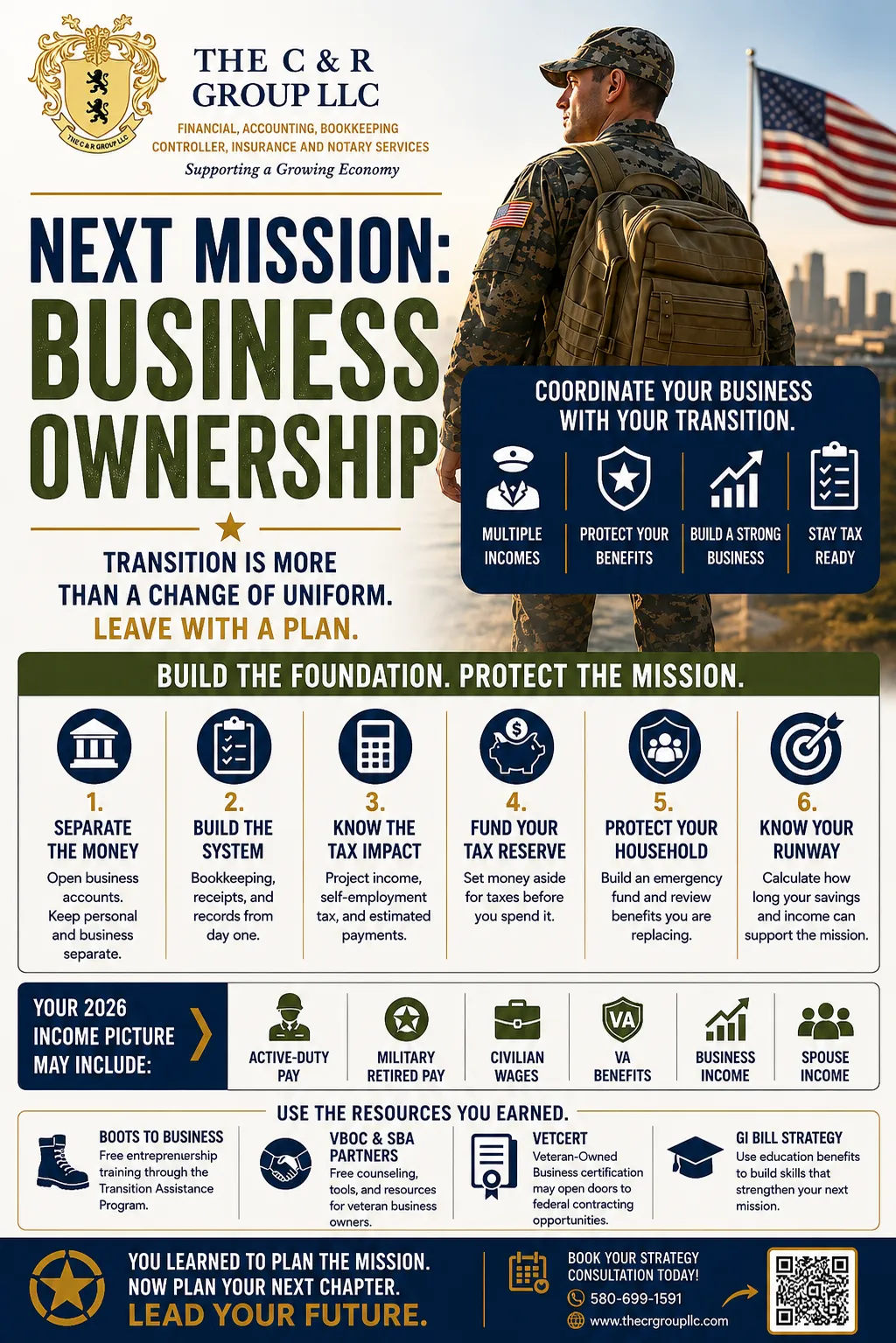
Starting a Business During Your Military Exit
Financial Horizons: Military Transition Tax Summary
Starting a Business During Your Military Exit
By Dr. Jose G. Cardenas | Chief Tax Strategist, The C & R Group, LLC
Military transition creates a natural question:
What comes next?
For some service members, the answer is:
A civilian job.
For others:
School.
Federal employment.
Contracting.
Consulting.
Franchising.
Or:
“I want to build something of my own.”
That can be a powerful next mission.
Military experience often translates well into entrepreneurship.
Service members understand:
Mission planning;
Resource management;
Leadership;
Accountability;
Risk;
Logistics;
Execution.
But starting a business while leaving military service creates a financial challenge that ordinary startup advice often misses.
You are not simply:
starting a company.
You may also be:
Leaving active-duty pay;
Starting military retired pay;
Beginning civilian employment;
Changing state residency;
Replacing benefits;
Using terminal leave;
Receiving VA benefits;
Moving your family;
Using the GI Bill;
Accessing TSP or other retirement assets;
Adjusting withholding;
Creating self-employment income.
Those events can happen within the same tax year.
The result can be one of the most complicated financial years of your career.
Meanwhile, the new business may begin producing income that has no employer withholding taxes from it.
The IRS states that self-employed individuals generally use estimated tax to pay federal income tax, Social Security tax, and Medicare tax because there is no employer automatically withholding those amounts. A taxpayer generally must file when net earnings from self-employment reach $400 or more, subject to the complete filing rules.
The SBA also offers Boots to Business, an entrepreneurship education program delivered through the Department of Defense Transition Assistance Program. It is available to service members—including Guard and Reserve members—and military spouses and covers foundational business ownership topics.
That leads to today's central principle:
Do not build the business separately from the military transition. Build one financial transition plan that includes both.
The Business May Start Before the Uniform Comes Off
Military entrepreneurship does not always begin after retirement.
Many service members begin testing business concepts while they are still serving.
They may:
Consult;
sell products;
provide professional services;
purchase rental property;
teach;
create online content;
perform freelance work;
build a federal contracting company.
This can be a smart way to test demand while active-duty compensation is still supporting the household.
But it creates an important distinction:
“I am still active duty” does not mean business income is automatically outside the tax system.
If the activity produces taxable self-employment income, the business may already have:
Recordkeeping responsibilities;
Tax obligations;
Estimated-payment considerations.
The side business does not wait for your retirement ceremony to become financially real.
1. Review Outside-Employment Rules Before Launching
Before starting a business while still serving, review the rules governing outside employment and conflicts of interest.
Depending on:
Branch;
duty status;
command;
position;
nature of the business,
you may need to consider:
Command approval;
ethics rules;
conflicts of interest;
use of government resources;
relationships with contractors;
prohibited representation;
security requirements.
Do not use:
Government equipment;
Government email;
Duty time;
Government information;
Nonpublic information
to operate the private business.
Your business should begin as a private enterprise.
Not as an extension of your government position.
2. Separate the Business From Your Military Identity
Your military experience can absolutely become part of your brand.
Leadership.
Discipline.
Mission focus.
Service.
Those are valuable.
But your business should not create the impression that:
The military endorses it;
The government sponsors it;
Your command supports the company;
Your official position is being used to generate sales.
A veteran-led business can be powerful.
A government-endorsed appearance can create problems.
Keep the distinction clear.
3. Use Transition Time to Learn Entrepreneurship
Service members approaching separation have access to a resource many civilian startup founders never receive:
structured entrepreneurship training.
The SBA's Boots to Business program is part of TAP and provides an introduction to business ownership. The program includes topics such as:
Business ownership;
opportunity recognition;
market analysis;
startup economics;
legal entities;
business planning;
financing;
SBA resources.
There is also a follow-on Revenue Readiness course for participants who complete the introductory training.
Take advantage of it.
A transition benefit that helps prevent an expensive business mistake has real economic value.
4. Use Veteran Business Outreach Centers
Boots to Business is only the beginning.
The SBA supports veteran entrepreneurship through its network, including:
Veterans Business Outreach Centers;
Small Business Development Centers;
SCORE;
other SBA partners.
These organizations can help with:
Business planning;
market research;
financing;
government contracting;
operational planning.
Do not pay thousands of dollars for generic startup coaching before using the resources already available to you.
Military members have spent years learning to use available resources.
Do the same in business.
5. Build the Business Model Before the Entity
One of the most common transition mistakes is:
“I formed an LLC, so now I have a business.”
Not necessarily.
You have an entity.
The business still needs:
Customer;
problem;
solution;
pricing;
revenue model;
sales process.
Before creating complicated structures, answer:
What do I sell?
________________
Who buys it?
________________
Why do they buy it?
________________
How much will they pay?
________________
What does it cost to deliver?
________________
What profit remains?
________________
The entity should support the business model.
Not substitute for one.
6. Know the Difference Between an LLC and Tax Classification
An LLC is created under state law.
Federal tax treatment is a separate question.
Depending on ownership and elections, an LLC may be treated for federal purposes as:
Disregarded entity;
partnership;
S corporation;
C corporation.
That means:
“I created an LLC”
does not answer:
“How will the business be taxed?”
Understand both.
7. Do Not Automatically Elect S Corporation Status
Veteran entrepreneurs hear the same advice everyone else hears:
“Make it an S corp and save taxes.”
Maybe.
Maybe not.
Before an S corporation election, model:
Expected business profit;
Reasonable compensation;
Payroll taxes;
Payroll administration;
State costs;
Tax preparation;
QBI effects.
If the business produces:
$8,000 of profit,
an elaborate payroll structure may not provide a meaningful economic benefit.
If the business later produces:
$150,000 of stable profit,
the analysis could look very different.
Let the numbers drive the decision.
8. Create Separate Business Banking Immediately
Military finance teaches accountability.
Apply that discipline to business money.
Create appropriate:
Business checking;
Business credit card;
Tax reserve account.
Avoid mixing:
Military pay;
retirement pay;
household expenses;
business revenue;
business expenses.
The IRS states that good business records help identify sources of income, track deductible expenses, prepare tax returns, and support items reported on the return.
Your business bank account should help tell that story.
9. Record Every Transaction
A good recordkeeping system should clearly show business income and expenses.
The IRS notes that supporting records may include:
Sales documents;
invoices;
receipts;
deposit information;
canceled checks;
credit-card records;
asset records.
This matters especially during military transition because household cash may be moving rapidly.
You may receive:
Final active-duty pay;
leave-related payments;
civilian wages;
military retired pay;
VA benefits;
business income.
Your records should clearly identify what each deposit represents.
Otherwise the transition-year tax return becomes unnecessarily complicated.
10. Do Not Treat Every Deposit as Business Revenue
Suppose you transfer:
$20,000
from personal savings into your startup.
That does not automatically mean the business generated:
$20,000 of revenue.
Likewise:
Business loan proceeds;
owner contributions;
transfers between accounts
need proper classification.
Record the source.
A deposit is not automatically a sale.
11. Build a Tax Reserve From the First Dollar
A new entrepreneur receives:
$10,000
from the first major contract.
The temptation is to spend it on:
Equipment;
advertising;
household bills;
debt;
lifestyle upgrades.
Before spending, calculate what portion may need to be reserved for taxes.
Self-employed individuals may have federal:
Income tax;
Social Security tax;
Medicare tax
to address through estimated payments.
The reserve percentage should reflect your total household situation.
Not a random percentage from social media.
12. Military Transition Makes the Tax Projection More Important
Consider a service member retiring during 2026.
The tax return might include:
January–June
Active-duty military wages.
July–December
Military retired pay.
July–December
Civilian wages.
Full year
Spouse wages.
Full year
New business profit.
One household.
Multiple income streams.
Now the tax projection becomes extremely important.
Do not calculate business taxes without reviewing the entire household return.
13. Military Retired Pay and VA Benefits Are Not the Same Thing
Transitioning veterans should distinguish between different military and veterans benefits.
Certain VA benefits—including VA disability compensation and VA education benefits—are generally excluded from gross income for federal income-tax purposes.
Military retirement based on years of service is generally treated differently and is generally taxable pension income, subject to the applicable rules.
This matters because:
Cash entering the household is not automatically taxed the same way.
Your business tax projection needs the correct classification of every major income stream.
14. Do Not Use VA Disability Compensation as Business Revenue
If a veteran receives nontaxable VA disability compensation and transfers some of that personal cash into the company, the business did not suddenly earn revenue.
The transfer may represent:
Owner contribution;
capital contribution;
other owner funding,
depending on structure.
Keep:
business earnings
separate from:
personal funding sources.
Otherwise your books can overstate revenue.
15. Use GI Bill Benefits Strategically
Some transitioning service members choose entrepreneurship immediately.
Others need additional education first.
The Post-9/11 GI Bill can support eligible:
Degree programs;
vocational training;
licensing;
certification;
apprenticeships;
other approved programs.
A veteran might use education benefits for:
MBA;
cybersecurity certification;
project-management credential;
skilled trade;
entrepreneurship-related education.
The correct decision should support the civilian mission.
Do not assume:
“GI Bill equals four-year college.”
It is a broader human-capital asset.
16. Review GI Bill Transfers Before Separation
If the family intends to transfer unused Post-9/11 GI Bill benefits to a spouse or dependent child, the transfer decision deserves attention before the member leaves service.
VA states that DoD controls transfer eligibility and that a transfer request generally must be made while the service member is on active duty or in the Selected Reserve. Up to 36 months of remaining entitlement may be transferred, subject to the applicable requirements.
That decision can affect startup planning.
Why?
Because if transferred education benefits reduce future college costs, more household capital may remain available for:
Emergency reserves;
Business startup;
Retirement.
Education-benefit planning and entrepreneurship can interact.
17. Do Not Empty the TSP to Fund the Startup Without Analysis
This is one of the biggest transition risks.
A service member leaves with:
TSP balance;
retirement assets;
startup idea.
Then decides:
“I’ll use my retirement money to fund the business.”
Stop.
Retirement-plan distributions can create:
Income tax;
Possible early-distribution penalties depending on the facts;
Lost future tax-deferred growth;
Reduced retirement security.
Before touching retirement assets, compare:
Personal savings;
Business loan;
SBA financing;
outside capital;
phased startup;
civilian employment plus business;
other funding.
The TSP should not automatically become the startup checking account.
18. Protect the Emergency Fund
Military transition already contains uncertainty.
New residence.
New career.
New insurance.
New income pattern.
Adding entrepreneurship increases uncertainty.
Maintain household liquidity.
A business owner should not invest every available dollar into:
Equipment;
inventory;
marketing;
office space.
while the family has no emergency reserve.
The mission is:
build the business without destabilizing the household.
19. Determine Your Transition Runway
Calculate:
Household monthly expenses
$________
Military retired pay or other reliable income
$________
Spouse income
$________
Civilian wages
$________
Business income
$________
Monthly business expenses
$________
Tax reserve
$________
Then determine:
How many months can the household operate if business revenue is slower than expected?
That is your runway.
Know it before the startup becomes the primary income source.
20. Do Not Confuse Revenue With Salary Replacement
Suppose active-duty compensation effectively supports:
$120,000 per year
of household economics.
Your business generates:
$120,000 of revenue.
That does not mean the business replaced military compensation.
Business revenue may still have:
Advertising;
software;
payroll;
insurance;
equipment;
taxes;
overhead.
The comparison should be:
Business net economic income
versus
the full value of military compensation and benefits being replaced.
21. Price the Business for Civilian Reality
Military members sometimes underprice consulting because they compare:
Hourly civilian revenue
to
Military base pay.
That comparison is incomplete.
A self-employed business may need to fund:
Both sides of payroll-type taxes;
Health insurance;
Retirement;
unpaid leave;
business insurance;
administration;
technology;
marketing.
A $50 hourly rate may not create anything close to $50 of personal economic income.
Price the service based on the actual business economics.
22. Build a Profit-and-Loss Statement Monthly
During military service, leaders use reports.
Business ownership should not operate on:
“It feels like we’re doing pretty well.”
Review monthly:
Revenue
$________
Cost of goods or direct costs
$________
Operating expenses
$________
Net profit
$________
Then ask:
Is profit increasing?
Which services are profitable?
Is pricing adequate?
Can the business support taxes?
Your P&L is part of the business commander's situation report.
23. Track Startup Costs Separately
Before the business officially begins operations, you may incur costs for:
Market research;
training;
legal setup;
branding;
website development;
planning;
travel.
Those expenses may require different tax treatment from ordinary ongoing operating expenses.
Keep them separately documented.
Do not lump everything into:
“Business expenses.”
Timing and purpose matter.
24. Know When the Business Actually Started
Document the transition from:
planning
to
operating.
Possible evidence:
First customer;
business open for clients;
first invoice;
website accepting business;
first contract.
This date can matter for tax analysis.
Keep it in the business file.
25. Federal Contracting May Be a Natural Veteran Business Path
Many veterans have experience working with:
Federal acquisition;
Government customers;
Logistics;
Program management;
Technical services.
A veteran-owned company may eventually pursue federal contracting.
SBA's Veteran Small Business Certification program provides qualifying veteran-owned businesses access to certain contracting opportunities. Certified VOSBs may pursue certain VA opportunities, while qualifying SDVOSBs may compete for certain set-aside and sole-source opportunities across the federal government.
But certification should follow a real business strategy.
Do not build the company solely around:
“I’m a veteran, so the government will give me contracts.”
Certification creates eligibility.
It does not create customers.
26. Build the Company for Government Contract Readiness
If federal contracting is part of the plan, eventually review:
SAM.gov registration;
UEI;
NAICS codes;
capability statement;
accounting system;
past performance;
pricing;
certifications.
A veteran-owned status can open doors.
The business still needs to perform.
Mission credibility helps.
Operational capability wins contracts.
27. Protect Government Ethics Boundaries During Transition
A transitioning service member may know:
Contractors;
acquisition officials;
military organizations;
future customers.
Those relationships can become valuable in civilian life.
They can also create ethics concerns.
Before:
Representing a business to your former agency;
Marketing to your former organization;
Working with matters you handled while in uniform;
review applicable post-government employment restrictions with appropriate ethics counsel.
Do not assume that separation erases every restriction overnight.
28. Review State Residency Before Forming the Company
Military families often have unusual residency situations.
You may:
Be stationed in one state;
claim legal residence in another;
move to a third state after separation.
The business may therefore face questions about:
Where to form;
Where to register;
State income tax;
Sales tax;
Franchise tax;
Local licensing.
Do not form an LLC in a state merely because:
“Someone said that state has no taxes.”
Form the business based on:
Where you operate;
where you live;
where customers are;
legal requirements;
actual economics.
29. Review the Business Again After the Move
Military transition often includes relocation.
If you form the company before separation and then move, review:
Business address;
State registrations;
Licensing;
Banking;
Insurance;
Payroll;
tax nexus.
Your pre-transition structure may need to change once civilian operations begin.
Do not assume the business automatically moves because you did.
30. Do Not Forget the Spouse
Military spouses can be:
Employees;
co-owners;
administrative support;
business partners;
independent professionals.
If a spouse works in the business, determine the actual relationship.
Do not simply move money between spouses and call it payroll.
Review:
Ownership;
compensation;
payroll;
retirement;
benefits.
The family business should have real roles and real records.
31. Hiring Children Requires Real Work and Real Documentation
Veteran families often look for ways to involve children in the business.
That can be valuable.
But:
“We paid the kids for tax purposes”
is not enough.
The child should perform:
Legitimate work;
appropriate duties;
at reasonable compensation.
Keep:
Job description;
hours;
payroll;
work product.
Tax strategy should follow actual business activity.
Not create fictional employment.
32. Build Insurance Into the Startup Budget
Military members often leave a system where significant risk protection was embedded in employment.
Business ownership changes that.
Review:
General liability;
professional liability;
commercial auto;
workers' compensation;
cyber coverage;
property insurance;
life insurance;
disability-income planning.
The business may also depend heavily on the owner's ability to work.
Protect that economic engine.
33. Replace Military Benefits Deliberately
Before leaving service, create a benefits replacement map.
Military system
Healthcare;
life insurance;
retirement;
leave;
disability protection;
education.
Civilian business system
Determine what replaces each item.
The business may not need to replace everything immediately.
But the household should know what disappeared.
A successful transition does not measure only:
business revenue.
It measures:
household financial resilience.
34. Separate Business Debt From Household Lifestyle Debt
A veteran entrepreneur may use credit to launch.
Distinguish:
Productive business borrowing
Potentially used for:
Equipment;
inventory;
working capital.
from
Personal lifestyle borrowing
Used because the household budget did not adjust after separation.
If household expenses exceed reliable income, the business can become a cash-transfer machine rather than an enterprise.
Protect business capital.
35. Create a Minimum Viable Business Before Scaling
Military planning favors:
Pilot;
test;
evaluate;
refine.
Use the same approach.
Before signing:
Long lease;
large equipment loan;
major payroll commitment,
prove:
Customer demand;
pricing;
gross margin;
repeatability.
Test small.
Then scale.
A successful pilot creates evidence.
Enthusiasm does not.
36. Do Not Hire Too Fast
A new business starts growing.
The owner immediately hires:
Assistant;
salesperson;
operations manager.
Payroll becomes fixed overhead.
Instead ask:
What work directly requires another person?
Then determine:
Employee;
contractor;
software;
outsourced service.
Growth without labor discipline can destroy cash flow.
37. Do Not Stay Solo Too Long Either
The opposite problem exists.
The veteran entrepreneur attempts to do:
Sales;
bookkeeping;
operations;
service delivery;
marketing;
compliance.
Eventually the owner's time becomes the bottleneck.
The question is not:
“Can I do this?”
Military veterans can usually figure out how to do almost anything.
The business question is:
“Should I still be the person doing it?”
Delegate when the economics justify it.
38. Build the Tax Calendar Into the Business Calendar
Military organizations live by calendars.
Use one for taxes.
Track:
Estimated tax dates;
Payroll filings;
Information returns;
State filings;
Entity deadlines;
License renewals.
Tax compliance should not depend on:
“I think something is due this month.”
Create recurring reminders.
39. Review Taxes Quarterly
Every quarter, calculate:
Business revenue
$________
Business expenses
$________
Net profit
$________
Federal withholding
$________
Estimated payments
$________
State payments
$________
Tax reserve
$________
Then combine those figures with the transition-year household income.
This is especially important when:
Active-duty wages end;
Retirement starts;
Civilian wages begin;
Business income changes.
One quarter can look completely different from the next.
40. Do Not Wait Until April for the First Business Review
If the new business begins in:
March,
and the first serious tax review happens the following:
March,
you have lost almost a year of planning opportunities.
Hold:
Monthly accounting reviews;
Quarterly tax reviews;
Annual strategy review.
Tax preparation documents history.
Tax planning shapes what happens before history is locked.
Illustrative Case Study: The Retiring Officer Who Starts Consulting
Assume Colonel James Taylor retires in 2026 after a long military career.
He decides to start:
Taylor Strategic Operations LLC
providing:
Leadership consulting;
Program management;
Organizational training.
He also expects to begin civilian employment.
Household Transition Income
During 2026, assume James receives:
Active-duty wages
January through June.
Military retired pay
Beginning July.
Civilian salary
Beginning September.
Business revenue
Throughout the year.
Spouse wages
Full year.
That is already a complicated household tax return.
The Business Starts Small
First quarter consulting revenue:
$6,000
James thinks:
“This is just a little side work.”
By August:
Revenue:
$35,000.
By December:
Revenue:
$70,000.
The business has become meaningful.
The Bad Version
James:
Deposits consulting income into personal checking;
keeps incomplete receipts;
makes no estimated tax projections;
assumes military withholding will cover everything;
forms an LLC but does not understand tax classification.
Then tax season arrives.
The business is profitable.
The system is weak.
The Better Version
Before terminal leave, James completes:
Boots to Business.
He builds:
Business plan;
pricing model;
startup budget.
He opens:
Business checking;
tax reserve.
He establishes:
Monthly bookkeeping;
Receipt capture;
Tax calendar.
Every quarter, he combines:
Military wages;
civilian wages;
retirement pay;
business profit;
spouse income.
Then adjusts:
Estimated payments;
withholding.
Now the business and transition plan operate together.
That is the objective.
Transition-Year Business Tax Checklist
BEFORE SEPARATION
Review outside-employment and ethics rules.
Complete Boots to Business where appropriate.
Meet with VBOC/SBA resources.
Define business model.
Build startup budget.
Review state of formation.
Review transition residency.
BUSINESS SETUP
Entity selected deliberately.
EIN obtained where appropriate.
Business banking opened.
Bookkeeping system established.
Insurance reviewed.
Contracts reviewed.
Licensing reviewed.
TAX
Business income tracked.
Expenses documented.
Startup costs separated.
Tax reserve funded.
Self-employment tax projected.
Estimated taxes reviewed.
State taxes reviewed.
Sales tax reviewed.
TRANSITION INCOME
Active-duty wages.
Military retired pay.
Civilian wages.
Spouse income.
Business profit.
VA benefits properly classified.
Education benefits properly classified.
BENEFITS
Healthcare plan.
Life insurance.
Retirement plan.
Emergency fund.
Disability-income protection.
GI Bill strategy.
TSP strategy.
PEOPLE
Contractor classification.
W-9s.
Employee payroll.
Spouse role.
Child employment documentation where applicable.
GROWTH
Federal contracting reviewed.
Veteran certification reviewed.
SAM.gov strategy reviewed.
Financing needs reviewed.
Exit from civilian employment modeled.
The Military Entrepreneur Tax Dashboard
HOUSEHOLD INCOME
Active-duty wages:
$________
Military retired pay:
$________
Civilian wages:
$________
Spouse income:
$________
Business profit:
$________
Other taxable income:
$________
BUSINESS
Revenue:
$________
Expenses:
$________
Net profit:
$________
TAX
Federal withholding:
$________
Estimated federal payments:
$________
State payments:
$________
Tax reserve:
$________
BENEFITS
Healthcare:
________________
Retirement plan:
________________
GI Bill:
________________
TSP:
________________
BUSINESS STATUS
Books current.
Receipts current.
Tax reserve current.
Estimated payments reviewed.
State compliance current.
Insurance current.
AI-Search Quick Answers
Can a service member start a business before leaving active duty?
Potentially, but service members should review applicable military ethics, outside-employment, command, conflict-of-interest, and security rules before operating a private business while serving.
What is Boots to Business?
Boots to Business is an SBA entrepreneurship education and training program delivered as part of the Department of Defense Transition Assistance Program. It is available to service members—including Guard and Reserve members—and military spouses.
What resources are available to veteran entrepreneurs?
SBA supports veterans through programs including Boots to Business, Veterans Business Outreach Centers, Small Business Development Centers, SCORE, and other partner resources.
Is business income taxable if I am still on active duty?
Yes. Taxable self-employment or gig income remains subject to the applicable tax rules even if it is earned while the taxpayer is also receiving military wages. The IRS states that net self-employment earnings of $400 or more generally trigger a filing requirement for self-employment tax.
How do self-employed taxpayers pay taxes during the year?
Self-employed taxpayers generally use estimated taxes to pay federal income tax, Social Security tax, and Medicare tax when those amounts are not withheld by an employer. Form 1040-ES is used to calculate estimated payments.
Are VA disability benefits taxable?
VA disability benefits are generally excluded from federal gross income.
Are VA education benefits taxable?
VA education benefits are generally excluded from federal taxable income.
Is military retired pay taxable?
Military retirement based on years of service is generally taxable as pension income, although special rules can apply to certain military disability benefits.
Can I transfer Post-9/11 GI Bill benefits after leaving military service?
The initial transfer generally must be requested while the member is still on active duty or in the Selected Reserve and meets DoD requirements.
What is VetCert?
SBA's Veteran Small Business Certification program certifies eligible VOSBs and SDVOSBs for certain federal contracting opportunities.
Does veteran-owned status guarantee federal contracts?
No. Certification can make a business eligible for certain set-aside or sole-source opportunities, but the company still must compete, meet procurement requirements, price effectively, and perform.
30 Questions to Answer Before Starting the Business During Transition
What business am I actually starting?
Who is the customer?
What problem do I solve?
What will customers pay?
What does it cost to deliver?
What profit should remain?
Can I legally operate this business while still serving?
Do I need command or ethics review?
Am I using any government resources?
Have I completed Boots to Business?
Have I used VBOC or other SBA counseling?
What entity should I use?
How will the entity be taxed?
Where should the company be formed?
Where will I live after separation?
Do I have business banking?
Is bookkeeping established?
What startup costs have I incurred?
How much tax should I reserve?
Do I need estimated payments?
What other taxable household income will I have?
Which VA benefits are nontaxable?
What will replace my military healthcare and other benefits?
How much household emergency cash do I have?
How much business runway do I have?
Am I considering using TSP money?
Does the GI Bill belong in my civilian career strategy?
Is federal contracting part of the business plan?
What business profit must I achieve before relying on the company full time?
If the business produces twice as much revenue as expected during my transition year, can my current tax, accounting, cash-flow, and compliance systems handle it?
That final question is the readiness test.
What to Do Next
Create a Military-to-Business Transition Map.
Use five sections.
1. MISSION
Business:
________________
Customer:
________________
Revenue target:
$________
Profit target:
$________
2. MILITARY TRANSITION
Separation or retirement date:
________
Terminal leave:
________
Move date:
________
Civilian employment start:
________
3. HOUSEHOLD FINANCES
Emergency reserve:
$________
Reliable monthly income after separation:
$________
Household monthly expenses:
$________
Business runway:
________ months
4. TAX
Projected business profit:
$________
Federal withholding:
$________
Estimated payments:
$________
Tax reserve:
$________
5. BUSINESS SYSTEM
Banking.
Bookkeeping.
Receipts.
Tax calendar.
Insurance.
Contracts.
Entity.
Payroll/contractor system.
Quarterly tax projection.
Update it every month during the transition year.
The goal is simple:
One mission plan for the household and the business.
Final Thought
Military transition is already a major life event.
Starting a business during that transition can multiply both:
opportunity
and
risk.
The opportunity is real.
You can use:
Leadership.
Experience.
Professional expertise.
Military networks.
Veteran resources.
Federal contracting opportunities.
To build something that creates:
Income;
freedom;
wealth;
legacy.
But entrepreneurship does not remove the need for financial discipline.
It increases it.
So before the uniform comes off:
Learn.
Plan.
Build the records.
Separate the money.
Protect the household.
Know the taxes.
Preserve the benefits.
Build the runway.
Then launch deliberately.
A military career teaches us not to begin a mission without understanding:
resources,
risks,
timelines,
and
objectives.
Your business deserves the same discipline.
The DD-214 should not mark the day the planning stops.
It should mark the day the next plan begins.
Leave military service with more than a business idea.
Leave with:
A mission.
A financial plan.
A tax process.
And a business system capable of supporting the next chapter.
Book Your Strategy Consultation
If you are transitioning from military service and starting or expanding a business, schedule a strategy consultation to coordinate the business with your broader financial transition.
We can review:
Self-employment income;
Military transition taxes;
Estimated payments;
Business structure;
Bookkeeping;
Startup costs;
Business deductions;
Retirement strategy;
GI Bill coordination;
TSP considerations;
Federal contracting readiness;
Veteran business planning.
Booking link:
https://api.leadconnectorhq.com/widget/booking/T4UHUjCijCtIB3rwoTDI
Phone: 580-699-1591
Booking your appointment now:

ABOUT THE AUTHOR
Dr. Jose G. Cardenas is a retired U.S. Army Finance Officer and the Chief Tax Strategist at The C & R Group, LLC. With a Doctorate in Business Administration and over 20 years of experience in tax planning and financial strategy, Dr. Cardenas helps individuals and business owners legally reduce taxes, strengthen cash flow, and build lasting wealth and legacy. Learn more at www.thecrgroupllc.com
DISCLOSURE
This article is for educational and informational purposes only and is not intended to serve as personalized legal, tax, or investment advice. Tax laws and regulations change over time and may vary by jurisdiction. You should consult with a qualified tax professional regarding your specific circumstances before implementing any strategy discussed here. Dr. Jose G. Cardenas, DBA, provides tax advisory services through The C & R Group, LLC. Insurance and investment strategies may be offered through his role as a licensed financial professional affiliated with Experior Financial Group.