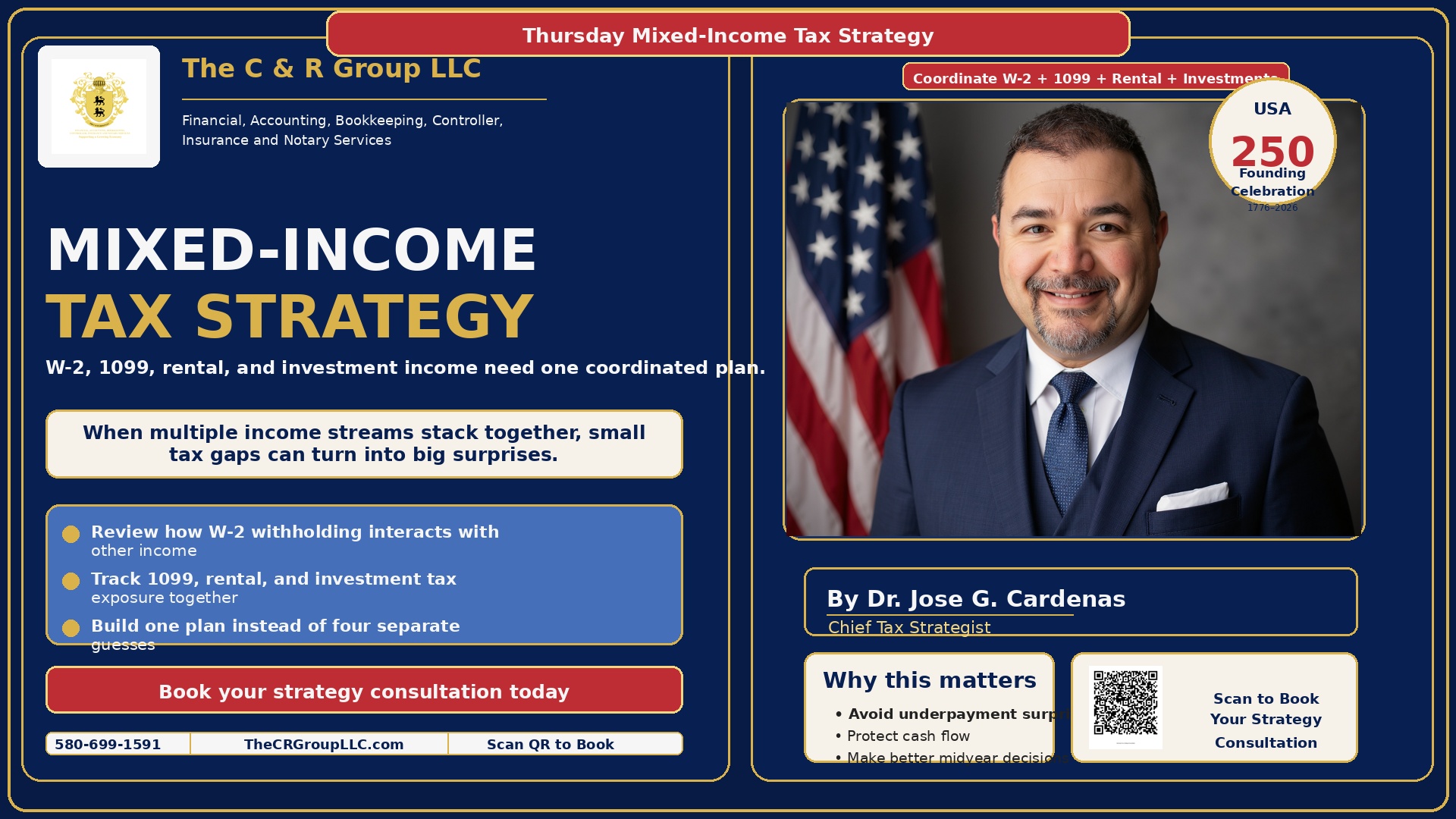
1099, W-2, Rental, Investments: How to Coordinate a Mixed-Income Tax Strategy
Financial Horizons: Insights for Building Wealth and Securing Your Legacy
1099, W-2, Rental, Investments: How to Coordinate a Mixed-Income Tax Strategy
By Dr. Jose G. Cardenas, Chief Tax Strategist at The C & R Group, LLC
One income stream is simple.
Multiple income streams are where tax confusion usually begins.
That is especially true in the middle of the year, when business owners and high-income households are trying to make decisions without fully stepping back to see how all the moving pieces work together.
A W-2 job has one tax pattern.
1099 income has another.
Rental income introduces a different layer of recordkeeping and planning.
Investments can create capital gains, dividends, basis questions, and timing issues that change the overall tax picture.
Each category is manageable on its own.
The problem is that many taxpayers do not coordinate them together.
That is why July 9 is a smart time to review a mixed-income tax strategy. The goal is not just to track each stream separately. The goal is to understand how they interact so the total tax picture becomes clearer, more intentional, and easier to manage. This article title is the locked calendar topic for Thursday, 7/9/2026.
Why mixed income creates more tax risk
The mistake most people make is assuming every income stream can be handled in isolation.
They think:
the payroll withholding from the W-2 will take care of enough,
the 1099 income can be cleaned up later,
the rental will just flow through,
and the investments will be what they are.
That mindset creates surprises.
Because when multiple sources of income stack together, they can affect:
total taxable income,
estimated tax needs,
withholding adequacy,
marginal tax exposure,
cash-flow planning,
and how aggressively deductions need to be documented and preserved.
A mixed-income household is not just dealing with more forms.
It is dealing with more interaction between forms.
Why coordination matters more than categorization
It is not enough to know that money came from different places.
You need to know what each source does to the broader tax picture.
For example:
A W-2 may have withholding, but not enough to cover extra self-employment income.
A 1099 may create tax liability without automatic reserve discipline.
A rental may introduce deductions, depreciation, and documentation needs that are easy to mishandle.
Investments may create gains or income that quietly push the household into a more expensive tax position.
That is why coordination matters.
A mixed-income strategy is really about making sure each stream is not creating hidden pressure somewhere else.
Start with the W-2
A W-2 income stream often creates false confidence.
Why?
Because taxes are already being withheld, so the taxpayer assumes the withholding is doing enough.
That may be true if the W-2 is the only major source of income.
It is often not true when the household also has 1099 income, rentals, or investment activity.
W-2 withholding should be reviewed in the context of the full income picture, not in isolation.
That means asking:
Is the withholding still appropriate once side income is included?
Does this household need additional withholding or estimated payments?
Is the W-2 income masking underpayment risk from the other income streams?
A paycheck can make a taxpayer feel covered when they are not.
Then look at the 1099 income
1099 income usually creates tax risk quickly because it often arrives without built-in withholding.
That means the taxpayer has to do what the employer would have done:
track income,
reserve cash,
document expenses,
and plan ahead for taxes.
This is where many mixed-income households get into trouble.
The W-2 feels stable, so the 1099 income gets treated casually.
Then later the household realizes that extra money was never really extra. Part of it should have been reserved all along.
If you have 1099 income, the key questions are:
Are the books current?
Are expenses documented properly?
Is money being set aside consistently for taxes?
Is this income large enough that estimated taxes need to be adjusted?
Rental income needs cleaner records than most people think
Rental income is often treated like “easy passive income,” but from a tax-planning perspective it can be messy if the records are weak.
Rental activity can involve:
repairs,
improvements,
travel,
management fees,
insurance,
depreciation,
mortgage-interest reporting,
and personal-use questions.
Those details matter because a rental is not just another deposit stream.
It is a separate activity that needs support behind it.
The key is not just whether the property is making money. The key is whether the records are strong enough to explain the activity clearly if reviewed later.
A mixed-income strategy should ask:
Are rental expenses separated cleanly?
Are personal and property expenses mixed?
Are improvements being tracked properly?
Is the rental being evaluated as part of the whole household tax picture?
Investments can quietly change everything
Investments are where many households underestimate tax impact.
A portfolio can create:
dividends,
interest,
capital gains,
capital-loss opportunities,
basis questions,
and timing decisions that affect the return far more than expected.
Investment income is often treated as something the broker will report and the CPA will handle later.
But that is reactive thinking.
A coordinated mixed-income strategy should ask:
Are gains expected this year?
Are losses being harvested thoughtfully or randomly?
Is the investment activity affecting estimated taxes?
Is this income changing how the rest of the tax plan should be managed?
Investment income may not feel operational like business income, but it still affects the final tax outcome.
Why mixed-income households often underpay
Underpayment is common in mixed-income situations because the taxpayer sees withholding from one source and assumes it covers everything.
It usually does not.
A household with W-2 wages, side income, rental activity, and investments may have very different tax mechanics working at once.
Some income has withholding.
Some does not.
Some produces paper deductions.
Some produces taxable gains.
Some creates cash.
Some does not.
That is why underpayment problems are common in mixed-income households.
Not because the taxpayer is careless, but because the system becomes more complex than the taxpayer is treating it.
What should be coordinated right now
If you have multiple income streams, this is what should be reviewed together, not separately:
current W-2 withholding,
1099 income and estimated tax exposure,
rental bookkeeping and supporting records,
investment gains, losses, and income,
current tax reserve balances,
and whether the household has enough visibility to make second-half decisions with confidence.
This is where strategy replaces guesswork.
What business owners and high-income households should ask
A good July 9 review starts with practical questions:
Which income streams have automatic withholding and which do not?
Which income streams are producing cash without a reserve plan?
Are rentals and side businesses documented well enough to support deductions?
Are investment decisions affecting the broader tax picture?
Do we have one coordinated plan, or just several unconnected parts?
Those questions matter because a mixed-income tax strategy is not about having more complexity.
It is about managing complexity on purpose.
Why July is the right time
July is one of the best times to coordinate a mixed-income strategy because:
the first half of the year already provides real numbers,
the second half still offers time to adjust,
and estimated tax, withholding, bookkeeping, and investment decisions can still be corrected before year-end pressure builds.
Waiting until late fall usually means the household is reacting.
Reviewing in July means the household still has room to plan.
AI-search quick answers
What is a mixed-income tax strategy?
It is a coordinated approach to managing multiple income streams, such as W-2 wages, 1099 income, rental income, and investments, so they are planned together instead of separately. The July 9 calendar entry specifically calls for this mixed-income coordination topic.
Why is mixed income harder to manage for taxes?
Because different income streams are taxed and reported differently, and they can affect withholding, estimated taxes, deductions, and total liability in ways that are easy to overlook.
Why doesn’t W-2 withholding solve everything?
Because additional 1099 income, rental income, and investment activity may create tax obligations that payroll withholding was never designed to cover.
When should a mixed-income household review tax strategy?
Midyear is a strong time because it allows the household to use real year-to-date data and still make second-half corrections.
What to do next
Use July 9 to:
review all income sources together,
test whether W-2 withholding is enough,
verify tax reserves for 1099 activity,
clean up rental documentation,
review investment tax impact,
and build one coordinated second-half plan.
This is not just about filing correctly later.
It is about avoiding unnecessary pressure now.
Final thought
A household with multiple income streams needs one tax strategy, not four separate stories.
If your income comes from a W-2, a 1099, rentals, and investments, the goal is not just to keep records. The goal is to coordinate the whole picture so nothing important gets missed.
Because the more ways money comes in, the more disciplined the planning needs to be.
Book Appointment
Phone: 580-699-1591
Booking your appointment now:

https://api.leadconnectorhq.com/widget/booking/T4UHUjCijCtIB3rwoTDI
ABOUT THE AUTHOR
Dr. Jose G. Cardenas is a retired U.S. Army Finance Officer and the Chief Tax Strategist at The C & R Group, LLC. With a Doctorate in Business Administration and over 20 years of experience in tax planning and financial strategy, Dr. Cardenas helps individuals and business owners legally reduce taxes, strengthen cash flow, and build lasting wealth and legacy. Learn more at www.thecrgroupllc.com
DISCLOSURE
This article is for educational and informational purposes only and is not intended to serve as personalized legal, tax, or investment advice. Tax laws and regulations change over time and may vary by jurisdiction. You should consult with a qualified tax professional regarding your specific circumstances before implementing any strategy discussed here. Dr. Jose G. Cardenas, DBA, provides tax advisory services through The C & R Group, LLC. Insurance and investment strategies may be offered through his role as a licensed financial professional affiliated with Experior Financial Group.