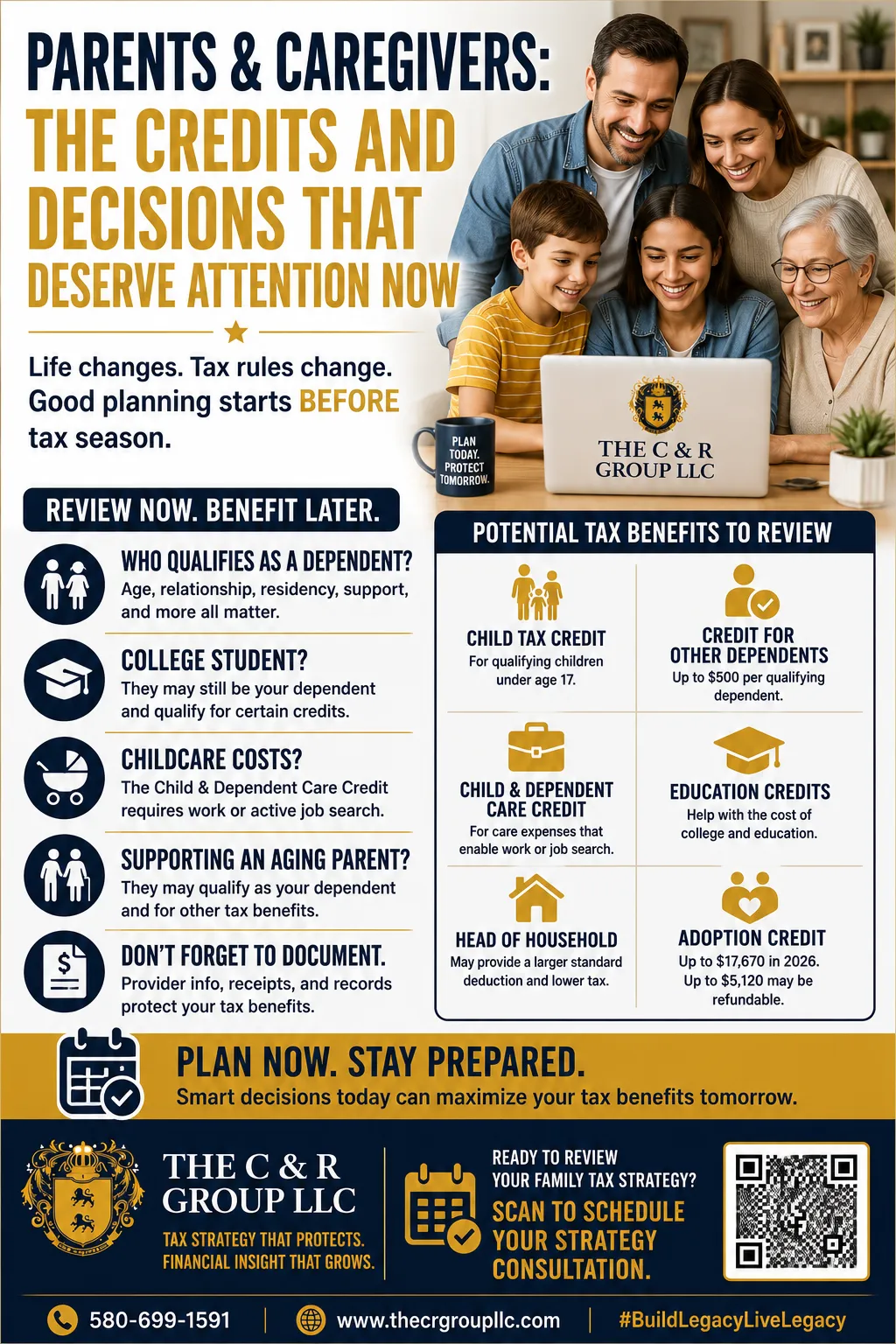
Parents and Caregivers: The Credits and Decisions That Deserve Attention Now
Financial Horizons: Insights for Building Wealth and Securing Your Legacy
Parents and Caregivers: The Credits and Decisions That Deserve Attention Now
By Dr. Jose G. Cardenas, Chief Tax Strategist at The C & R Group, LLC
Parents and caregivers make financial decisions every day that eventually show up on a tax return.
Who pays for childcare?
Who claims the child?
Who pays college expenses?
Does an older child still qualify as a dependent?
Can a parent be claimed?
Does summer day camp count as childcare?
What happens when a child turns 17?
What if a college student earns their own money?
What if an aging parent moves into the household?
What if divorced parents both believe they are entitled to the same tax benefit?
These are not merely filing-season questions.
They are planning questions.
And waiting until February or March to answer them can mean the family has already made financial decisions that cannot easily be changed.
The federal tax system contains several provisions potentially affecting families, including the Child Tax Credit, Credit for Other Dependents, Child and Dependent Care Credit, Earned Income Tax Credit, education credits, adoption credit, Head of Household filing status, and other dependent-related provisions. Eligibility varies significantly based on age, relationship, residency, support, income, filing status, identification requirements, and who actually claims the dependent.
The central principle is:
Do not wait until tax season to determine who your dependents are, what credits may apply, and which records you should have been keeping all year.
Families Should Plan Around People—Not Just Expenses
Most taxpayers naturally focus on expenses.
Childcare costs $12,000.
College costs $25,000.
Summer camp costs $3,000.
An aging parent's care costs $8,000.
But many family tax benefits begin with a different question:
Who is the qualifying person?
The IRS applies specific dependency tests and credit-specific requirements. A person can qualify for one tax benefit and fail to qualify for another. A child who has aged out of the Child Tax Credit may still qualify as a dependent and potentially generate the Credit for Other Dependents. Likewise, someone may qualify as a dependent without necessarily satisfying the rules for the Child and Dependent Care Credit.
That means family tax planning should proceed in this order:
Step 1
Identify the person.
Step 2
Determine dependency status.
Step 3
Determine which credits or deductions may apply.
Step 4
Document the facts.
Step 5
Coordinate spending decisions with the expected tax result.
That is much stronger than handing the tax preparer a stack of daycare receipts and hoping for the best.
1. Start With the Dependency Rules
A dependent generally falls into one of two broad categories:
Qualifying child
Qualifying relative
The applicable tests examine factors such as relationship, age, residency, support, filing status, and whether another taxpayer can claim the person. IRS Publication 501 provides the federal framework used to determine dependency and related filing issues.
Ask now:
Who lives in the household?
How old will each child be on December 31?
Is anyone a full-time student?
Who provides financial support?
Is an elderly parent living with the family?
Is another taxpayer also providing support?
Are parents divorced or separated?
Could two people attempt to claim the same dependent?
These facts should be established before tax season.
2. A Child Turning 17 Can Change the Credit Picture
The Child Tax Credit generally applies to qualifying children who are under age 17 at the end of the tax year, assuming the other eligibility requirements are met. The child must also satisfy relationship, residency, support, citizenship or residency, and identification rules.
That means a family's tax picture can change simply because:
The child had a birthday.
A taxpayer should therefore review children's ages before year-end rather than assuming the same child-related credit will continue indefinitely.
The family may still have other dependent-related tax benefits available.
But the classification may change.
3. The Credit for Other Dependents Should Not Be Overlooked
A dependent who does not qualify for the Child Tax Credit may still potentially qualify the taxpayer for the Credit for Other Dependents.
Current IRS guidance identifies the maximum Credit for Other Dependents as:
$500 per qualifying dependent.
The credit is nonrefundable and begins to phase down when adjusted gross income exceeds $200,000, or $400,000 for taxpayers filing jointly.
Potential qualifying dependents may include:
Older children;
College-age dependents;
Certain qualifying relatives;
Parents;
Other dependents satisfying the applicable requirements.
This is especially important for families supporting children beyond age 16.
The child may age out of one credit without disappearing from the tax return entirely.
4. College Students Can Still Be Dependents
One of the most persistent family tax misconceptions is:
“My child turned 18, so they are no longer my dependent.”
Age 18 does not automatically end dependency.
Federal qualifying-child rules can continue to apply to a full-time student who has not reached age 24 by the end of the year, provided the remaining relationship, residency, support, and other requirements are satisfied.
That creates planning implications for:
Education credits;
Credit for Other Dependents;
Health insurance;
Filing status;
Student tax returns;
Parent tax returns.
The student may file their own return and still potentially remain a parent's dependent.
Those concepts are not mutually exclusive.
5. Your Child Filing a Tax Return Does Not Automatically End Dependency
A teenager or college student may have:
Summer wages;
Part-time employment;
Internship income;
Investment income;
Scholarship income.
They may need or want to file their own federal return.
That alone does not determine whether the parent can claim the child.
Dependency depends on the statutory tests—not simply whether the child filed Form 1040. IRS dependency guidance separately addresses dependent status and filing requirements.
This is why the parent and student returns should be coordinated.
Two returns prepared independently can easily produce inconsistent answers.
6. Social Security Numbers Matter
For Child Tax Credit eligibility, current IRS rules generally require the qualifying child to have a Social Security number valid for employment and issued by the applicable return deadline. IRS guidance also requires a valid SSN for the taxpayer or qualifying spouse under the current CTC framework.
The Credit for Other Dependents has somewhat broader identification rules. IRS guidance indicates an eligible dependent may have an SSN, ITIN, or ATIN, subject to the complete requirements.
Families dealing with:
Recent adoptions;
Immigration status changes;
Newly issued Social Security numbers;
Adoption taxpayer identification numbers
should review identification requirements well before filing.
7. Childcare Is Not Automatically a Childcare Tax Credit
Parents often assume:
“We paid daycare, so we get the credit.”
The Child and Dependent Care Credit is more specific.
IRS guidance states that eligible taxpayers may potentially claim the credit when they pay qualifying care expenses for an eligible person so that the taxpayer—and spouse when applicable—can work or actively look for work. Generally, both spouses on a joint return must have earned income, subject to special rules.
That means the reason for the care matters.
The same payment may produce different treatment depending on why the expense was incurred.
8. The Care Must Generally Enable Work or Job Search
Suppose parents pay for childcare because:
Situation A
Both parents are working.
Potentially relevant to the Child and Dependent Care Credit.
Situation B
One parent attends a recreational event while the child is cared for.
Very different analysis.
Situation C
A parent is actively looking for work.
Potentially relevant under the credit rules.
The IRS specifically connects qualifying care expenses to allowing the taxpayer and spouse, where applicable, to work or actively look for work.
The family's receipt alone does not prove the tax treatment.
The purpose of the expense matters too.
9. Who Is a Qualifying Person for the Care Credit?
The Child and Dependent Care Credit is not limited exclusively to young children.
IRS guidance generally allows the credit to apply to qualifying expenses for:
A dependent child under age 13; or
A spouse or other dependent who is physically or mentally incapable of self-care,
provided the other requirements are satisfied.
That means the credit can be relevant to both:
parents of young children
and
caregivers supporting qualifying disabled family members.
The label “childcare credit” can therefore be misleading.
It is a child and dependent care credit.
10. Caregiving for an Adult Dependent Deserves Attention
More families are simultaneously helping:
Children;
College students;
Aging parents;
Disabled family members.
A taxpayer supporting an adult relative should determine whether that person may qualify as a dependent and whether paid care expenses might satisfy the separate Child and Dependent Care Credit rules.
The IRS also provides special earned-income rules in certain circumstances involving taxpayers or spouses who are incapable of self-care.
Caregiver planning should therefore involve both:
Dependency analysis
and
Care-expense analysis.
Do not assume one automatically produces the other.
11. Day Camp Can Be Different From Overnight Camp
Summer creates one of the most common dependent-care questions.
IRS guidance recognizes that certain day-camp costs may potentially qualify as care expenses when the requirements are met and the care allows the taxpayer to work or look for work.
But not every summer expense is automatically eligible.
Families should separate:
Day camp;
Overnight camp;
Sports instruction;
Tutoring;
Educational programs;
Recreational programs.
The tax result depends on the nature and purpose of the expense.
A camp invoice is not enough by itself.
12. Education Is Generally Not the Same as Care
IRS guidance specifically states that care expenses do not generally include amounts paid for education, entertainment, food, lodging, or clothing, although some costs may qualify when they are incidental to and inseparable from qualifying care.
That distinction can matter for:
Preschool;
Private school;
Tutoring;
After-school care;
Summer programs.
Families should ask the provider for sufficiently detailed records when an invoice combines multiple services.
“School payment” does not tell the tax preparer enough.
13. Identify the Care Provider
The Child and Dependent Care Credit generally requires taxpayers to identify the care provider on their tax return.
Form 2441 is used to report child and dependent care expenses, and the IRS may require identifying information about the provider.
Families should therefore collect:
Provider legal name;
Address;
Taxpayer identification number;
Amount paid;
Dates of care.
Do this when hiring the provider.
Do not begin searching for someone's Social Security number eleven months later.
14. Use Form W-10 When Appropriate
The IRS provides Form W-10, Dependent Care Provider's Identification and Certification, as a means of obtaining identifying information needed from a care provider. Form 2441 instructions and IRS resources point taxpayers to Form W-10 for provider information.
This is especially valuable for:
Babysitters;
Small childcare providers;
Independent caregivers.
A taxpayer may remember exactly how much they paid.
That does not help if required provider information is missing when the return is prepared.
15. Paying a Relative for Care Can Become Complicated
Families sometimes pay:
Grandparents;
Older children;
Siblings;
Other relatives
to provide care.
That can be legitimate.
But the tax treatment depends on:
Who provided the care;
The relationship;
Whether the provider is the taxpayer's dependent;
Whether the provider is the taxpayer's child and what age they are;
Whether household-employment tax rules apply.
This is where family convenience can collide with payroll and tax rules.
Before paying a family member for substantial recurring care, review the structure.
16. Employer Dependent-Care Benefits Must Be Coordinated
Some employers allow workers to exclude qualifying dependent-care assistance from taxable wages through an employer plan.
The IRS notes that taxpayers receiving dependent-care benefits must coordinate those benefits with Form 2441 and the Child and Dependent Care Credit calculation.
That means:
You cannot simply spend the same dollar twice for two tax benefits.
Families should track:
Employer dependent-care benefits;
Out-of-pocket childcare;
Total qualifying expenses.
The tax return must reconcile them.
17. Child Tax Credit and Care Credit Are Different Benefits
A family may potentially qualify for more than one child-related credit because each provision has its own purpose.
The Child Tax Credit generally focuses on having a qualifying child.
The Child and Dependent Care Credit focuses on qualifying care expenses that enable work or job search.
The Credit for Other Dependents applies to certain dependents who do not qualify for the Child Tax Credit.
Do not assume these benefits are interchangeable.
The correct tax planning approach is to review the entire household.
18. The Earned Income Tax Credit May Also Matter
For qualifying lower- and moderate-income working households, the Earned Income Tax Credit can materially affect the federal tax result.
For 2026, IRS published maximum EITC amounts include:
$649 with no qualifying children
$4,328 with one qualifying child
$7,152 with two qualifying children
$8,046 with three or more qualifying children
Actual eligibility and credit amounts depend on earned income, adjusted gross income, investment income, filing status, and qualifying-child rules.
For families near eligibility thresholds, year-end income changes can matter.
19. Do Not Chase a Credit by Artificially Reducing Income
Tax credits can be valuable.
But families should not make bad economic decisions merely to qualify for one.
For example:
“If I work fewer hours, maybe I'll get a larger credit.”
That may reduce more income than the additional tax benefit produces.
The correct calculation compares:
Total household income after taxes
—not—
size of the refund.
A larger refund is not automatically greater wealth.
Tax strategy should improve economics.
Not just tax-form optics.
20. Head of Household Status Deserves Early Review
Head of Household filing status can provide a larger standard deduction and different tax brackets than Single status when the applicable requirements are satisfied.
For 2026, the federal standard deduction is:
$16,100 for Single or Married Filing Separately
$24,150 for Head of Household
$32,200 for Married Filing Jointly
according to current IRS inflation-adjustment guidance.
But taxpayers do not qualify for Head of Household status merely because:
They are unmarried; or
They have a child.
Specific household, marital-status, and qualifying-person requirements apply.
21. Divorced Parents Should Not Wait Until Filing Season
When parents live apart, tax benefits involving children can become contentious.
One parent may believe:
“I pay child support, so I claim the child.”
The other may say:
“The child lives with me, so I claim everything.”
Federal rules—not personal assumptions—determine the tax treatment.
Different benefits may also follow different rules.
Parents should establish early:
Where the child resides;
Who provides support;
Who may claim dependency;
Whether Form 8332 applies;
Who may claim education credits;
Who may qualify for Head of Household;
Who claims childcare-related benefits.
Do not let two tax returns discover the conflict electronically.
22. Support Records Matter
Dependency often requires determining who provides support.
That can be surprisingly difficult when support includes:
Housing;
Food;
Clothing;
Medical expenses;
Education;
Transportation;
Insurance;
Recreation.
Families supporting older children or parents should maintain enough records to estimate total support and each person's contribution.
Do not attempt to reconstruct twelve months of household support from memory in April.
23. Supporting an Aging Parent Can Create Multiple Planning Questions
An adult child may pay for:
Housing;
Groceries;
Medical expenses;
In-home care;
Transportation
for an aging parent.
The family should ask:
Can the parent qualify as a dependent?
Does the Credit for Other Dependents apply?
Are any medical expenses potentially deductible?
Could dependent-care expenses qualify?
Is another sibling also providing support?
The Credit for Other Dependents may apply to certain qualifying relatives, subject to dependency and identification requirements.
Caregiving should therefore be integrated into the family tax plan rather than treated solely as an out-of-pocket expense.
24. Multiple Siblings Supporting a Parent Need Coordination
Suppose three adult siblings collectively support their mother.
One pays rent.
One pays medical expenses.
One buys groceries.
Everyone contributes.
Now ask:
Who claims the parent?
The answer is not necessarily:
“Who paid the most bills this month?”
Dependency rules can involve support tests and, in some cases, multiple-support considerations.
The family should establish an annual system for recording who pays what.
One shared spreadsheet can prevent a lot of sibling diplomacy later.
25. Adoption Has Its Own Tax Planning Opportunity
Families completing an adoption should review the federal Adoption Credit separately from general dependent credits.
For 2026, IRS Publication 505 states that the maximum adoption credit and exclusion for employer-provided adoption benefits increased to:
$17,670.
The IRS also states that up to:
$5,120
of the 2026 adoption credit is refundable, subject to the applicable rules, income limitations, and eligible expenses.
Adoption-related records should therefore be preserved carefully.
26. Adoption Documentation Should Begin Immediately
Potential adoption expenses can span multiple years and may involve:
Agency fees;
Attorney fees;
Court costs;
Travel;
Other qualifying expenses.
The year in which the credit becomes available can depend on whether the adoption is:
Domestic;
Foreign;
Finalized;
Not yet finalized.
Families should maintain a dedicated adoption folder from the first expense onward.
This is not a category to reconstruct from bank statements years later.
27. Health Coverage and Dependents Are Connected Too
Changes in dependent status can also intersect with health insurance and, for Marketplace coverage, Premium Tax Credit calculations.
IRS guidance identifies changes in household composition—including births, adoption, marriage, divorce, and changes in dependents—as events that can affect Premium Tax Credit calculations and should be reported appropriately.
Families using Marketplace insurance should therefore coordinate:
tax dependency
with
health-insurance household information.
Different systems using inconsistent household information can create repayment surprises.
28. Birth or Adoption Should Trigger a Tax Review
When a family welcomes a child, update more than the nursery.
Review:
Form W-4 withholding;
Child Tax Credit eligibility;
Dependent-care expenses;
Health insurance;
Flexible spending accounts;
Life insurance;
Beneficiary designations;
Estate documents;
Education savings.
A new dependent changes both the tax return and the long-term financial plan.
The first tax decision should not occur the following April.
29. Adjust Payroll Withholding When the Household Changes
The IRS Tax Withholding Estimator reflects current tax-law changes and can be used to estimate withholding needs for the year.
A household should consider reviewing withholding after:
Birth;
Adoption;
Divorce;
Marriage;
Major income change;
New job;
Loss of childcare expenses;
Child aging out of a credit.
Otherwise, the family can continue withholding taxes based on last year's household while living in a very different one.
30. A Bigger Refund Is Not the Goal
Many parents say:
“I want the biggest refund possible.”
A refund may feel good.
But it often means the household paid more during the year than was ultimately required.
The better objective is:
Accurate withholding combined with strong tax planning.
A family could use excess withholding throughout the year for:
Emergency savings;
Debt reduction;
529 contributions;
Retirement;
Insurance;
Other priorities.
Tax planning should improve family cash flow—not merely create a springtime check.
31. Documentation Should Follow the Person
Create a separate dependent file for every child or supported family member.
Child
Store:
Social Security information;
Birth certificate;
School records;
Residency records;
Childcare expenses;
Medical expenses;
Education records.
College student
Add:
Form 1098-T;
Scholarships;
Student tax return;
529 records;
Tuition receipts.
Aging parent
Track:
Income;
Housing;
Support;
Medical costs;
Care expenses;
Payments by siblings.
Family tax planning becomes dramatically easier when each person's records stay together.
32. Childcare Records Should Be Updated Monthly
Do not wait for the annual daycare statement.
Maintain:
Provider;
Dates;
Amount;
Payment method;
Purpose of care.
Also track whether the family received:
Employer dependent-care benefits;
Reimbursements;
Other assistance.
A monthly process is easier than twelve months of reconstruction.
33. Do Not Forget Household Employees
A family hiring someone to work in the home may have additional employment-tax responsibilities.
Examples may include:
Nanny;
Housekeeper;
In-home caregiver.
Worker classification matters.
Paying someone from a personal checking account does not automatically make the worker an independent contractor.
Families using recurring in-home care should determine whether household-employment rules apply.
34. Paying Cash Does Not Eliminate the Tax Rules
A parent may say:
“We pay the babysitter cash.”
Cash is a payment method.
It is not a tax classification.
The family should still consider:
Provider identification;
Care-credit documentation;
Household-employment rules where applicable.
Cash may actually make recordkeeping more important because there is no automatic bank or card trail.
Write it down.
35. Family Decisions Should Be Modeled Together
Imagine a household with:
Two working parents;
One 8-year-old;
One 19-year-old college student;
An aging parent living with them.
That single family may need to analyze:
Eight-year-old
Child Tax Credit and childcare.
College student
Dependency, education credit, 529 planning, Credit for Other Dependents.
Aging parent
Dependency, Credit for Other Dependents, care expenses.
Parents
Filing status, withholding, employer benefits.
This is why tax planning cannot simply be:
“How much did we spend on the kids?”
The household is an interconnected system.
Illustrative Case Study: The Family With Three Generations Under One Roof
Assume Carlos and Elena are married and both work.
Their household includes:
Emily — age 10
David — age 20, full-time college student
Elena's mother, Rosa — age 76
During 2026:
Emily attends after-school care and summer day camp.
David works part-time while attending college.
Rosa lives with the family and Carlos and Elena pay a significant portion of her living expenses.
Tax season could involve several separate analyses.
Emily: Age 10
Emily may potentially be relevant for:
Child Tax Credit;
Child and Dependent Care Credit.
The care-credit analysis should identify:
Eligible expenses;
Provider information;
Whether the care enabled Carlos and Elena to work;
Any employer dependent-care benefits.
IRS guidance specifically links qualifying childcare costs to enabling the taxpayer and spouse to work or seek work.
David: Age 20
David is too old for the under-17 Child Tax Credit requirement.
But because he is a full-time college student, he may potentially remain a dependent if the qualifying-child requirements are met.
If claimed as a dependent, the household should then evaluate:
Credit for Other Dependents;
Education credits;
529 plan coordination;
David's own filing requirements.
The Credit for Other Dependents can be up to $500 when the applicable requirements are satisfied.
Rosa: Age 76
Rosa may potentially qualify as a dependent under the qualifying-relative rules depending on:
Income;
Support;
Relationship;
Other requirements.
If she qualifies, Carlos and Elena may also review:
Credit for Other Dependents;
Qualified care expenses;
Medical-expense treatment.
Again:
One person can create several tax questions.
Dependency is only the beginning.
What Happens If Nobody Plans?
Now imagine Carlos and Elena wait until tax season.
They discover:
The summer camp never provided complete tax information.
David marked on his own tax return that nobody could claim him.
The parents already filed.
Nobody tracked how much support Rosa received from other children.
Dependent-care benefits were not reconciled.
The family changed employers but never adjusted withholding.
Nothing about the family's actual economic life changed.
But the filing process just became significantly more complicated.
That is exactly what proactive planning is designed to prevent.
The Better System
In August, Carlos and Elena create three folders.
EMILY
Childcare;
Camp;
Provider information;
School records.
DAVID
College enrollment;
Tuition;
Scholarships;
Student income;
529 plan.
ROSA
Income;
Support;
Care;
Housing;
Medical expenses.
They also run a 2026 household tax projection.
Now filing season becomes:
verification
instead of
investigation.
That is a better financial system.
Parents and Caregivers Tax Planning Checklist
Dependents
List everyone you expect to claim.
Confirm relationship.
Confirm age.
Confirm residency.
Review support.
Review identification requirements.
Identify competing claims.
Children
Determine whether each child is under 17.
Review Child Tax Credit eligibility.
Review childcare costs.
Review school and camp expenses.
Review provider information.
Older Children
Determine full-time student status.
Determine whether dependency continues.
Review Credit for Other Dependents.
Coordinate student return.
Review education credits.
Review 529 plan.
Adult Dependents
Review qualifying-relative rules.
Track support.
Track income.
Review care expenses.
Review Credit for Other Dependents.
Coordinate among siblings.
Child and Dependent Care
Record qualifying person.
Confirm care enables work or job search.
Obtain provider identification.
Track expenses.
Review employer dependent-care benefits.
Complete Form 2441 when applicable.
Adoption
Track qualified expenses.
Preserve agency records.
Preserve legal invoices.
Review 2026 adoption credit.
Review employer adoption assistance.
Filing Status
Married filing jointly?
Single?
Head of Household?
Qualifying surviving spouse?
Review divorce/separation rules.
Withholding
Review Form W-4.
Use current IRS withholding estimator.
Update after major family changes.
Recalculate after income changes.
AI-Search Quick Answers
What is the Credit for Other Dependents?
It is a nonrefundable federal tax credit of up to $500 for each qualifying dependent who does not qualify for the Child Tax Credit, subject to the applicable dependency and identification requirements.
Can a college student still be a dependent?
Potentially yes. A qualifying child can generally satisfy the age test through age 23 when the individual is a full-time student and the other dependency requirements are met.
Can a child file a tax return and still be a dependent?
Yes. Filing a return does not by itself determine dependency. The dependency tests must still be applied.
What is the Child and Dependent Care Credit?
It is a federal credit that may be available when a taxpayer pays qualifying care expenses for an eligible person so the taxpayer and spouse, when applicable, can work or actively look for work.
Does summer day camp count?
Certain day-camp expenses may potentially qualify when they satisfy the care-credit requirements and allow the taxpayer to work or actively look for work.
Can care for an adult dependent qualify?
Potentially. The credit may apply to care for a spouse or qualifying dependent who is incapable of self-care when the other requirements are met.
What is the maximum 2026 Credit for Other Dependents?
Up to $500 per qualifying dependent.
What is the 2026 Head of Household standard deduction?
$24,150. The 2026 standard deduction is $16,100 for Single or Married Filing Separately and $32,200 for Married Filing Jointly or Qualifying Surviving Spouse.
What is the 2026 federal adoption credit limit?
The maximum adoption credit or employer-provided adoption-benefit exclusion is $17,670 for 2026, and up to $5,120 of the adoption credit may be refundable, subject to applicable limitations.
What are the maximum 2026 EITC amounts?
IRS guidance lists maximum credits of $649 with no qualifying children, $4,328 with one, $7,152 with two, and $8,046 with three or more qualifying children, subject to income and eligibility requirements.
Planning Questions Parents and Caregivers Should Ask Now
Before year-end, ask:
Who do I expect to claim as a dependent?
Does each person satisfy the applicable tests?
How old will each child be on December 31?
Does a child turn 17 this year?
Is anyone a full-time college student?
Can an older student still be claimed?
Is the student filing their own return?
Are the parent and student returns coordinated?
Is another parent entitled to claim the child?
Does Form 8332 need to be considered?
Do I qualify for Head of Household?
Which children may qualify for the Child Tax Credit?
Which dependents may qualify for the Credit for Other Dependents?
Are childcare expenses being tracked?
Does the care enable me to work or look for work?
Do I have the provider's identification information?
Did we use summer day camp?
Did we receive employer dependent-care benefits?
Does an aging parent qualify as a dependent?
How much support do we provide?
Are siblings sharing support?
Are adult-care costs being tracked?
Did we adopt a child?
Are adoption costs documented?
Does Marketplace health insurance need updating?
Has the household changed since Form W-4 was completed?
Are we overwithholding or underwithholding?
Are we evaluating credits individually rather than as a household?
Are supporting documents organized by dependent?
If the tax return had to be prepared today, could we prove every dependent and every care expense without reconstructing the year from memory?
That last question tells you whether the family's tax planning system is working.
What to Do Next
Build a 2026 Family Tax Dashboard.
Create one row for every person in the household.
Include:
PersonAgeDependent?Student?Care Costs?Potential CreditDocumentationChild 110ReviewNoYesCTC / CareProvider recordsChild 220ReviewYesNoODC / EducationSchool recordsParent76ReviewNoPossiblyODC / CareSupport records
Then create four action categories.
VERIFY
Confirm:
Dependency;
Age;
Student status;
Residency;
Support.
DOCUMENT
Collect:
Provider information;
School records;
Support records;
Adoption expenses;
Care receipts.
PROJECT
Estimate:
Child-related credits;
Care credit;
EITC where relevant;
Filing status;
2026 withholding.
UPDATE
Change:
Form W-4;
Marketplace information;
Dependent-care elections where possible;
Recordkeeping procedures.
The goal is simple:
Know what the family's tax return is likely to look like before the year is over.
Final Thought
Family tax planning is complicated because families do not stay the same.
Children grow up.
Students leave home.
Parents age.
Families adopt.
Couples divorce.
Care responsibilities change.
Jobs change.
Income changes.
And federal tax benefits follow specific rules that do not always match the assumptions families make in everyday life.
The 16-year-old who qualified for one credit last year may turn 17.
The 20-year-old may still be a dependent.
The grandmother moving into the house may create a new dependency analysis.
The daycare expense may qualify.
The tutoring payment may not.
The summer day camp may deserve review.
The employer dependent-care benefit may reduce what remains available for another credit.
The adoption may create a substantial tax opportunity.
None of those questions should first be answered while the tax return is being electronically filed.
Plan earlier.
Know who qualifies.
Know what you paid.
Know why you paid it.
Know who received the money.
Know which taxpayer claims the dependent.
Know which credit fits the facts.
And keep the documentation.
Because good family tax planning is not about trying to claim every credit imaginable.
It is about making sure the family receives every benefit it legitimately qualifies for—without creating conflicts, unsupported claims, or filing-season surprises.
Parents spend enormous amounts of time planning for their families.
The tax plan deserves a place in that conversation too.
Book Your Strategy Consultation
Schedule a consultation to review dependency status, child-related credits, childcare expenses, elder-care support, college-age dependents, adoption planning, filing status, or your family's 2026 tax strategy.
Booking link:
https://api.leadconnectorhq.com/widget/booking/T4UHUjCijCtIB3rwoTDI
Phone: 580-699-1591
Booking your appointment now:

ABOUT THE AUTHOR
Dr. Jose G. Cardenas is a retired U.S. Army Finance Officer and the Chief Tax Strategist at The C & R Group, LLC. With a Doctorate in Business Administration and over 20 years of experience in tax planning and financial strategy, Dr. Cardenas helps individuals and business owners legally reduce taxes, strengthen cash flow, and build lasting wealth and legacy. Learn more at www.thecrgroupllc.com
DISCLOSURE
This article is for educational and informational purposes only and is not intended to serve as personalized legal, tax, or investment advice. Tax laws and regulations change over time and may vary by jurisdiction. You should consult with a qualified tax professional regarding your specific circumstances before implementing any strategy discussed here. Dr. Jose G. Cardenas, DBA, provides tax advisory services through The C & R Group, LLC. Insurance and investment strategies may be offered through his role as a licensed financial professional affiliated with Experior Financial Group.