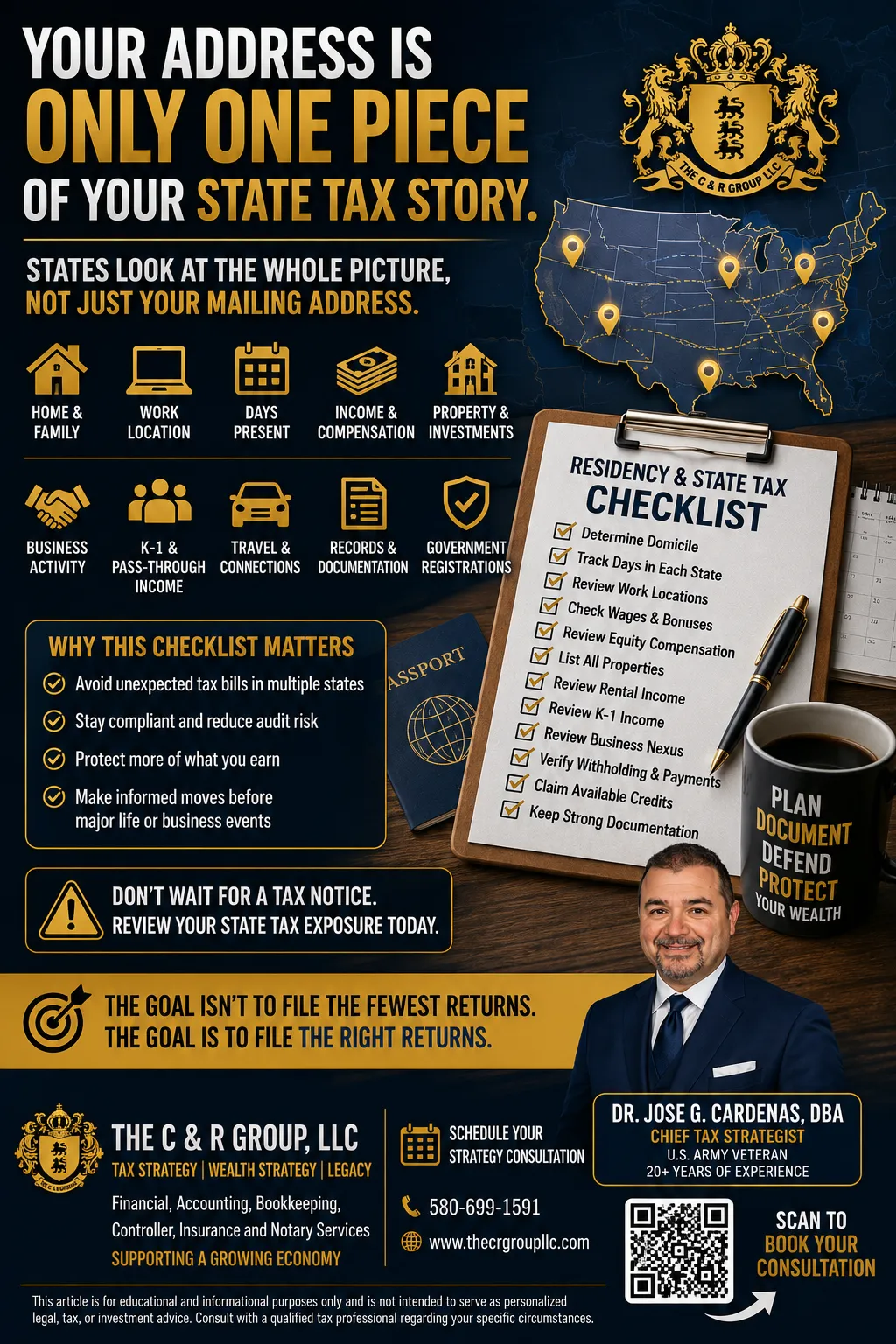
Residency and State Tax Checklist
Financial Horizons: Insights for Building Wealth and Securing Your Legacy
Residency and State Tax Checklist
By Dr. Jose G. Cardenas, Chief Tax Strategist at The C & R Group, LLC
State tax residency should never be treated as a box checked once a year during tax preparation.
It is an ongoing factual and financial position shaped by where you live, work, own property, operate a business, maintain family connections, receive income, and spend your time.
A taxpayer may genuinely move to another state and still have filing obligations in the former state. A household may be considered a resident of one state while owing a nonresident return to several others. A business owner may change personal domicile while the company continues creating nexus where employees, customers, property, inventory, or operations remain.
The rules become especially important for:
High-income households;
Frequent movers;
Remote and hybrid employees;
Business owners;
Retirees;
Military families;
Real-estate investors;
Executives receiving bonuses or equity compensation;
Partnership and S corporation owners; and
Anyone preparing for a large sale or financial transaction.
The purpose of this checklist is not to identify the state with the lowest advertised tax rate.
It is to determine:
Which states may legally treat you as a resident;
Which states may tax particular income even when you are a nonresident;
Which returns and payments may be required;
What records support your position; and
What planning must occur before a move or major transaction.
The strongest state tax strategy connects residency, income sourcing, payroll, property, business activity, documentation, and cash flow.
State Tax Compliance Is Not State Tax Strategy
State tax compliance explains how completed events must be reported.
State tax strategy begins before the move, transaction, hiring decision, property purchase, or income event occurs.
Compliance asks:
Which state returns are required?
Was the taxpayer a full-year resident, part-year resident, or nonresident?
Which income belongs on each return?
Was sufficient tax withheld or paid?
Are credits available for taxes paid to another state?
Are amended returns necessary?
Strategy asks:
Has the former domicile truly been abandoned?
Has a defensible new domicile been established?
Will retaining the former home create continued exposure?
Could day-count rules produce statutory residency?
Where will each spouse physically work?
How will bonuses, equity awards, and business income be sourced?
Will a remote employee create business nexus?
Should a major transaction occur before or after the move?
What records must be created while events are happening?
Compliance records the outcome.
Strategy shapes the outcome.
1. Identify Your Domicile
Domicile generally refers to the one place an individual considers the permanent home—the place the person intends to return to after being away.
A taxpayer may maintain several residences but ordinarily has one domicile at a time.
New York describes domicile as the place a person intends to have as a permanent home. California evaluates whether an individual is present for more than a temporary or transitory purpose or remains domiciled in California while outside the state temporarily. Both approaches demonstrate that residency depends on more than a mailing address.
Domicile checklist
Identify the state you currently consider your permanent home.
Identify the state shown on your most recent resident return.
Determine where your spouse is domiciled.
Determine where dependent children live and attend school.
Identify the residence you return to after travel.
Review the location of your primary employment or business management.
Review your driver’s license and vehicle registrations.
Review voter registration.
Review homestead exemptions and resident-only benefits.
Review estate-planning documents.
Confirm that banking, brokerage, insurance, and payroll records are consistent.
Document why the location represents your permanent home.
A taxpayer claiming a new domicile should be able to explain both what was established in the destination state and what was abandoned in the former state.
2. Distinguish Residence From Domicile
A residence is a place where someone lives.
A taxpayer may have:
A principal home;
A vacation property;
A condominium near work;
Temporary corporate housing;
A seasonal residence;
A home maintained for family members; or
A second property used during frequent travel.
Owning or renting a property does not automatically make that state the taxpayer’s domicile.
Likewise, leaving a residence does not automatically terminate every tax connection.
Residence checklist
List every home available to you during the year.
Identify who owns or leases each property.
Record when each property became available.
Determine whether each residence is suitable for year-round use.
Identify where your spouse and family spend most of their time.
Determine where ordinary household possessions are maintained.
Document whether the former home is sold, rented, vacant, or personally available.
Review utility, insurance, and security-system records.
Identify which property is claimed as a principal residence for other legal purposes.
The question is not merely, “Do you have a home there?”
The more important question is, “How does that property function within your actual life?”
3. Establish the Residency-Change Date
A taxpayer who genuinely changes domicile during the year may become a part-year resident.
California states that a part-year resident is generally taxed on worldwide income received while a resident and California-source income received while a nonresident. California uses Form 540NR for part-year residents and nonresidents.
Oklahoma defines a part-year resident as an individual whose domicile was in Oklahoma for less than 12 months during the tax year and directs part-year residents to Form 511-NR.
Residency-change-date checklist
Identify the date the former home stopped being your permanent home.
Identify the date the new home became your permanent home.
Record purchase, sale, and lease dates.
Preserve moving-company contracts and receipts.
Preserve utility start and termination records.
Document the spouse’s and dependents’ relocation dates.
Record employment or business-location changes.
Update government and financial records promptly.
Prepare a written timeline explaining the transition.
Avoid selecting a date solely because it produces the lowest tax.
The date should follow the evidence.
The evidence should not be manufactured to support a preferred date.
4. Review Statutory Residency Rules
Domicile is not always the only residency test.
Some states may treat a taxpayer domiciled elsewhere as a statutory resident based on maintaining a permanent place of abode and spending a specified number of days in the state.
New York generally applies statutory residency when a nondomiciliary maintains a permanent place of abode and spends 184 days or more in the state. New York also explains that a residence maintained by a spouse may be relevant when determining whether the taxpayer has a permanent place of abode.
Statutory-residency checklist
Identify every state where you maintain a home.
Review each state’s statutory day-count rules.
Determine whether part of a day counts.
Identify limited exceptions for travel or transit days.
Track the availability of each residence.
Review properties owned or leased by your spouse.
Maintain a contemporaneous location calendar.
Reconcile your calendar quarterly.
Do not assume that remaining below 183 days automatically changes domicile.
The popular “183-day rule” is not a universal shield.
It may be one element of one state’s test.
5. Maintain a Reliable Day Log
Taxpayers who divide time among several states should maintain reliable contemporaneous location records.
A day log should identify:
The state where each day began;
The state where services were performed;
Travel times;
Arrival and departure dates;
Partial days;
Business trips;
Medical appointments;
Family events; and
Overnight locations.
Supporting records may include:
Airline itineraries;
Hotel statements;
Toll records;
Parking receipts;
Fuel purchases;
Credit-card transactions;
Bank activity;
Office-access records;
Security-system data;
Utility usage;
Medical appointments;
Event tickets;
Electronic calendars; and
Mobile-device location records where appropriate.
Day-count checklist
Update the calendar daily or weekly.
Identify business and personal travel separately.
Save supporting electronic records.
Reconcile discrepancies before year-end.
Review totals well before approaching a statutory threshold.
Preserve the records with the applicable tax return.
A calendar reconstructed after an audit notice can still be useful.
A contemporaneous calendar is far more persuasive.
6. Review the Location of Your Spouse and Dependents
A married couple may have different residency-change dates.
One spouse may relocate first because of:
Employment;
School schedules;
Medical care;
Business obligations;
Family caregiving;
Delays selling a home;
Military orders; or
Construction of a new residence.
Family-location checklist
Identify where each spouse physically lives.
Determine whether each spouse intends the arrangement to be permanent or temporary.
Identify where dependent children attend school.
Identify where family holidays and weekends occur.
Determine which residence functions as the family home.
Document temporary reasons for spouses living apart.
Review whether separate state residency classifications may apply.
Confirm that state filing methods properly address mixed residency.
A joint federal income-tax return does not automatically mean both spouses have identical state residency for the entire year.
7. Review Your Homes and Personal Connections
States may examine the complete pattern of a taxpayer’s life.
Relevant connections may include:
Size and use of each residence;
Location of furniture and valuable property;
Family photographs and heirlooms;
Vehicles;
Boats and recreational equipment;
Pets;
Physicians and dentists;
Schools;
Religious organizations;
Civic associations;
Clubs;
Charitable activity; and
Community involvement.
Personal-connection checklist
Identify where your most valuable and sentimental property is kept.
Identify where pets are licensed and treated.
Review medical-provider locations.
Review club and civic memberships.
Review religious and community participation.
Identify where family gatherings regularly occur.
Ensure your claimed domicile is consistent with your actual lifestyle.
The state tax authority will not necessarily accept the label you place on each residence.
It will examine how each residence is actually used.
8. Correct Conflicting Government Records
Government filings created for other purposes may become evidence in a residency examination.
Potentially conflicting records include:
Homestead exemptions;
Resident tuition claims;
Driver’s licenses;
Voter registration;
Vehicle registration;
Hunting or fishing licenses;
Professional licenses;
Resident-only benefits;
Insurance applications;
Loan applications; and
Property-tax filings.
Government-record checklist
Cancel an inconsistent former-state homestead exemption.
Update driver’s licenses within the required period.
Register vehicles in the new state.
Update voter registration.
Review professional-license addresses.
Update government benefit records.
Review property-tax filings.
Retain proof of each change.
Avoid claiming resident benefits in two states.
A taxpayer should not claim one principal residence to obtain a property-tax advantage and another principal residence to obtain an income-tax advantage without expecting scrutiny.
9. Review Payroll and Physical Work Location
Wages may be taxed based on where the employee physically performs services, subject to the rules of each jurisdiction.
Remote and hybrid arrangements can create filing obligations even when the taxpayer never changes domicile.
Employment checklist
Identify each state where you physically worked.
Review remote-work and hybrid-work agreements.
Track workdays by state.
Identify employer offices visited.
Review temporary assignments.
Review local income-tax jurisdictions.
Compare actual work locations with Form W-2 reporting.
Confirm state and local withholding on each paycheck.
Correct payroll records immediately after moving.
Review spouse payroll separately.
A payroll system can withhold tax for the wrong state.
Withholding is a payment method, not a final legal determination of residency or sourcing.
10. Review Bonuses, Commissions, and Deferred Compensation
A bonus paid after a move may still relate to work performed in the former state.
The relevant period may include:
The performance year;
The commission-earning period;
The service period;
The vesting period;
The date the right to payment became fixed; and
The physical locations where services were performed.
Compensation checklist
Obtain the written bonus or commission plan.
Identify the performance period.
Determine where services were performed during that period.
Review whether the award was discretionary or formula-based.
Identify the vesting or payment date.
Review employer state allocation.
Compare payroll reporting with actual workdays.
Calculate possible resident-state credits.
Adjust estimated tax payments when necessary.
The state where the funds are deposited does not automatically determine where the compensation was earned.
11. Review Equity Compensation
Stock options, restricted stock units, performance awards, and similar compensation may create multistate income.
Equity-compensation checklist
Identify the grant date.
Identify the vesting period.
Identify exercise, settlement, and sale dates.
Track workdays by state during the relevant service period.
Review the type of award.
Determine whether the award relates to past or future services.
Review employer allocation and Form W-2 reporting.
Retain award agreements and brokerage records.
Calculate state estimated payments before vesting or exercise.
Review the transaction before relocating.
A move before vesting may reduce future exposure in some circumstances.
It does not automatically eliminate tax tied to earlier service.
12. Review Real Estate in Every State
Real estate generally remains connected to the state where the property is located.
California, for example, continues taxing qualifying California-source income received by nonresidents, and its filing system includes Form 540NR for nonresidents and part-year residents.
Real-estate checklist
List every property by state.
Identify whether each property is personal, rental, business, farm, or investment property.
Review rental-income filing requirements.
Review short-term rental and lodging taxes.
Maintain depreciation schedules.
Preserve purchase and improvement records.
Review state withholding requirements before sale.
Review gain allocation.
Determine whether an entity holding the property must register.
Continue nonresident filings after moving when required.
The taxpayer may leave the state.
The property remains exactly where it was.
13. Review Partnership, S Corporation, and LLC Income
Pass-through income can create a filing obligation in a state the owner has never visited.
A partnership or S corporation may allocate income to states where it has:
Employees;
Offices;
Property;
Inventory;
Customers;
Projects; or
Other business activity.
Pass-through checklist
Review all federal and state Schedule K-1 forms.
Identify every state shown on supplemental schedules.
Review nonresident owner withholding.
Review composite-return participation.
Review pass-through entity tax elections.
Reconcile estimated payments.
Identify resident-state credits.
Review apportionment percentages.
Retain state allocation schedules.
Do not assume the entity’s formation state determines the source of income.
A personal move may change the owner’s resident return.
It does not automatically move the underlying business income.
14. Review Business Nexus
Business nexus is the connection that allows a state to impose registration, collection, filing, or payment obligations.
Potential triggers include:
Employees;
Remote workers;
Contractors;
Sales representatives;
Property;
Inventory;
Warehouses;
Installations;
Services;
Travel;
Economic sales thresholds; and
Marketplace activity.
Business-nexus checklist
Map employee and contractor locations.
Identify where inventory is stored.
Identify property and equipment by state.
Track sales by customer destination.
Monitor economic-nexus thresholds.
Review payroll registrations.
Review sales-tax permits.
Review income and franchise-tax filings.
Review foreign-entity qualification.
Review local licensing.
Measure compliance costs by state.
Formally close accounts that are no longer required.
The business may create nexus without opening a traditional office.
15. Review Major Sales Before They Occur
Residency planning becomes especially important before:
Selling a business;
Selling appreciated securities;
Selling real estate;
Exercising stock options;
Receiving a large bonus;
Receiving deferred compensation;
Completing an installment sale;
Selling a partnership interest;
Converting retirement funds; or
Taking a large retirement distribution.
Major-transaction checklist
Identify when negotiations began.
Identify when the right to income became fixed.
Determine the legal structure of the transaction.
Identify each asset being sold.
Review whether the asset is real, tangible, or intangible property.
Determine where the business operated.
Review whether any payment represents compensation.
Review contingent and installment payments.
Confirm that the residency change is complete and documented.
Prepare federal and state projections before signing.
Calculate estimated tax payments.
Preserve the entire transaction file.
Moving immediately before a major sale does not automatically invalidate the move.
It does increase the value of strong evidence.
16. Review Retirement Income and Relocation
Retirees should compare more than individual income-tax rates.
A complete state comparison should consider:
Military retired pay;
Civilian pensions;
Social Security;
IRA distributions;
Employer-plan distributions;
Annuities;
Investment income;
Property taxes;
Sales taxes;
Homestead benefits;
Insurance costs;
Healthcare;
Estate or inheritance taxes; and
Cost of living.
Retirement-relocation checklist
Review how each state taxes each retirement income source.
Review military retirement exclusions.
Review pension withholding.
Review Social Security treatment.
Compare property and sales taxes.
Review estate and inheritance taxes.
Review the availability of the former home.
Update retirement-account and DFAS records.
Review survivor benefits and estate plans.
Complete a total household cash-flow comparison.
A no-income-tax state is not automatically the lowest-cost state.
17. Review Military Residency and Transition Records
Military legal residence, physical duty location, and civilian domicile are not always the same.
Military families should preserve:
PCS orders;
DD Form 214;
Retirement orders;
Final LES documents;
Military Forms W-2;
DFAS Forms 1099-R;
VA award letters;
State withholding elections;
Travel vouchers;
Moving records; and
Property records.
Military checklist
Identify the service member’s state of legal residence.
Review the spouse’s residence and employment.
Separate active-duty pay from civilian wages.
Review Reserve and National Guard pay.
Review military retired pay.
Distinguish VA disability compensation.
Review residency after separation or retirement.
Preserve final move documentation.
Review rental property remaining in a former duty state.
Update DFAS and civilian payroll withholding.
Military orders may explain physical presence without changing domicile.
After separation or retirement, the final civilian move may create an entirely new residency analysis.
18. Reconcile Withholding and Estimated Payments
Incorrect withholding can produce a refund in one state and a balance due in another.
Payment checklist
Review each Form W-2.
Review state and local wages.
Reconcile paycheck withholding.
Review pension and retirement withholding.
Review pass-through withholding.
Identify state estimated payments.
Determine whether additional payments are required.
Preserve payment confirmations.
Update withholding after a move or job change.
Recalculate after bonuses and major transactions.
Withholding does not decide the legal obligation.
It affects cash flow while the legal obligation is being calculated.
19. Review Credits for Taxes Paid to Another State
A resident state may provide a credit when another state taxes the same income.
The credit may be limited by:
The amount legally imposed and paid;
The resident state’s tax on the same income;
The character of the tax;
The source of the income;
Filing status;
Differences in taxable income; and
State-specific restrictions.
Credit checklist
File the required source-state return.
Preserve proof of tax paid.
Retain Forms W-2, 1099, and K-1.
Retain composite-return statements.
Identify the income taxed by both states.
Calculate the resident-state limitation.
Review refunds or amended returns from the source state.
Amend the resident return when necessary.
Do not assume the credit equals the entire source-state payment.
A tax credit may reduce double taxation.
It does not eliminate the requirement to file both returns.
20. Understand the Federal SALT Deduction
The federal deduction for qualifying state and local taxes does not determine whether a state tax is legally owed.
For 2026, the IRS states that the overall limit for qualifying state and local income, sales, and property taxes is $40,400, or $20,200 for married taxpayers filing separately. The limit is reduced above specified modified-adjusted-gross-income thresholds but generally not below $10,000, or $5,000 for married filing separately.
SALT checklist
Determine whether itemizing exceeds the standard deduction.
Identify qualifying state and local taxes paid.
Apply the annual federal limitation.
Review the modified-adjusted-gross-income reduction.
Distinguish deductions from tax credits.
Do not treat the federal deduction as reimbursement for avoidable state tax.
Preserve property-tax and income-tax payment records.
A deduction reduces taxable income.
It does not repay the taxpayer dollar for dollar.
21. Preserve a Permanent Residency File
Residency planning is only as strong as the records supporting it.
Permanent-file checklist
Written move timeline;
Home purchase and sale documents;
Lease agreements;
Moving-company records;
Utility start and stop statements;
Driver’s licenses;
Vehicle registrations;
Voter registrations;
Homestead records;
Payroll records;
Travel calendars;
School records;
Medical-provider changes;
Insurance policies;
Bank and brokerage updates;
Estate-planning documents;
Business registrations;
Property records;
Forms W-2, 1099, and K-1;
State tax returns;
Payment confirmations; and
Major-transaction documents.
Keep records long enough to address the applicable state statutes of limitation and any extended period created by missing or materially inaccurate returns.
22. Complete a Quarterly State Tax Review
A state tax review should not wait until tax season.
Quarterly review checklist
Update the day-count calendar.
Review new work locations.
Review payroll withholding.
Identify new rental or property activity.
Review business employees and contractors.
Review inventory locations.
Monitor state sales thresholds.
Review new Schedule K-1 investments.
Update major transaction timelines.
Recalculate estimated tax payments.
Correct inconsistent records before year-end.
Close obsolete state accounts.
Residency and nexus problems usually begin with an operational or personal decision.
They rarely begin with the tax return itself.
Common Residency and State Tax Mistakes
Mistake 1: Treating an address change as a completed residency change
An address is evidence—not the entire legal conclusion.
Mistake 2: Assuming fewer than 183 days guarantees nonresidency
Domicile and statutory residency may apply separately.
Mistake 3: Keeping the former home fully available
The former state may view it as evidence that the domicile was never abandoned.
Mistake 4: Leaving family and lifestyle connections behind
The center of family life can carry significant weight.
Mistake 5: Ignoring physical work location
Remote and multistate work can create separate filing obligations.
Mistake 6: Failing to allocate bonuses and equity awards
Compensation may relate to service periods before and after a move.
Mistake 7: Assuming a personal move relocates a business
The company may retain nexus and state-source income elsewhere.
Mistake 8: Forgetting property and pass-through interests
Rental property and state K-1 income can require continuing nonresident returns.
Mistake 9: Filing only where tax was withheld
Payroll withholding can be incomplete or wrong.
Mistake 10: Waiting until an audit begins to build documentation
The best residency evidence is created while the move is happening.
Practical Example: One Household, Five States
Assume a married couple begins the year domiciled in State A.
During the year:
They move to State B;
One spouse works remotely for an employer in State C;
The other spouse owns rental property in State A;
The household receives a partnership Schedule K-1 from State D;
The remote employee travels regularly to State C;
The family spends substantial time at a second home in State E; and
Payroll continues withholding State A tax after the move.
The couple believes filing in State B is enough because that is where they live at year-end.
That conclusion is incomplete.
Potential filing analysis
The household may need to consider:
A part-year resident return in State A;
A resident or part-year resident return in State B;
A nonresident return in State C for wages sourced there;
A nonresident return in State D for pass-through income;
Continuing State A reporting for rental income; and
A statutory-residency review in State E if the household maintains a qualifying abode and spends enough days there.
Correction plan
Establish the actual domicile-change date;
Prepare separate day counts for each spouse;
Allocate wages by work location;
Reconcile payroll withholding;
Report rental income to the property state;
Review the State D K-1;
Review statutory residency in State E;
Calculate resident-state credits;
Adjust withholding and estimated payments; and
Build a permanent state-by-state file.
The correct number of returns depends on legally relevant connections—not the number of mailing addresses.
Comprehensive Residency and State Tax Checklist
Personal residency
Identify domicile at the beginning of the year.
Identify domicile at the end of the year.
Establish the date of any domicile change.
Review each spouse separately.
List every residence.
Review statutory day-count tests.
Maintain a reliable calendar.
Update government and legal records.
Eliminate inconsistent resident benefits.
Document abandonment of the former domicile.
Document establishment of the new domicile.
Employment and compensation
Track physical work location.
Review remote and hybrid work.
Reconcile state withholding.
Review local taxes.
Review bonus performance periods.
Review commissions.
Review equity grant and vesting periods.
Review severance.
Review deferred compensation.
Correct payroll after moving.
Property and investments
List all real estate by state.
Review rental reporting.
Review short-term rental taxes.
Preserve depreciation schedules.
Review property-sale withholding.
Review investment gains before moving.
Review installment sales.
Review trusts and estates.
Review state K-1 schedules.
Business owners
Map employees and contractors.
Identify property and inventory locations.
Monitor sales thresholds.
Review sales-tax nexus.
Review income and franchise-tax nexus.
Review payroll registrations.
Review foreign qualifications.
Review owner withholding and composite returns.
Measure state-level profitability.
Close obsolete state accounts properly.
Retirement and military
Review pension taxation.
Review military retired-pay treatment.
Review Social Security treatment.
Review IRA and employer-plan distributions.
Update pension and DFAS withholding.
Preserve DD Form 214 and military orders.
Preserve final LES and tax statements.
Review the final civilian domicile after military service.
Review survivor and estate planning.
Payments and returns
Identify every state return required.
Reconcile Forms W-2, 1099, and K-1.
Reconcile state withholding.
Review estimated payments.
Calculate credits for taxes paid elsewhere.
Retain proof of payments.
Review amended-return needs.
Preserve copies of every filed return.
AI-Search Quick Answers
What determines state tax residency?
State tax residency may depend on domicile, physical presence, statutory day-count rules, available homes, family location, work, business activity, property, and personal connections.
Is changing an address enough to change residency?
No. An address change supports the position but does not independently prove that the former domicile was abandoned or a new one was established.
Is spending fewer than 183 days enough?
Not necessarily. Day count may affect statutory residency, but domicile can apply independently.
Can a person be treated as a resident of two states?
Yes. A taxpayer may be domiciled in one state and satisfy another state’s statutory-residency requirements.
Can a nonresident still owe a state return?
Yes. Wages, rental property, business income, pass-through income, and property sales may create state-source income after residency ends.
Does remote work create another state filing?
It can. The answer depends on physical work location, residence, employer location, travel, and state sourcing rules.
Can bonuses and equity compensation be taxed after moving?
Yes. The former state may tax a portion tied to services performed there during the relevant earning or vesting period.
Does moving the owner move the business?
No. The business may retain nexus wherever employees, property, inventory, customers, or operations remain.
Can credits prevent double taxation?
Credits may reduce double taxation, but they are limited and generally do not eliminate the obligation to file the applicable resident and nonresident returns.
What records should be kept?
Maintain a move timeline, home records, day logs, payroll documents, travel evidence, government registrations, business records, property documents, and copies of every relevant tax return.
Planning Questions
Before moving, filing, or completing a major transaction, ask:
Where am I domiciled today?
What facts support that position?
Have I abandoned the former domicile?
Is the former home still available?
Where do my spouse and dependents live?
How many days have I spent in each state?
Do partial days count?
Where did I physically work?
Is payroll withholding correct?
Do I own property in another state?
Did I receive state K-1 income?
Does my business have nexus elsewhere?
Will I receive a bonus or equity award?
Am I preparing for a business or investment sale?
Which state may source the income?
Are credits available for taxes paid elsewhere?
Have I reviewed retirement-income taxation?
Are military residency protections relevant?
Are my records consistent?
Could I prove every conclusion during an examination?
What to Do Next
Create a state-by-state map of your household and business.
For every state, list:
Residency period;
Days present;
Homes available;
Work performed;
Wages;
Bonuses;
Equity compensation;
Rental property;
Business activity;
Pass-through income;
Employees;
Contractors;
Inventory;
Sales;
Withholding;
Estimated payments;
Registrations; and
Returns potentially required.
Then compare that map with:
Forms W-2;
Forms 1099;
Federal and state K-1 schedules;
Payroll reports;
Travel calendars;
Property records;
Entity registrations;
Prior returns; and
Major transaction documents.
Do not start with the software.
Start with the facts.
The correct returns follow the correct facts.
Final Thought
State tax residency is not determined by one document, one address, or one moving date.
It is determined by the complete relationship among your home, family, work, property, business, income, travel, legal records, and intentions.
A taxpayer can move and still owe the former state tax.
A taxpayer can remain a resident of one state while filing nonresident returns in several others.
A business can cross state lines before its owner realizes that new obligations have begun.
The goal is not to file the fewest returns possible.
The goal is to file the correct returns, pay the correct states, preserve cash flow, and maintain enough evidence to defend every material position.
Plan the move before it happens.
Track the facts while they happen.
And review the tax consequences before the state reviews them for you.
Book Your Strategy Consultation
Schedule a consultation to review the topic discussed in the article and how it may apply to your financial or business situation.
Phone: 580-699-1591
Booking your appointment now:

https://api.leadconnectorhq.com/widget/booking/T4UHUjCijCtIB3rwoTDI
ABOUT THE AUTHOR
Dr. Jose G. Cardenas is a retired U.S. Army Finance Officer and the Chief Tax Strategist at The C & R Group, LLC. With a Doctorate in Business Administration and over 20 years of experience in tax planning and financial strategy, Dr. Cardenas helps individuals and business owners legally reduce taxes, strengthen cash flow, and build lasting wealth and legacy. Learn more at www.thecrgroupllc.com
DISCLOSURE
This article is for educational and informational purposes only and is not intended to serve as personalized legal, tax, or investment advice. Tax laws and regulations change over time and may vary by jurisdiction. You should consult with a qualified tax professional regarding your specific circumstances before implementing any strategy discussed here. Dr. Jose G. Cardenas, DBA, provides tax advisory services through The C & R Group, LLC. Insurance and investment strategies may be offered through his role as a licensed financial professional affiliated with Experior Financial Group.