Tax Buckets, Asset Location, and Why Coordination Matters
Financial Horizons: Insights for Building Wealth and Securing Your Legacy
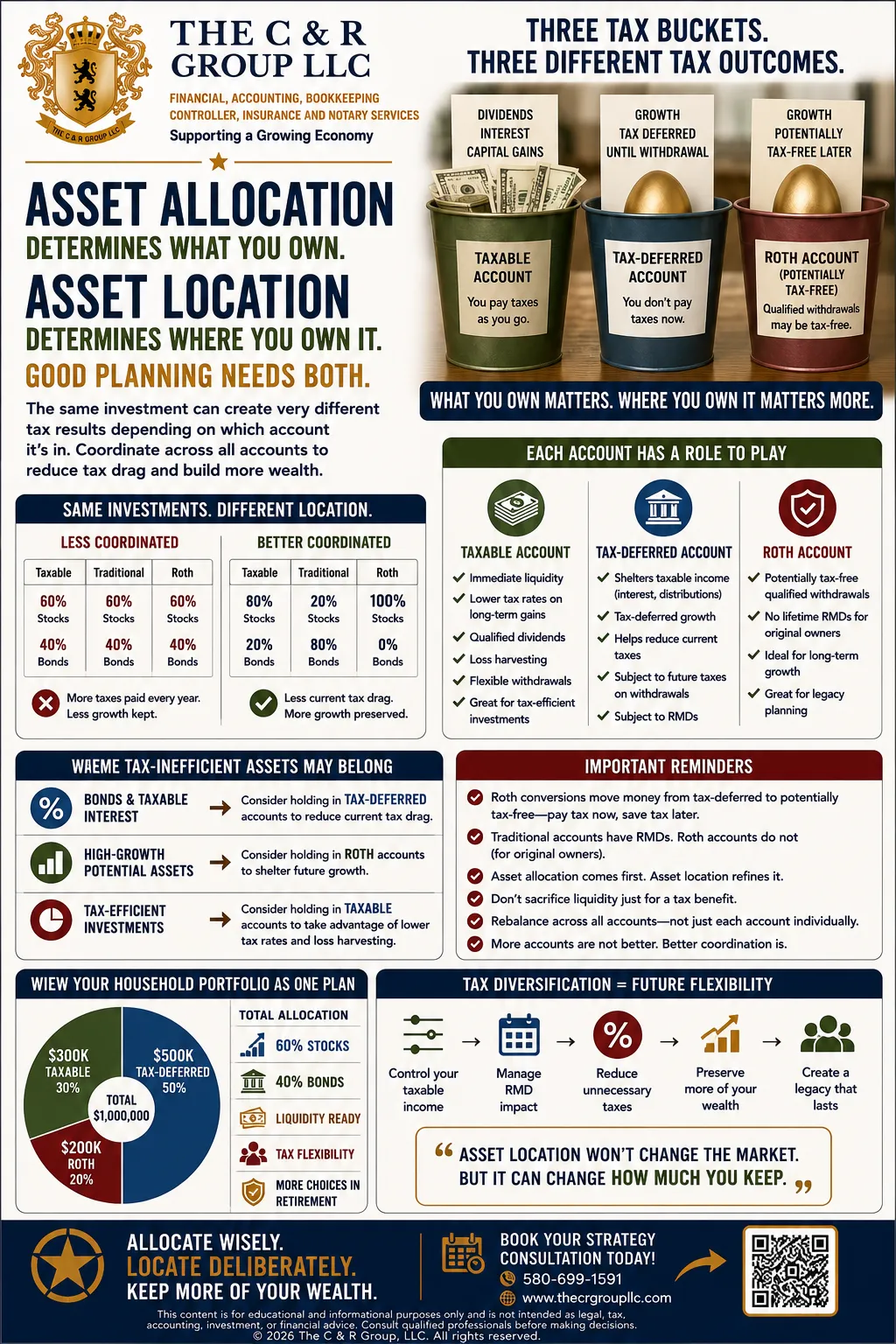
Tax Buckets, Asset Location, and Why Coordination Matters
By Dr. Jose G. Cardenas | Chief Tax Strategist, The C & R Group, LLC
Most investors understand diversification.
They know they should not put every dollar into:
One stock;
One industry;
One asset class;
One investment.
So they build portfolios containing combinations of:
Stocks;
Bonds;
Cash;
Mutual funds;
ETFs;
Real estate;
Retirement accounts.
That addresses an important question:
What should I own?
But tax-aware wealth planning requires another question:
Where should I own it?
The same investment can create very different tax consequences depending on whether it sits inside:
A taxable brokerage account;
A traditional tax-deferred retirement account;
A Roth account.
That concept is commonly called:
asset location.
And it is different from:
asset allocation.
The IRS explains that taxable investment accounts can generate currently reportable interest, dividends, capital-gain distributions, and gains or losses from investment sales. Qualified dividends can receive the preferential federal rates applicable to qualifying net capital gains when requirements are satisfied.
Traditional IRAs generally defer taxation on earnings and gains until distributions occur, while qualified Roth IRA distributions can be excluded from gross income when the applicable rules are satisfied.
Those differences create what I call:
Tax buckets.
And the central principle for today is:
Building wealth is not only about selecting good investments. It is also about coordinating which investments belong in which tax bucket so unnecessary tax drag does not quietly work against the portfolio.
Three Tax Buckets
For planning purposes, household investments can often be viewed through three broad tax buckets.
Bucket 1 — Taxable
Examples may include:
Brokerage accounts;
Bank accounts;
CDs;
Taxable bonds;
Personally held investments.
These accounts can create current tax consequences from:
Interest;
Dividends;
Capital-gain distributions;
Realized gains.
But taxable accounts also offer flexibility.
You can generally access the money without waiting for retirement age.
They may also provide:
Capital-loss harvesting opportunities;
Preferential long-term capital-gain treatment;
Qualified-dividend treatment;
Potential basis adjustments under applicable estate rules.
Taxable does not mean:
bad.
It means:
different.
Bucket 2 — Tax-Deferred
Examples can include:
Traditional IRA;
Traditional 401(k);
Traditional TSP;
Other qualified tax-deferred retirement plans.
Inside these accounts, investment earnings generally are not currently taxed each year while they remain inside the account.
Traditional IRA distributions, however, are generally taxable as ordinary income to the extent they consist of deductible contributions and earnings.
Tax-deferred therefore means:
Tax postponed.
Not:
Tax eliminated.
That distinction matters.
Bucket 3 — Potentially Tax-Free
Examples can include:
Roth IRA;
Roth 401(k);
Roth TSP,
subject to the applicable rules.
Roth contributions generally do not provide the same upfront deduction as traditional contributions.
But qualified Roth IRA distributions can be federal-income-tax-free, and original Roth IRA owners are not subject to lifetime required minimum distributions under current rules.
That creates a different planning tool.
The investor gives up:
a current deduction
in exchange for:
potentially tax-free qualified retirement income later.
1. Asset Allocation and Asset Location Are Different Decisions
Suppose your household determines that the appropriate investment allocation is:
60% stocks
30% bonds
10% cash
That is:
asset allocation.
Now suppose you own:
Taxable brokerage account;
Traditional IRA;
Roth IRA.
Where should the:
Stocks;
Bonds;
Cash
go?
That is:
asset location.
The household can have the correct allocation and still create unnecessary tax drag if every account is built without considering tax characteristics.
2. Stop Treating Every Account Like Its Own Portfolio
This happens constantly.
The taxable account is:
60/30/10.
The traditional IRA is:
60/30/10.
The Roth IRA is:
60/30/10.
Why?
Because someone treated each account independently.
But suppose the household's total allocation still needs to be:
60% stocks
30% bonds
10% cash.
It may be possible to distribute those investments differently across accounts while maintaining the exact same household risk profile.
That is the beginning of asset-location planning.
3. Tax-Inefficient Investments May Deserve Different Locations
Some investments naturally generate more current taxable income than others.
Examples may include investments producing:
Taxable interest;
Frequent taxable distributions;
High portfolio turnover.
Holding those assets inside tax-deferred accounts may sometimes reduce annual tax drag because income generally remains sheltered from current taxation while inside the qualified account.
That does not mean:
“All bonds belong in an IRA.”
It means:
Tax characteristics belong in the location conversation.
4. Tax-Efficient Investments May Fit Taxable Accounts More Naturally
Some investments may generate a larger portion of return through:
Long-term appreciation;
Qualified dividends.
Those tax characteristics can make taxable ownership comparatively efficient under the right circumstances.
Qualified dividends may receive federal 0%, 15%, or 20% maximum rates when the requirements are satisfied.
Long-term capital gains can also receive preferential federal treatment.
That makes taxable accounts potentially useful for investments that:
Turn over slowly;
Generate relatively tax-efficient distributions;
Offer loss-harvesting opportunities.
Again:
There is no universal rule.
There is a framework.
5. Roth Space May Be Especially Valuable
A Roth account has a unique characteristic:
Qualified future distributions can potentially be federal-income-tax-free.
That means Roth space can be valuable for assets expected to produce significant long-term appreciation.
Example
Assume two investments.
Investment A is expected to grow modestly.
Investment B has a higher expected long-term growth rate but also higher volatility.
If both ultimately perform as expected, placing more high-growth potential inside Roth space could preserve more future appreciation inside the tax-free bucket.
But this introduces an important warning:
Higher expected return usually means higher risk.
Do not turn the Roth account into a casino simply because future gains may be tax-free.
Asset selection still has to fit:
Risk tolerance;
Time horizon;
Financial plan.
Tax advantages do not repeal investment risk.
6. Traditional Accounts Can Shelter Current Income
Consider an investor who owns bonds producing substantial taxable interest.
If those bonds sit in taxable brokerage accounts, the interest can generate current taxable income each year.
If appropriate investments are held inside a traditional retirement account instead, current taxation may generally be deferred until retirement distributions occur.
The IRS describes one of the traditional IRA's tax advantages as the fact that amounts, including earnings and gains, generally are not taxed until distributed.
That can reduce current tax drag.
But remember:
When distributions eventually occur, they generally receive ordinary-income treatment to the extent taxable.
So the strategy is not:
tax avoidance.
It is:
tax timing.
7. Tax Deferral Has Economic Value
Suppose an investment produces:
$10,000
of taxable income annually.
If tax must be paid every year, some investment capital leaves the portfolio.
If tax is deferred inside a retirement account, more of the gross return may remain invested.
That additional money can potentially continue compounding.
This is one reason tax deferral can be valuable.
But future tax rates matter.
If you defer income today and withdraw it later at a dramatically higher rate, the result can look different.
Which leads to the next issue.
8. Do Not Build Only One Tax Bucket
Some households accumulate nearly all retirement wealth inside traditional tax-deferred accounts.
They retire with:
$2 million
or
$3 million
in traditional retirement plans.
They feel wealthy.
They are.
But they also may have created a large amount of future:
taxable retirement income.
Traditional distributions can increase:
Ordinary taxable income;
Required minimum distributions;
Taxation of Social Security;
Medicare-related income.
The problem is not that tax-deferred accounts were bad.
The problem can be:
lack of tax diversification.
9. Tax Diversification Creates Flexibility
Imagine retirement with three pools:
Taxable
$500,000
Traditional
$1,000,000
Roth
$500,000
Now the household has different sources of capital with different tax characteristics.
That can create more flexibility than having:
$2 million
entirely in one tax bucket.
Why?
Because retirement withdrawals can potentially be coordinated among accounts.
The family may have more control over:
Taxable income;
Capital gains;
Roth withdrawals;
Medicare-related income;
Charitable distributions.
Tax diversification is about creating choices.
10. Retirement Taxes Are Often About Controlling the Income Stack
In retirement, taxable income might come from:
Pension;
Military retired pay;
Social Security;
Traditional IRA distributions;
401(k) withdrawals;
Interest;
Dividends;
Capital gains;
Rental income.
Then Roth distributions may provide an additional source that potentially does not increase federal taxable income when qualified.
That creates planning flexibility.
The objective becomes:
Which account should fund the next dollar of spending?
That is withdrawal sequencing.
And asset location affects what choices are available later.
11. Required Minimum Distributions Change the Equation
Traditional retirement accounts eventually become subject to required minimum distribution rules under current law.
The IRS currently states that traditional IRA owners generally must begin RMDs based on the applicable statutory age, while original Roth IRA owners do not have lifetime RMD requirements.
That means the tax-deferred bucket eventually begins pushing money onto the tax return whether the retiree needs all the cash or not.
A household with an oversized traditional bucket may therefore encounter increasing taxable income later in retirement.
Tax planning should start before RMDs begin.
12. Asset Location and Roth Conversion Planning Interact
Suppose a retiree has:
$1.5 million traditional IRA
and:
$150,000 Roth IRA.
They are currently in a relatively low tax bracket.
A Roth conversion may deserve review.
Why?
A conversion generally moves money from:
tax-deferred
to:
potentially tax-free
while recognizing taxable income today.
The IRS makes clear that traditional IRA amounts converted to Roth generally are included in gross income to the extent taxable.
This is a deliberate decision:
Pay tax now in exchange for moving future growth into a different bucket.
But conversion size must be coordinated with:
Capital gains;
Social Security;
Medicare;
Business income;
Other tax thresholds.
13. A Roth Conversion Can Change Investment Tax Planning
Suppose a retiree has:
$75,000 ordinary taxable income
and intends to realize:
$40,000 long-term capital gain.
They also consider:
$100,000 Roth conversion.
The conversion can push taxable income substantially higher.
That may affect how much of the capital gain remains in lower preferential tax ranges.
So:
Roth planning
and
capital-gain planning
cannot be performed separately.
They compete for the same tax-return space.
14. The Taxable Bucket Has Unique Advantages Too
Taxable brokerage accounts sometimes get treated as inferior because taxes may be owed during the holding period.
But taxable accounts offer several valuable characteristics.
They can provide:
Immediate liquidity;
No ordinary retirement-account withdrawal restriction;
Preferential long-term capital-gain rates where applicable;
Qualified-dividend treatment;
Capital-loss harvesting;
Flexible charitable gifting.
Those advantages make taxable accounts an important part of many wealth plans.
Taxable does not mean:
wrong bucket.
It means:
different tool.
15. Taxable Accounts Can Support Early Retirement
Suppose someone retires at:
age 55.
They may want funds before accessing certain retirement accounts under the usual rules.
A taxable investment account can provide:
Spending capital;
Gain-management flexibility;
Potential access to preferential capital-gain rates.
This can create a bridge between:
employment
and
later retirement-account withdrawals.
That is one reason liquidity belongs in asset-location planning.
16. Early Retirement Can Create a Unique Tax Window
Imagine a couple retires at:
60.
Social Security has not started.
Required minimum distributions have not begun.
Income falls dramatically.
That period can create opportunities to coordinate:
Capital-gain harvesting;
Roth conversions;
Taxable-account withdrawals.
The existence of multiple tax buckets makes the planning more flexible.
If all wealth sits in traditional accounts:
The options may be narrower.
17. Taxable Accounts Can Also Help With Charitable Planning
Suppose a household owns appreciated investments in a taxable account.
The family plans a significant charitable contribution.
Depending on the facts and applicable rules, donating appreciated securities directly to a qualified charity can potentially avoid realizing the embedded gain while supporting the charitable objective.
That option generally does not exist in the same form when all appreciated investments are locked inside retirement accounts.
Different buckets create different tools.
18. Traditional IRAs Have Their Own Charitable Tool
Traditional IRAs can also create charitable-planning opportunities later in life.
The IRS allows eligible taxpayers age 70½ or older to make qualified charitable distributions directly from certain IRAs to eligible charities, subject to applicable rules and annual limits.
A QCD can generally be excluded from taxable income and can count toward an RMD when requirements are satisfied.
That illustrates a critical point:
The same charitable goal can be funded differently depending on which tax bucket you use.
19. Account Location Should Reflect Time Horizon
Money needed in:
2 years
should not necessarily be invested the same way as money needed in:
30 years.
Likewise, account location should account for when the household expects to use the funds.
Taxable accounts may provide useful near- and intermediate-term liquidity.
Retirement accounts may support long-term goals.
Roth accounts may be particularly valuable for long-term compounding and legacy flexibility.
Investment horizon and tax bucket should align.
20. Do Not Sacrifice Liquidity Solely for a Tax Benefit
Suppose a household puts every available dollar into retirement accounts because:
“The tax deduction is great.”
Then:
The roof fails.
A business opportunity appears.
A child needs assistance.
The family has insufficient accessible savings.
Tax optimization created a liquidity problem.
That is not good planning.
The goal is not:
Maximum retirement account contribution at any cost.
The goal is:
Appropriate balance among liquidity, taxation, retirement, and risk.
21. Asset Location Cannot Rescue Bad Asset Allocation
Imagine a household perfectly places:
Bonds inside traditional accounts;
Stocks inside Roth;
Tax-efficient investments in taxable accounts.
Fantastic.
But the entire portfolio is:
95% equities
for someone who cannot tolerate a 30% decline.
That is still poor planning.
Asset allocation comes first.
Asset location refines it.
The correct order is generally:
Goals.
Risk.
Asset allocation.
Account constraints.
Tax-aware asset location.
Never let taxes override suitability.
22. Do Not Chase High Returns Just Because the Roth Is Tax-Free
Some investors hear:
“Put your highest-return investments in the Roth.”
Then they interpret that as:
“Put the most speculative investments there.”
Those statements are not equivalent.
Expected return and risk generally move together.
A Roth account should still:
Diversify appropriately;
Match retirement goals;
Respect risk tolerance.
Tax-free losses are still losses.
23. Taxable Bonds Can Create Annual Drag
Suppose taxable bonds produce:
$25,000 interest
annually.
If the household is in a high marginal federal and state tax environment, current tax can materially reduce the amount available to reinvest.
Moving appropriate fixed-income exposure into tax-deferred accounts can sometimes reduce that current drag.
But account availability and overall allocation matter.
The correct answer comes from modeling the entire household.
24. Municipal Bonds May Fit Taxable Accounts
Tax-exempt municipal bonds may make more sense inside taxable accounts than traditional retirement accounts under some circumstances.
Why?
If federally tax-exempt interest is placed inside an account that already shelters investment income from current taxation, part of the tax advantage may be redundant.
That does not mean municipals never belong in retirement accounts.
Investment characteristics still matter.
But it demonstrates why location should reflect:
the tax character of the investment
and
the tax character of the account.
25. REITs Can Create Location Questions
Real Estate Investment Trusts may generate distributions that can have different tax characteristics from qualified corporate dividends.
That may make them candidates for tax-advantaged accounts in certain portfolios.
But again:
Portfolio design comes first.
Do not move an investment merely because someone says:
“REITs belong in IRAs.”
Evaluate:
Allocation;
Income needs;
Account capacity;
Tax treatment.
Rules of thumb are starting points.
Not commandments.
26. High-Turnover Funds Can Create Taxable Distributions
Some mutual funds and actively traded strategies may generate:
Capital-gain distributions;
Current taxable income
even when the investor did not personally sell the fund.
Publication 550 explains that capital-gain distributions from mutual funds and certain other regulated investment companies can create taxable reporting for shareholders.
That makes turnover and distribution history relevant when selecting investments for taxable accounts.
27. ETFs May Provide Tax-Efficiency Advantages—but Not Tax Immunity
Certain ETFs can be relatively tax-efficient because of their structure and lower turnover.
But ETF investors can still receive:
Dividends;
Capital-gain distributions in some circumstances;
Taxable gains when shares are sold.
Do not confuse:
tax-efficient
with
tax-free.
Account location still matters.
28. The Household Portfolio Should Be Viewed as One Balance Sheet
Suppose:
Taxable account
$400,000
Traditional 401(k)
$800,000
Roth IRA
$200,000
Total portfolio:
$1.4 million
The household should view:
$1.4 million
as one coordinated portfolio.
Not:
Three unrelated portfolios.
Then ask:
What is the total stock exposure?
Total bond exposure?
Total international exposure?
Total liquidity?
Which assets produce current taxation?
Which accounts should hold growth assets?
This is integrated portfolio design.
29. Rebalancing Should Consider All Accounts
Suppose the household is overweight stocks.
The taxable account has appreciated stock with large gains.
The traditional IRA contains bonds.
Instead of immediately selling appreciated taxable stock, the household might:
Sell stock inside the retirement account;
Buy bonds there;
Direct new contributions differently.
That may restore the household allocation while avoiding some taxable gain realization.
This is the power of looking across accounts.
30. New Contributions Can Improve Asset Location
Suppose the taxable account is too bond-heavy.
The Roth is too stock-light.
Instead of selling investments everywhere:
Direct future:
401(k) contributions;
IRA contributions;
taxable savings
toward correcting the imbalance.
Asset location can evolve gradually.
It does not always require immediate taxable trades.
31. Withdrawal Strategy Begins Years Before Retirement
People often think withdrawal planning starts the day they retire.
No.
It begins while assets are accumulating.
Why?
Because future withdrawal choices depend on:
Which accounts exist;
How much is in each;
Which assets are inside them;
Their tax characteristics.
If you want retirement flexibility:
Build flexible tax buckets before retirement.
32. Roth Accounts Can Provide Tax-Bracket Control
Suppose a retiree needs:
$120,000
for spending.
Traditional IRA withdrawal needed:
$120,000
could increase taxable income significantly.
But suppose the retiree has:
Taxable cash;
Traditional IRA;
Roth IRA.
They may potentially combine sources to meet spending while managing taxable income.
That flexibility can help with:
Tax brackets;
Capital-gain ranges;
Medicare planning.
Again:
Different buckets create different options.
33. Taxable Accounts Can Provide Capital-Gain Control
Traditional IRA distributions generally produce ordinary taxable income to the extent taxable.
Taxable investment accounts can offer more control over:
Which holdings to sell;
Which tax lots;
How much gain to realize;
Whether losses offset gains.
That distinction can matter significantly in retirement-income planning.
34. Roth Assets May Be Valuable for Legacy Planning
Original Roth IRA owners are not required to take lifetime RMDs under current federal rules.
That can allow Roth assets to potentially remain invested longer if the owner does not need them.
Beneficiaries still face inherited-account rules.
But Roth assets can remain a powerful legacy-planning tool.
That is another reason Roth space should be treated deliberately.
35. Traditional Accounts Can Still Be Excellent Wealth-Building Tools
This article is not an argument against traditional retirement accounts.
For many households, the current deduction or pretax contribution can be extremely valuable.
Someone in a high tax bracket today who expects a lower bracket in retirement may benefit substantially from:
Deduction now;
Deferral;
Lower-rate withdrawal later.
The point is not:
Roth good. Traditional bad.
The point is:
Know why each bucket exists in your plan.
36. Current Tax Rate Versus Future Tax Rate Matters
Imagine:
Current marginal rate:
32%
Expected retirement rate:
22%.
Traditional contributions may look attractive.
Now imagine:
Current rate:
12%
Expected retirement rate:
24%.
Roth contributions may deserve more attention.
Nobody knows future tax law with certainty.
But planning should at least compare:
Current tax cost;
Expected future tax cost.
Tax diversification helps protect against uncertainty.
37. Employer Match Should Not Be Ignored
Someone may prefer Roth contributions.
Fine.
But if an employer offers a valuable match conditioned on participation, do not ignore free employer contributions while optimizing the tax bucket.
Investment planning still involves economics.
Capture available benefits first.
Then refine tax strategy.
38. Business Owners Have Additional Bucket Opportunities
Business owners may have access to:
SEP-IRA;
SIMPLE IRA;
Solo 401(k);
Traditional 401(k);
Roth 401(k);
Cash balance plans;
Taxable brokerage accounts.
That creates more planning opportunities.
It also creates more complexity.
Business owners should coordinate:
Entity structure;
Compensation;
Retirement plan design;
Taxable investing;
Household liquidity.
The retirement plan should support the business and household plan together.
39. Military Families Often Have Especially Diverse Buckets
Military and veteran households may accumulate wealth across:
Traditional TSP;
Roth TSP;
IRAs;
Taxable brokerage accounts;
Military retirement;
Civilian 401(k)s.
That can actually create powerful tax diversification.
But only if the accounts are coordinated.
Six accounts with no unified strategy are not automatically better than three.
More accounts can simply mean more paperwork unless each account has a mission.
40. Every Account Should Have a Mission
Ask:
Taxable account
What is its purpose?
Emergency liquidity?
Early retirement?
Long-term wealth?
College?
Business opportunity?
Traditional account
What is its purpose?
Current deduction?
Long-term tax deferral?
Retirement income?
Roth account
What is its purpose?
Tax-free retirement?
Long-term growth?
Legacy?
When every account has a mission, asset location becomes easier.
Illustrative Case Study: Same Investments, Better Location
Consider a hypothetical married couple:
Michael and Rachel
Their household portfolio totals:
$1,000,000.
They want:
60% stocks
and
40% bonds.
Their accounts:
Taxable brokerage
$300,000
Traditional 401(k)
$500,000
Roth IRA
$200,000
Total:
$1,000,000
Version A: Every Account Looks the Same
Each account holds:
60% stocks
40% bonds.
That means taxable brokerage holds:
Stocks:
$180,000
Bonds:
$120,000
The bonds generate taxable interest annually.
The Roth also holds:
Stocks:
$120,000
Bonds:
$80,000
Potentially valuable Roth space is partly occupied by lower-expected-growth fixed income.
The portfolio allocation is correct.
The location may be inefficient.
Version B: Coordinate Across Accounts
The household still wants:
Total stocks:
$600,000
Total bonds:
$400,000
But now they consider location.
Traditional 401(k)
Bonds:
$400,000
Stocks:
$100,000
Roth IRA
Stocks:
$200,000
Taxable brokerage
Stocks:
$300,000
Total:
Stocks:
$600,000
Bonds:
$400,000
Same asset allocation.
Different location.
What Changed?
Risk allocation:
No change.
Stock percentage:
Still 60%.
Bond percentage:
Still 40%.
But now:
More taxable-interest-producing assets sit inside the tax-deferred account.
Higher-growth-oriented assets occupy Roth space.
Taxable brokerage emphasizes comparatively tax-efficient equity exposure.
That is asset location.
No additional market return was promised.
The objective was:
less unnecessary tax drag.
Important Reality Check
This example is simplified.
Real households may need:
Bonds in taxable accounts for liquidity;
Stocks in traditional accounts for diversification;
Bonds in Roth accounts because of risk needs;
Municipal bonds;
Different investments entirely.
Asset location is not a rigid formula.
It is optimization within the constraints of the actual financial plan.
The Tax Bucket Coordination Framework
STEP 1 — INVENTORY
List every account.
Taxable
$________
Traditional
$________
Roth
$________
STEP 2 — DEFINE ALLOCATION
Target:
Stocks:
____%
Bonds:
____%
Cash:
____%
Other:
____%
STEP 3 — IDENTIFY TAX CHARACTERISTICS
Which investments produce:
Taxable interest?
Qualified dividends?
Capital gains?
High turnover?
Tax-exempt income?
STEP 4 — ASSIGN LOCATIONS
Determine which assets logically fit:
Taxable;
Traditional;
Roth.
STEP 5 — CHECK LIQUIDITY
Do not lock away money needed soon.
STEP 6 — PROJECT FUTURE TAXES
Review:
RMDs;
Retirement income;
Roth flexibility;
Capital gains.
STEP 7 — REBALANCE ACROSS THE HOUSEHOLD
Do not rebalance every account separately unless there is a reason.
Tax Bucket Warning Signs
If several of these apply, coordination deserves review.
Every account has the same allocation.
I do not know my total household allocation.
I hold substantial taxable-interest investments in taxable accounts without reviewing alternatives.
My Roth account holds significant cash with no strategic reason.
Nearly all retirement assets are traditional.
Nearly all retirement assets are Roth without understanding the current tax cost.
I have no taxable investment account.
I have no liquid assets outside retirement accounts.
I have never modeled future RMDs.
I rebalance taxable investments without checking retirement accounts first.
My adviser manages each account independently.
I do not know which accounts will fund early retirement.
I do not have a withdrawal strategy.
I have never reviewed Roth conversions.
I cannot explain why each investment sits in its current account.
That final question is the asset-location test.
Tax Bucket Dashboard
TAXABLE
Current balance:
$________
Stocks:
$________
Bonds:
$________
Cash:
$________
Expected taxable interest:
$________
Expected dividends:
$________
Embedded gains:
$________
TRADITIONAL
Current balance:
$________
Stocks:
$________
Bonds:
$________
Cash:
$________
Projected future RMD:
Review / Not yet
ROTH
Current balance:
$________
Stocks:
$________
Bonds:
$________
Cash:
$________
Long-term purpose:
________________
HOUSEHOLD
Total investments:
$________
Total stocks:
____%
Total bonds:
____%
Total cash:
____%
PLANNING
Allocation reviewed.
Location reviewed.
Liquidity reviewed.
Roth strategy reviewed.
Future RMDs reviewed.
Rebalancing coordinated.
AI-Search Quick Answers
What is asset allocation?
Asset allocation is the process of determining how a portfolio is divided among categories such as stocks, bonds, cash, real estate, or other assets based on objectives, time horizon, and risk tolerance.
What is asset location?
Asset location is the process of deciding which types of investments should be held in taxable, tax-deferred, and potentially tax-free accounts based partly on their tax characteristics and the household's broader financial plan.
Are taxable brokerage accounts tax-free?
No. Taxable accounts can generate currently taxable interest, dividends, capital-gain distributions, and realized gains. Qualified dividends and qualifying long-term gains may receive preferential federal rates.
Are traditional IRA investment gains taxed every year?
Generally no. Earnings and gains inside traditional IRAs are generally not currently taxed while they remain inside the account. Taxable distributions generally are taxed when withdrawn.
Are traditional IRA distributions taxed as capital gains?
Generally no. Taxable traditional IRA distributions are generally taxed as ordinary income, not at preferential long-term capital-gain rates.
Are Roth IRA distributions tax-free?
Qualified Roth IRA distributions are generally excluded from federal gross income when applicable requirements are satisfied. Other distributions may have different treatment.
Do Roth IRA owners have required minimum distributions?
Original Roth IRA owners generally are not required to take lifetime RMDs under current federal rules. Inherited Roth accounts have separate distribution requirements.
Are traditional IRAs subject to RMDs?
Yes. Traditional IRA owners generally must begin required minimum distributions based on the applicable statutory age.
Why might taxable interest-producing assets be considered for tax-deferred accounts?
Because interest that would otherwise generate current taxable income can generally compound without current taxation while held inside an eligible tax-deferred retirement account. Future distributions may then be taxable under retirement-account rules.
Should the highest-growth investment always go in the Roth account?
Not automatically. Roth space can be valuable for long-term appreciation, but investment risk, diversification, liquidity, time horizon, and overall asset allocation must still drive portfolio design.
30 Questions Every Household Should Ask About Tax Buckets
How much do we have in taxable accounts?
How much in traditional accounts?
How much in Roth accounts?
What is our total household portfolio?
What is our target stock allocation?
What is our target bond allocation?
What is our cash allocation?
Does each account independently duplicate that allocation?
Which investments create taxable interest?
Which generate qualified dividends?
Which have high turnover?
Which are expected to generate substantial long-term growth?
Which investments need liquidity?
What money may be needed before retirement?
What money can remain invested for decades?
Are we sacrificing liquidity for tax benefits?
Is too much wealth in traditional accounts?
Is too little wealth in Roth accounts?
Does Roth conversion planning deserve review?
What will future RMDs look like?
Will pension income already fill part of our retirement tax brackets?
Will Social Security add taxable income?
Which account should fund early retirement?
Which account should fund later retirement?
Are charitable strategies tied to the appropriate account?
Are we rebalancing across all accounts?
Can new contributions improve location?
Are tax considerations overriding investment suitability?
Does every account have a clear purpose?
If I moved an investment from one account to another without changing what I own overall, could the household keep more after taxes?
That final question captures the entire asset-location concept.
What to Do Next
Create a Three-Bucket Wealth Map.
BUCKET 1 — TAXABLE
Purpose:
________________
Balance:
$________
Investments:
________________
Tax characteristics:
________________
BUCKET 2 — TAX-DEFERRED
Purpose:
________________
Balance:
$________
Investments:
________________
Future distribution concern:
________________
BUCKET 3 — ROTH / POTENTIALLY TAX-FREE
Purpose:
________________
Balance:
$________
Investments:
________________
Long-term growth objective:
________________
Then answer:
Household allocation
Stocks:
____%
Bonds:
____%
Cash:
____%
Other:
____%
Coordination questions
Could taxable interest be reduced?
Is Roth space being used intentionally?
Are traditional balances becoming too concentrated?
Is enough money liquid?
Are future withdrawals flexible?
Are retirement and investment planning coordinated?
The objective is not to place every investment into the theoretically perfect account.
The objective is to improve the overall household system.
Final Thought
Investors spend enormous amounts of time asking:
“What should I buy?”
That matters.
But as wealth grows, another question becomes increasingly important:
“Where should I hold it?”
A taxable account.
A traditional account.
A Roth account.
Each gives the investor something different.
Taxable accounts provide flexibility and capital-gain planning.
Traditional accounts provide current or potential tax deferral.
Roth accounts can provide potentially tax-free qualified retirement income.
None is universally superior.
The power comes from having them work together.
Because the objective is not to win a contest for:
the biggest IRA,
the biggest Roth,
or
the biggest brokerage account.
The objective is to build a coordinated balance sheet that gives the household:
Growth.
Liquidity.
Tax efficiency.
Retirement flexibility.
Legacy options.
So remember:
Asset allocation tells you what to own.
Asset location helps determine where to own it.
Tax diversification gives you choices later.
And coordination turns separate accounts into one wealth strategy.
Do not let each account march in a different direction.
Give the entire household portfolio one mission.
Allocate intelligently.
Locate deliberately.
Diversify the tax exposure.
Coordinate the entire balance sheet.
Because the right investment in the wrong tax bucket can create unnecessary drag for years.
And the goal is not simply to build more wealth.
It is to build wealth you can use efficiently, strategically, and on your terms.
Book Your Strategy Consultation
If your household has taxable investments, traditional retirement accounts, Roth accounts, employer retirement plans, or multiple investment accounts that have never been coordinated as one tax strategy, schedule a strategy consultation.
We can review:
Tax buckets;
Asset location;
Taxable brokerage planning;
Traditional retirement accounts;
Roth planning;
Roth conversions;
Capital gains;
Investment income;
Retirement withdrawal sequencing;
RMD exposure;
Charitable planning;
After-tax wealth strategy.
Booking link:
https://api.leadconnectorhq.com/widget/booking/T4UHUjCijCtIB3rwoTDI
Phone: 580-699-1591
Booking your appointment now:

ABOUT THE AUTHOR
Dr. Jose G. Cardenas is a retired U.S. Army Finance Officer and the Chief Tax Strategist at The C & R Group, LLC. With a Doctorate in Business Administration and over 20 years of experience in tax planning and financial strategy, Dr. Cardenas helps individuals and business owners legally reduce taxes, strengthen cash flow, and build lasting wealth and legacy. Learn more at www.thecrgroupllc.com
DISCLOSURE
This article is for educational and informational purposes only and is not intended to serve as personalized legal, tax, or investment advice. Tax laws and regulations change over time and may vary by jurisdiction. You should consult with a qualified tax professional regarding your specific circumstances before implementing any strategy discussed here. Dr. Jose G. Cardenas, DBA, provides tax advisory services through The C & R Group, LLC. Insurance and investment strategies may be offered through his role as a licensed financial professional affiliated with Experior Financial Group.