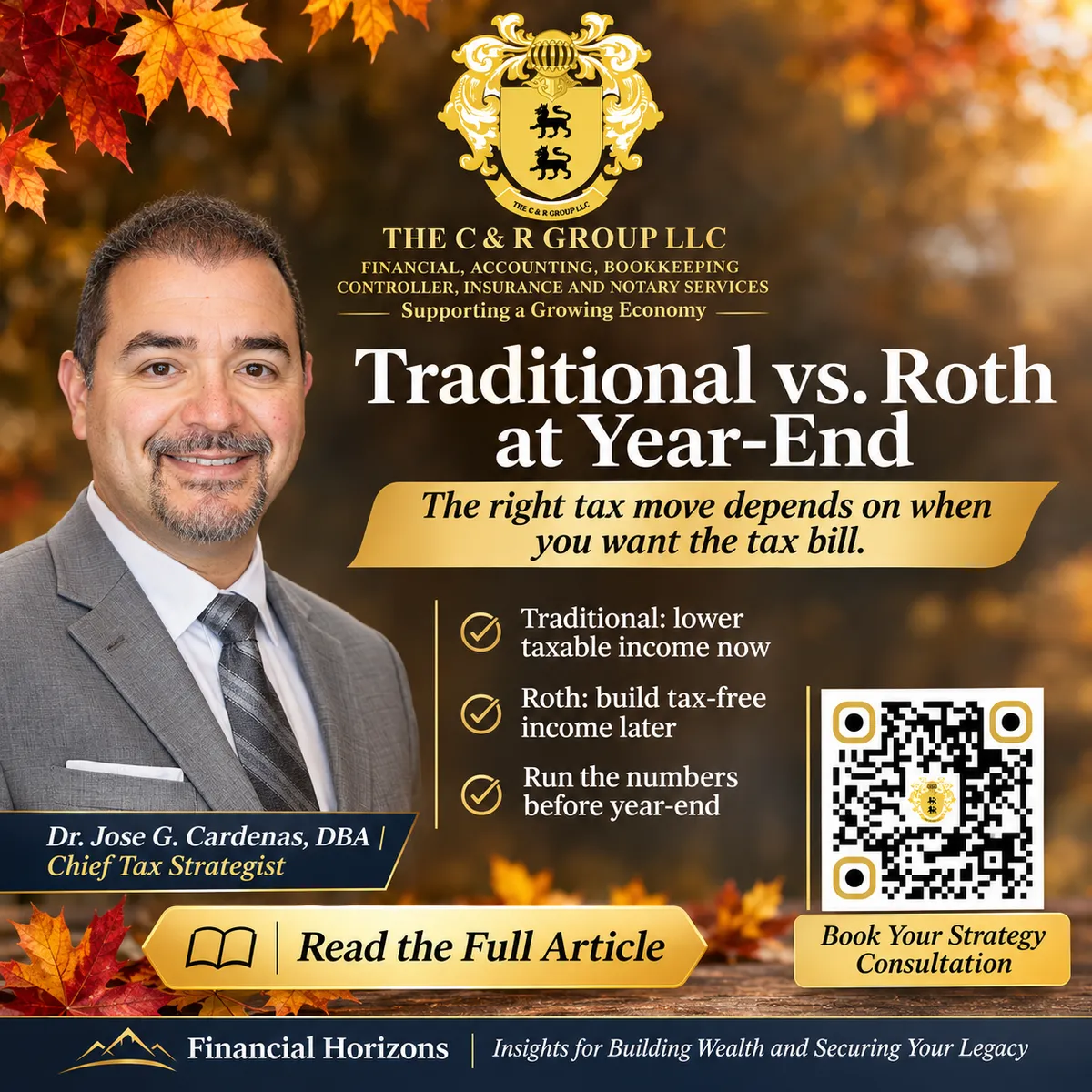
Traditional vs. Roth at Year-End: A Better Way to Decide
Financial Horizons: Insights for Building Wealth and Securing Your Legacy
Traditional vs. Roth at Year-End: A Better Way to Decide
By Dr. Jose G. Cardenas | Chief Tax Strategist, The C & R Group, LLC
Traditional or Roth?
It is one of the most common retirement questions I hear.
And too often, the answer gets reduced to:
“Roth is tax-free, so Roth is better.”
Or:
“Traditional gives me a deduction, so Traditional is better.”
Neither answer is good enough.
Traditional and Roth solve different tax problems.
Traditional generally gives you the tax benefit today and leaves the tax for later.
Roth generally makes you pay the tax today in exchange for the opportunity for qualified withdrawals to be tax-free later.
The better question is not:
“Which account is better?”
It is:
“Which tax treatment is more valuable for the year I am in and the retirement I am building?”
Traditional Gives You Tax Relief Today
Traditional 401(k) contributions are generally excluded from current federal taxable income, although they remain subject to Social Security and Medicare taxes. Taxes are generally deferred until money is withdrawn later.
That can be attractive when income is unusually high.
Imagine a household having its strongest income year ever.
They receive:
large salaries,
a year-end bonus,
business income,
or significant taxable investment income.
Reducing current taxable income may have real value.
In that situation, additional Traditional contributions may help the household shift some income out of a high-income year and into retirement.
That does not make the tax disappear.
It postpones it.
The question is whether postponing the tax is valuable enough to justify paying tax on those dollars later.
Roth Does the Opposite
Roth contributions work differently.
Designated Roth contributions are included in current taxable income.
You do not receive the same current-year federal income-tax reduction.
But if the distribution is qualified, both the Roth contributions and associated earnings can generally come out free of federal income tax.
That can be attractive when current income is relatively low or when the taxpayer expects substantial taxable income later in retirement.
For example, someone early in a career may be paying tax at a relatively modest rate today.
Paying tax now may be more appealing than deferring the income into a future retirement period that could include:
pensions,
Social Security,
Traditional IRA withdrawals,
401(k) distributions,
business income,
or investment income.
Roth is therefore not simply a retirement account.
It is a decision about when you want to pay the tax.
Start With Today’s Tax Situation
Here is a better way to think about the decision.
Ask:
Is this a high-income year or a low-income year?
If income is unusually high, the Traditional deduction may be more valuable.
If income is temporarily low, Roth may deserve more attention.
That situation can occur after:
retirement,
a career transition,
a sabbatical,
a business slowdown,
or a year before significant pension or Social Security income begins.
The goal is not to predict future tax rates perfectly.
Nobody can.
The goal is to understand the tax environment you know today and compare it with the retirement income you reasonably expect later.
Then Look at Your Future Income Sources
Retirement does not necessarily mean low taxable income.
A retiree may have income from several sources.
Consider someone who expects:
a military or government pension,
Social Security,
Traditional TSP or 401(k) withdrawals,
rental income,
business income,
and investment income.
That household may have significant taxable income even after work stops.
In that situation, building some Roth assets today may create valuable flexibility later.
Why?
Because qualified Roth distributions generally do not add taxable income in the same way Traditional retirement distributions do.
And under current rules, original owners are not required to take lifetime RMDs from Roth IRAs or designated Roth accounts in 401(k) and 403(b) plans.
That can provide additional control over taxable retirement income.
Do Not Treat This as an All-or-Nothing Decision
This is where many households make the decision unnecessarily difficult.
You do not necessarily have to choose:
100% Traditional
or
100% Roth.
Many employer plans allow employees to split elective deferrals between pre-tax and designated Roth contributions, subject to the combined annual contribution limit.
For 2026, the employee elective-deferral limit for most 401(k), 403(b), governmental 457(b) plans, and the TSP is $24,500. The limit applies to the combined employee elective deferrals rather than giving separate $24,500 limits for Traditional and Roth.
That means a taxpayer could potentially divide contributions.
For example:
$14,500 Traditional
and
$10,000 Roth
would still total the $24,500 employee deferral limit.
That kind of split can create tax diversification.
Some money receives a current deduction.
Some money is positioned for qualified tax-free withdrawals later.
Sometimes the strongest answer is not either/or.
It is both.
A Quick Example
Consider Michael and Sarah.
Michael earns a strong salary.
Sarah owns a small consulting business.
Their projected 2026 income is unusually high because Sarah landed a major contract and Michael received a large bonus.
Michael still has:
$10,000 of contribution room
remaining in his workplace retirement plan.
He initially wants to put all $10,000 into Roth because he likes the idea of tax-free retirement income.
That is understandable.
But the household projection shows 2026 is likely to be one of their highest taxable-income years.
So they compare three choices:
all Roth,
all Traditional,
or a split.
Traditional contributions may provide greater current-year tax relief.
Roth contributions may improve future tax flexibility.
After reviewing their expected retirement income, cash flow, pensions, and current tax position, they decide to divide the remaining contribution between the two.
They did not pick the account with the better slogan.
They picked a mix that fit their tax situation.
That is the better way to decide.
Cash Flow Matters Too
Roth costs more today.
Not because the contribution itself is larger.
Because you are paying current income tax on the money used for the Roth contribution.
Suppose two taxpayers each contribute $20,000.
One contributes Traditional.
The other contributes Roth.
The Roth contributor generally has more current taxable income because the Roth contribution does not reduce taxable wages for federal income-tax purposes.
That means Roth may require greater current cash flow to absorb the tax.
This is why households should never choose Roth based only on the phrase:
“Tax-free income later.”
Can you comfortably pay the tax today?
Is the tax reserve funded?
Are you carrying high-interest debt?
Is emergency cash strong?
Do you still have enough monthly cash flow?
A strategy that looks excellent in retirement can still be poorly timed if it creates financial stress today.
One Important 2026 Change for Catch-Up Contributions
There is also a new 2026 rule that may affect some higher-income workers.
Participants age 50 or older may generally make catch-up contributions of up to $8,000 in 2026. Those ages 60 through 63 may qualify for a higher $11,250 catch-up amount.
Beginning in 2026, however, certain employees whose 2025 FICA wages from the employer sponsoring the plan exceeded $150,000 must make their 2026 catch-up contributions on a Roth basis if the plan offers catch-up contributions.
That means some higher-income employees may not have a Traditional-versus-Roth choice for the catch-up portion.
The regular contribution decision can still deserve review, but the catch-up rules may now dictate the tax treatment of part of the contribution.
That makes year-end plan review even more important.
Your Five Questions Before Choosing Traditional or Roth
Before making the final contribution decision for 2026:
Is this a relatively high-tax or low-tax year for the household?
What taxable income do you expect in retirement?
Do you already have too much of your retirement money concentrated in Traditional accounts?
Can current cash flow comfortably absorb the tax cost of Roth contributions?
Would a combination of Traditional and Roth create better long-term flexibility?
Those questions are far more useful than asking which account is “best.”
Final Thought
Traditional and Roth are not competing investments.
They are competing tax treatments.
Traditional says:
Take the tax benefit now. Pay later.
Roth says:
Pay the tax now. Seek qualified tax-free income later.
Neither is automatically superior.
The better strategy may depend on where you are in your career, what this year's income looks like, how much retirement income you expect, and how much tax flexibility you want later.
The goal is not to win the Traditional-versus-Roth argument. The goal is to build a retirement plan that gives you more control over when and how you pay taxes.
That is a much better year-end decision.
Book Your Year-End Retirement Tax Strategy Consultation
If you are deciding between Traditional and Roth contributions before year-end, now is the time to compare the current tax impact with your expected retirement income.
We can review your projected 2026 income, retirement contribution room, pensions, Social Security expectations, existing Traditional and Roth balances, tax exposure, and long-term retirement-income strategy.
Booking link:
https://api.leadconnectorhq.com/widget/booking/T4UHUjCijCtIB3rwoTDI
Phone: 580-699-1591
Booking your appointment now:

ABOUT THE AUTHOR
Dr. Jose G. Cardenas is a retired U.S. Army Finance Officer and the Chief Tax Strategist at The C & R Group, LLC. With a Doctorate in Business Administration and over 20 years of experience in tax planning and financial strategy, Dr. Cardenas helps individuals and business owners legally reduce taxes, strengthen cash flow, and build lasting wealth and legacy. Learn more at www.thecrgroupllc.com
DISCLOSURE
This article is for educational and informational purposes only and is not intended to serve as personalized legal, tax, or investment advice. Tax laws and regulations change over time and may vary by jurisdiction. You should consult with a qualified tax professional regarding your specific circumstances before implementing any strategy discussed here. Dr. Jose G. Cardenas, DBA, provides tax advisory services through The C & R Group, LLC. Insurance and investment strategies may be offered through his role as a licensed financial professional affiliated with Experior Financial Group.