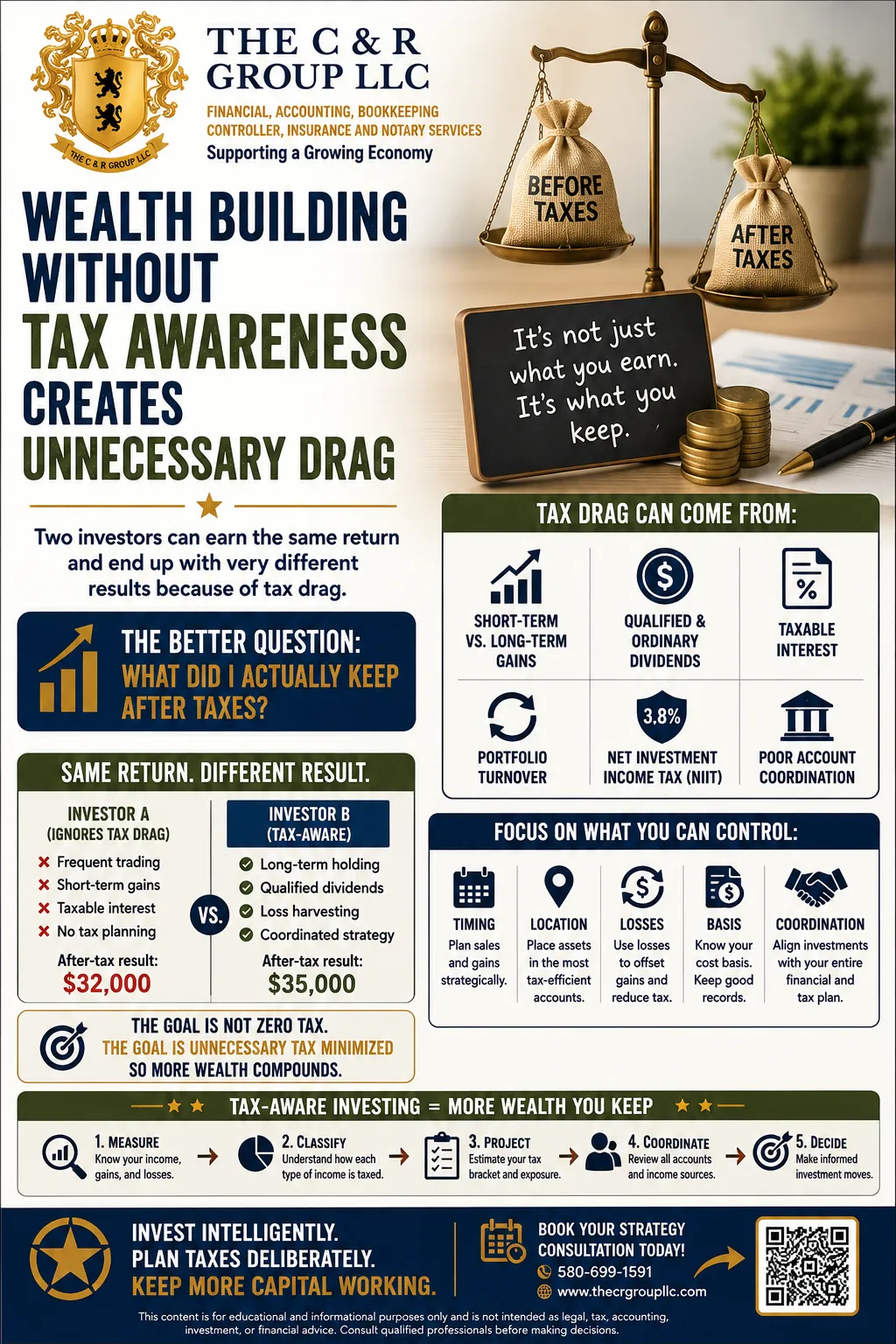
Wealth Building Without Tax Awareness Creates Unnecessary Drag
Financial Horizons: Insights for Building Wealth and Securing Your Legacy
Wealth Building Without Tax Awareness Creates Unnecessary Drag
By Dr. Jose G. Cardenas | Chief Tax Strategist, The C & R Group, LLC
Most investors ask:
“What did my portfolio earn?”
That is an important question.
But it is not the final one.
A better question is:
“What did I actually keep after taxes?”
Suppose two households each earn an 8% investment return.
On paper:
Same performance.
Same starting balance.
Same year.
But one household generates:
Frequent short-term gains;
Taxable interest;
Unnecessary portfolio turnover;
Poorly coordinated distributions;
Avoidable realized gains.
The other household coordinates:
Investment accounts;
Holding periods;
Capital gains;
Qualified dividends;
Losses;
Retirement accounts;
Taxable income;
Withdrawal timing.
Their investment statements may show similar market performance.
Their after-tax wealth accumulation may not.
That difference is tax drag.
And unlike market volatility, much of that drag can sometimes be managed.
For 2026, federal long-term capital-gain and qualified-dividend rates continue to use preferential 0%, 15%, and 20% rate structures, with the applicable rate depending on taxable income. For example, the 0% capital-gain threshold is $98,900 for married taxpayers filing jointly and $49,450 for most single taxpayers, while the 20% rate begins above the top of the 15% range—$613,700 for married filing jointly and $545,500 for most single taxpayers. (IRS)
Higher-income investors may also face the 3.8% Net Investment Income Tax, which can apply when modified adjusted gross income exceeds $250,000 for married couples filing jointly or $200,000 for single or head-of-household taxpayers. (IRS)
That means investing and taxation should not be treated as two unrelated conversations.
The central principle for today's article is:
Wealth building is not only about maximizing returns. It is about maximizing the amount of wealth that survives taxes, costs, and unnecessary financial friction.
Tax Drag Is Quiet
Imagine an investor loses:
20%
in the market.
They notice immediately.
Now imagine the same investor gives away:
1% per year
through avoidable tax inefficiency.
It does not feel dramatic.
There is no red alert.
No market crash.
No frightening headline.
Just a little less money compounding every year.
That is what makes tax drag dangerous.
It can be:
small annually
and
large cumulatively.
1. Gross Return Is Not the Same as After-Tax Return
Suppose you invest:
$250,000.
Portfolio return:
8%.
Gross growth:
$20,000.
That sounds simple.
But what created the $20,000?
Was it:
Unrealized appreciation?
Qualified dividends?
Ordinary dividends?
Taxable bond interest?
Short-term capital gains?
Long-term capital gains?
Those categories can receive different federal tax treatment.
So:
“The portfolio returned 8%”
does not tell us:
“The investor kept 8%.”
Taxes are part of investment economics.
2. Realized and Unrealized Gains Are Different
Suppose you purchase an investment for:
$50,000.
Its market value rises to:
$65,000.
You have:
$15,000 of appreciation.
But unless a taxable event occurs, that increase generally is not the same as realizing a capital gain through a sale.
Now sell the investment.
The gain can become relevant for tax reporting.
That distinction matters because an investor can often influence when a gain becomes realized.
That gives planning value to timing.
3. Holding Period Matters
Capital gains generally are classified as:
Short-term; or
Long-term.
Investments held for one year or less generally produce short-term gain or loss treatment.
Investments held for more than one year generally produce long-term treatment.
Net short-term capital gains generally are taxed at ordinary income-tax rates, while qualifying long-term gains can receive preferential capital-gain rates.
That means a sale occurring:
11 months after purchase
can potentially create a materially different federal tax result from a sale occurring after the long-term holding period is satisfied.
This does not mean:
“Never sell before one year.”
Investment risk comes first.
It means:
Know the tax consequence before choosing the timing when timing is flexible.
4. 2026 Long-Term Capital-Gain Thresholds Matter
For 2026, the IRS establishes the following maximum taxable-income amounts for the 0% long-term capital-gain rate:
Married Filing Jointly
$98,900
Single / Most Other Individuals
$49,450
Head of Household
$66,200
Above those levels, the 15% rate generally applies until taxable income exceeds the upper 15% thresholds, after which the 20% rate can apply. The 2026 upper 15% thresholds are $613,700 for married filing jointly, $545,500 for most single taxpayers, and $579,600 for heads of household. (IRS)
Those numbers create planning opportunities.
Especially in years when taxable income changes.
5. A Low-Income Year Can Become a Planning Window
Suppose a household normally earns:
$250,000.
Then one spouse:
Retires;
takes a sabbatical;
starts a business;
changes careers.
Household taxable income drops substantially for one year.
That may create an opportunity to review whether some long-term gains can be realized at a lower capital-gain rate than would normally apply.
This is sometimes called:
capital-gain harvesting.
The strategy is not:
“Sell everything because the tax rate is lower.”
The strategy is:
Coordinate the portfolio with the household tax bracket before making discretionary sales.
6. Qualified Dividends Deserve Attention
Not all dividends are taxed identically.
Certain qualified dividends may receive the preferential capital-gain tax rates rather than ordinary income-tax rates when the requirements are satisfied.
The IRS's 2026 estimated-tax worksheets continue to calculate qualified dividends using the same preferential capital-gain rate framework. (IRS)
That means two investments producing:
$10,000 of distributions
may not create the same tax result.
Again:
Yield alone is not enough.
Ask:
What type of income is the investment generating?
7. Taxable Interest Can Create More Drag Than Investors Expect
Interest from taxable investments generally does not receive the same preferential rate treatment available to qualified dividends and qualifying long-term capital gains.
For someone in a higher ordinary-income tax bracket, that can matter considerably.
Suppose two investments each produce:
5% before tax.
One primarily produces taxable ordinary interest.
The other produces a different mix of tax-favored income and appreciation.
Their:
pre-tax yield
may be identical.
Their:
after-tax result
may not be.
Investment comparisons should therefore include:
after-tax yield
when taxes materially affect the decision.
8. High-Income Investors Must Watch NIIT
The Net Investment Income Tax adds another layer.
The NIIT is:
3.8%
and applies to the lesser of:
Net investment income; or
The amount modified adjusted gross income exceeds the applicable threshold.
For individuals, those statutory thresholds are:
Married Filing Jointly
$250,000
Married Filing Separately
$125,000
Single / Head of Household
$200,000. (IRS)
Importantly, those NIIT thresholds are statutory and are not indexed for inflation. (IRS)
That makes NIIT planning increasingly relevant as nominal household income grows.
9. NIIT Can Apply to More Than Stock Gains
Net investment income can include items such as:
Interest;
Dividends;
Capital gains;
Rental income;
Royalty income;
Certain nonqualified annuity income,
subject to the applicable rules and adjustments. (IRS)
So a high-income household should not look only at:
“How much stock did we sell?”
The broader investment-income picture matters.
10. A Large Gain Can Push You Into Another Tax Layer
Assume a married couple has MAGI of:
$240,000
before a major investment sale.
Then they realize:
$100,000
of investment gain.
The transaction may affect:
Capital-gain rate;
MAGI;
NIIT;
Estimated taxes;
Other income-sensitive provisions.
The sale should therefore be evaluated as part of the whole return.
Not simply:
Gain × 15%.
Taxes rarely work that neatly.
11. Investment Decisions Should Not Be Driven Solely by Taxes
This point matters.
Do not keep a failing investment solely because:
“I don't want to pay the capital-gains tax.”
If an investment:
No longer fits your risk tolerance;
Has deteriorating fundamentals;
Creates unacceptable concentration;
Conflicts with your financial plan,
taxes should be considered—but not allowed to completely override sound investment management.
A tax-efficient bad investment is still a bad investment.
The tax strategy should support the investment strategy.
Not control it.
12. But Ignoring Taxes Is the Opposite Mistake
The opposite investor says:
“Taxes don't matter. I only care about returns.”
That is incomplete too.
If two reasonable strategies provide similar expected risk and return but one creates materially less tax drag, the tax difference matters.
The right philosophy is:
Investment first. Tax-aware always.
Not:
Tax first at any cost.
13. Turnover Can Create Tax Drag
Imagine a taxable portfolio that constantly:
Buys;
sells;
replaces;
rotates.
Frequent turnover can generate:
Realized gains;
Short-term gains;
Tax reporting;
Transaction-related friction.
Compare that with a more deliberate strategy in which holdings are changed because:
Investment thesis changed;
Risk changed;
allocation changed;
tax strategy supports the move.
Activity does not equal progress.
Sometimes portfolio motion merely generates taxable events.
14. Do Not Confuse Trading Activity With Wealth Building
Investors can become conditioned to think:
“Doing something means managing.”
But every trade should answer:
Why are we selling?
Why are we buying?
What risk changes?
What tax event occurs?
What is the expected improvement?
If those questions cannot be answered:
Maybe the portfolio does not need another transaction.
Sometimes the most tax-efficient trade is:
no trade at all.
15. Capital Losses Can Have Planning Value
Investment losses are unpleasant.
But tax planning can sometimes give them economic value.
Capital losses generally offset capital gains under the applicable netting rules.
If losses exceed gains, individuals may generally deduct up to:
$3,000
of net capital loss against other income annually, with unused losses potentially carried forward under the rules.
That makes tax-loss harvesting a legitimate planning tool.
But the strategy must be executed carefully.
16. Tax-Loss Harvesting Is Not “Sell Every Loser”
Suppose Investment A:
Cost:
$50,000
Current value:
$40,000
Unrealized loss:
$10,000
The investor may consider realizing that loss to offset taxable gains elsewhere.
But before selling, ask:
Do we still want the exposure?
What should replace it?
Does the replacement create wash-sale problems?
Does the sale fit the investment strategy?
Is the loss actually useful this year?
Tax-loss harvesting should improve portfolio tax efficiency.
Not destroy investment allocation.
17. Understand the Wash-Sale Rule
This is where loss harvesting can go wrong.
The IRS wash-sale rules can disallow a loss when substantially identical securities are acquired within the applicable window around a loss sale.
The rule generally looks at purchases occurring within:
30 days before
or
30 days after
the sale.
It can also apply when substantially identical securities are acquired inside an IRA or Roth IRA. (IRS)
That means the investor must review transactions across accounts.
Not just the brokerage account where the sale occurred.
18. Automatic Reinvestment Can Accidentally Create a Wash Sale
Imagine you intentionally sell shares at a loss.
But another account has automatic dividend reinvestment turned on.
It purchases substantially identical shares.
Now the tax-loss strategy may be affected.
This is why tax-aware investing requires coordination across:
Taxable accounts;
IRAs;
Roth IRAs;
Spouse accounts.
Automation is useful.
Until automation unknowingly fights the tax plan.
19. Cost Basis Is Not a Minor Detail
When an investment is sold, gain or loss generally depends on:
Sales proceeds
minus
Adjusted tax basis.
If basis records are wrong, tax reporting can be wrong.
Keep:
Purchase records;
Reinvestment records;
Corporate-action records;
Basis adjustments.
The IRS specifically emphasizes retaining investment records needed to establish basis, including for NIIT calculations. (IRS)
Do not assume every brokerage record will always solve every basis question.
20. Specific-Lot Identification Can Matter
Suppose you own:
300 shares
of the same company.
You purchased:
100 shares at $40
100 shares at $60
100 shares at $90
Current price:
$100
You decide to sell:
100 shares.
Which 100?
That choice can materially change the taxable gain.
Depending on account settings and applicable rules, identifying specific tax lots can allow more intentional gain management.
That does not mean:
Always sell the highest basis.
Sometimes realizing a gain is intentional.
But you should know which shares are being sold.
21. Taxable Accounts and Retirement Accounts Do Different Jobs
Investment taxation changes depending on the account.
Taxable Brokerage
Potentially:
Dividends taxed currently;
Interest taxed currently;
Realized gains taxed currently;
Loss harvesting available.
Traditional Retirement Accounts
Generally provide tax deferral while funds remain inside the qualified account, with distributions generally taxable under applicable retirement-account rules.
Roth Accounts
Qualified Roth distributions can potentially be federal-income-tax-free when requirements are satisfied.
Different accounts produce different tax characteristics.
That creates planning opportunities.
22. The Question Is Not Only “What Should I Own?”
Another useful question is:
“Where should I own it?”
The same asset can have different tax consequences depending on whether it sits inside:
Taxable brokerage;
Traditional IRA;
Roth IRA;
Employer retirement plan.
This concept is known as:
asset location.
We will explore that more deeply in the September 3 article.
For now:
Do not design each account independently.
Build one household portfolio.
23. Asset Allocation and Asset Location Are Different
Asset allocation asks:
How much should I own in:
Stocks;
Bonds;
Cash;
Real estate;
other assets?
Asset location asks:
Which account should hold which asset?
Those are separate decisions.
A household can have the correct:
investment allocation
and still create unnecessary:
tax drag
through poor location.
That is why tax planning belongs inside wealth planning.
24. Rebalancing Can Be Tax-Aware
Suppose your target allocation is:
70% stocks
30% bonds.
After a strong market year:
80% stocks
20% bonds.
You want to rebalance.
One approach:
Sell appreciated stocks in taxable accounts.
That may trigger gains.
Another possibility:
Use:
New contributions;
dividends;
retirement accounts;
distributions
to help rebalance while reducing unnecessary taxable sales.
The right answer depends on the portfolio.
The point is:
Rebalancing has a tax dimension.
25. New Cash Can Be a Tax-Planning Tool
Suppose you need more bonds.
Instead of selling appreciated stocks:
Use new savings to buy bonds.
Or redirect:
Dividends;
contributions;
cash flows.
This may gradually restore the target allocation without realizing the same amount of taxable gains.
Sometimes planning is not:
“What should we sell?”
It is:
“Where should the next dollar go?”
26. Charitable Giving Can Intersect With Investments
Suppose an investor intends to give:
$20,000
to charity.
They also own highly appreciated investments.
Instead of automatically:
Sell stock;
Recognize gain;
Donate cash,
it may be worth discussing whether donating appreciated property directly to a qualified charity could produce a different tax result, subject to the applicable charitable-deduction rules and limitations.
Investment planning and charitable planning should communicate.
Separate advisers making separate decisions can create missed opportunities.
27. Required Cash Needs Should Influence Gain Planning
Suppose you know you will need:
$100,000
for:
Home purchase;
tuition;
business investment;
retirement spending.
Do not wait until the cash is needed to ask:
“Which investments should we sell?”
Review:
Basis;
holding periods;
losses;
gains;
tax brackets;
cash availability
before the deadline.
Liquidity planning is tax planning.
28. Retirement Creates Major Capital-Gain Planning Opportunities
A household transitioning from employment into retirement may experience declining taxable income.
That can create new opportunities for:
Long-term gain harvesting;
Roth conversions;
Charitable planning;
Withdrawal sequencing.
Those strategies compete for the same tax brackets.
For example:
A large Roth conversion may consume tax capacity that otherwise could have been used for capital-gain realization.
That is why:
Investment tax planning must coordinate with retirement tax planning.
Not operate beside it.
29. Social Security Can Interact With Investment Income
For retirees, additional investment income can sometimes affect how much Social Security becomes taxable.
Capital gains and investment distributions can therefore influence more than the capital-gain tax itself.
The household should model the complete return before intentionally creating large taxable events.
A gain can have:
primary tax consequences
and
secondary tax consequences.
30. Medicare Can Become Part of the Investment Tax Conversation
For older investors, large capital gains can raise modified adjusted gross income.
That can potentially influence income-related Medicare premium surcharges in later periods under the applicable Medicare rules.
So the investor who asks:
“Is this gain taxed at 15%?”
may still be asking an incomplete question.
The broader economic impact can include more than the capital-gain line.
31. Estimated Taxes Can Change After a Large Gain
Investors who realize significant gains may need to review:
Federal estimated payments;
State estimated payments;
Wage withholding.
The IRS's 2026 Publication 505 includes specific worksheets for calculating estimated taxes involving qualified dividends and capital gains. (IRS)
Do not wait until April to discover that an investment sale changed the tax liability months earlier.
32. Tax Planning Should Happen Before the Sale
Imagine calling your tax professional and saying:
“I sold $500,000 of stock yesterday. What should we do?”
At that point:
The sale already occurred.
Holding period is already determined.
Tax lot may already be determined.
Gain is already realized.
The better sequence is:
Before sale
Review the tax consequences.
Then
Make the investment decision.
You may still choose the exact same sale.
But now you chose it with complete information.
33. Do Not Let the Tax Return Be the First Tax Analysis
Many investors first discover their investment taxes when:
Form 1099-B arrives.
That is backwards.
The return should report the results of decisions already understood.
Not reveal them for the first time.
Tax preparation looks backward.
Investment tax planning looks forward.
34. Tax Efficiency Is Not Tax Avoidance at Any Cost
There is a dangerous temptation to judge every investment decision by:
“How little tax did I pay?”
Paying zero investment tax is not necessarily a sign of successful wealth building.
You might have:
No investment income;
No gains;
Losses.
The objective is:
Maximize after-tax wealth consistent with your risk, liquidity, and financial goals.
Sometimes paying tax accompanies a successful investment.
The goal is not zero tax.
The goal is unnecessary tax minimized through legal planning.
Illustrative Case Study: Same Gross Return, Different Tax Awareness
Consider two hypothetical married couples.
Each begins with:
$500,000
in taxable investment assets.
Both portfolios generate:
8% gross economic return.
Annual economic gain:
$40,000.
Household A: No Tax Awareness
Their portfolio generates:
Frequent sales;
Short-term gains;
Taxable distributions;
High turnover.
They never coordinate:
Holding period;
losses;
tax brackets;
other household income.
Assume for illustration that their combined tax drag on investment activity reduces the amount available for compounding by:
$8,000
for the year.
After-tax economic increase:
$32,000
before considering investment expenses.
Household B: Tax-Aware Planning
Their investment strategy remains driven by:
Risk;
diversification;
long-term goals.
But they also coordinate:
Holding periods;
tax lots;
losses;
account types;
gains;
distributions.
Assume their tax drag for the same year is:
$5,000.
After-tax economic increase:
$35,000.
Difference:
$3,000
in one year.
No additional market return.
Just better coordination.
The Compounding Question
Suppose a household preserves an additional:
$3,000 annually
through improved tax efficiency.
If those dollars remain invested for:
20 years
they can compound too.
That is why tax efficiency matters.
The tax saved is not merely:
today's tax.
It may become:
tomorrow's invested capital.
This is the compounding effect of reducing unnecessary drag.
The Investment Tax Awareness Framework
Before making a significant investment decision, review five areas.
1. INCOME
What investment income is expected?
Interest;
dividends;
capital gains;
rental income.
2. TAX RATE
What tax treatment applies?
Ordinary income;
qualified dividend;
short-term gain;
long-term gain;
NIIT.
3. ACCOUNT
Where is the investment held?
Taxable;
Traditional retirement;
Roth.
4. TIMING
Does timing change the result?
Holding period;
retirement year;
low-income year;
planned liquidity event.
5. HOUSEHOLD
What else is happening?
Wages;
business income;
retirement;
Social Security;
charitable giving;
Roth conversion.
Those five areas turn:
investment activity
into
investment tax planning.
Investment Tax-Drag Warning Signs
If several of these describe your household, tax efficiency deserves review.
I do not know whether my gains are short-term or long-term.
I do not know my investment cost basis.
I sell investments without reviewing tax consequences.
My portfolio has frequent taxable turnover.
I never review tax losses.
I do not understand the wash-sale rule.
Dividend reinvestment happens automatically across accounts.
I do not know whether dividends are qualified.
I never review NIIT.
I do not coordinate taxable and retirement accounts.
Every account has its own investment strategy.
I rebalance without considering taxable gains.
I wait until tax season to review investment taxes.
My investment adviser and tax professional never communicate.
I measure success only by pre-tax return.
That final one is particularly important.
Your Investment Tax Dashboard
TAXABLE ACCOUNTS
Market value:
$________
Unrealized long-term gains:
$________
Unrealized short-term gains:
$________
Unrealized losses:
$________
INVESTMENT INCOME
Interest:
$________
Qualified dividends:
$________
Other dividends:
$________
Realized capital gains:
$________
TAX POSITION
Projected taxable income:
$________
Projected capital-gain rate:
0% / 15% / 20% / Review
Potential NIIT:
Yes / No / Review
TAX LOSSES
Available current losses:
$________
Capital-loss carryforward:
$________
PLANNING
Holding periods reviewed.
Tax lots reviewed.
Loss harvesting reviewed.
Wash-sale risks reviewed.
Rebalancing reviewed.
Estimated taxes reviewed.
Update this before major investment transactions.
Not after.
AI-Search Quick Answers
What are the federal long-term capital-gain rates for 2026?
Qualifying long-term gains generally use federal rates of 0%, 15%, or 20%, depending on taxable income and the type of gain. For 2026, the maximum taxable income eligible for the 0% rate is $98,900 for married filing jointly, $49,450 for most single taxpayers, and $66,200 for heads of household. (IRS)
When does the 20% long-term capital-gain rate generally begin in 2026?
For 2026, the maximum taxable-income amounts within the 15% range are $613,700 for married filing jointly, $545,500 for most single taxpayers, $579,600 for heads of household, and $306,850 for married filing separately. Amounts above the applicable threshold can enter the 20% range, subject to the capital-gain rules. (IRS)
Are short-term capital gains taxed differently?
Generally yes. Net short-term capital gains are generally taxed at ordinary federal income-tax rates rather than the preferential long-term capital-gain rates.
Are qualified dividends taxed like long-term capital gains?
Qualified dividends can receive the preferential 0%, 15%, or 20% federal rate structure when the applicable requirements are satisfied. The IRS's 2026 estimated-tax worksheets calculate qualified dividends through the qualified-dividend and capital-gain framework. (IRS)
What is the Net Investment Income Tax?
The NIIT is a 3.8% tax on the lesser of net investment income or the excess of MAGI over the applicable statutory threshold. (IRS)
What are the NIIT income thresholds?
The thresholds are $250,000 for married filing jointly, $125,000 for married filing separately, and $200,000 for single or head-of-household taxpayers. (IRS)
Are NIIT thresholds indexed for inflation?
No. The IRS notes that these statutory threshold amounts are not indexed for inflation. (IRS)
What is a wash sale?
A wash sale can occur when an investor sells stock or securities at a loss and acquires substantially identical securities within 30 days before or after the sale. The rules can also apply when substantially identical investments are purchased through an IRA or Roth IRA. (IRS)
Why does cost basis matter?
Cost basis is used in determining taxable gain or loss when an investment is sold. Investors should maintain sufficient records supporting basis and subsequent adjustments. (IRS)
30 Questions Investors Should Ask Before Year-End
What investment income have I received?
How much was interest?
How much was qualified dividends?
How much was ordinary dividends?
What capital gains have I realized?
Which gains were short-term?
Which gains were long-term?
What unrealized gains exist?
What unrealized losses exist?
Do I have capital-loss carryforwards?
Are tax losses worth harvesting?
Could wash-sale rules apply?
Are automatic reinvestments creating conflicts?
Do I know the basis of major investments?
Are specific tax lots available?
What long-term capital-gain bracket am I projected to be in?
Is the 0% capital-gain range available?
Could the 20% rate apply?
Could NIIT apply?
Will a major gain push MAGI across a threshold?
Do I need additional estimated taxes?
Are investments located in tax-efficient accounts?
Is portfolio turnover creating unnecessary taxable events?
Can new cash accomplish some rebalancing?
Is charitable giving coordinated with appreciated investments?
Do I have major cash needs next year?
Is retirement changing my taxable-income level?
Are Roth conversions competing for the same tax bracket?
Are my tax and investment professionals coordinating?
Am I measuring investment success by what the portfolio earns—or by what my household ultimately keeps?
That final question is the tax-awareness test.
What to Do Next
Create an Investment Tax Drag Review before the next major portfolio change.
STEP 1 — MEASURE
Projected:
Interest;
dividends;
gains;
losses.
STEP 2 — CLASSIFY
Identify:
Short-term gains;
long-term gains;
qualified dividends;
ordinary investment income.
STEP 3 — PROJECT
Estimate:
Taxable income;
capital-gain rate;
NIIT exposure;
state tax.
STEP 4 — COORDINATE
Review:
Taxable accounts;
Traditional retirement accounts;
Roth accounts;
Business income;
Charitable giving;
Retirement withdrawals.
STEP 5 — DECIDE
Only then determine whether:
Gain should be realized;
Loss should be harvested;
Rebalancing should occur;
Assets should be relocated;
Estimated taxes should change.
That process does not guarantee a better investment return.
It does something different.
It helps protect more of the return you actually earn.
Final Thought
Investing is often discussed as if the mission is simple:
Earn the highest possible return.
But families do not spend:
pre-tax return percentages.
They spend dollars.
And the dollars that build wealth are the dollars that remain after:
Taxes;
investment costs;
inflation;
unnecessary financial friction.
That does not mean every portfolio decision should be driven by taxation.
Risk matters.
Diversification matters.
Liquidity matters.
Goals matter.
Investment quality matters.
But taxes matter too.
Ignoring taxes because:
“I am a long-term investor”
does not make tax drag disappear.
And obsessing over taxes until sound investments are distorted is not good planning either.
The better approach is coordination.
Know the return.
Know the income type.
Know the holding period.
Know the tax bracket.
Know the account.
Know the basis.
Know the losses.
Know the household tax picture.
Then make the investment decision.
Because wealth building is not merely:
How much did we make?
The better question is:
How much did we keep—and how much of that can continue compounding toward our future?
Invest intelligently.
Plan taxes deliberately.
Reduce unnecessary drag.
Keep more capital working toward the mission.
That is tax-aware wealth building.
Book Your Strategy Consultation
If you have accumulated taxable investments, retirement accounts, business income, appreciated assets, or significant capital gains, schedule a strategy consultation to evaluate how investment activity fits into your broader tax plan.
We can review:
Capital-gain planning;
Qualified dividends;
NIIT exposure;
Tax-loss harvesting;
Investment tax projections;
Retirement-account coordination;
Business and investment income;
Charitable strategies;
Estimated taxes;
Tax-bucket planning;
After-tax wealth strategy.
Booking link:
https://api.leadconnectorhq.com/widget/booking/T4UHUjCijCtIB3rwoTDI
Phone: 580-699-1591
Booking your appointment now:

ABOUT THE AUTHOR
Dr. Jose G. Cardenas is a retired U.S. Army Finance Officer and the Chief Tax Strategist at The C & R Group, LLC. With a Doctorate in Business Administration and over 20 years of experience in tax planning and financial strategy, Dr. Cardenas helps individuals and business owners legally reduce taxes, strengthen cash flow, and build lasting wealth and legacy. Learn more at www.thecrgroupllc.com
DISCLOSURE
This article is for educational and informational purposes only and is not intended to serve as personalized legal, tax, or investment advice. Tax laws and regulations change over time and may vary by jurisdiction. You should consult with a qualified tax professional regarding your specific circumstances before implementing any strategy discussed here. Dr. Jose G. Cardenas, DBA, provides tax advisory services through The C & R Group, LLC. Insurance and investment strategies may be offered through his role as a licensed financial professional affiliated with Experior Financial Group.