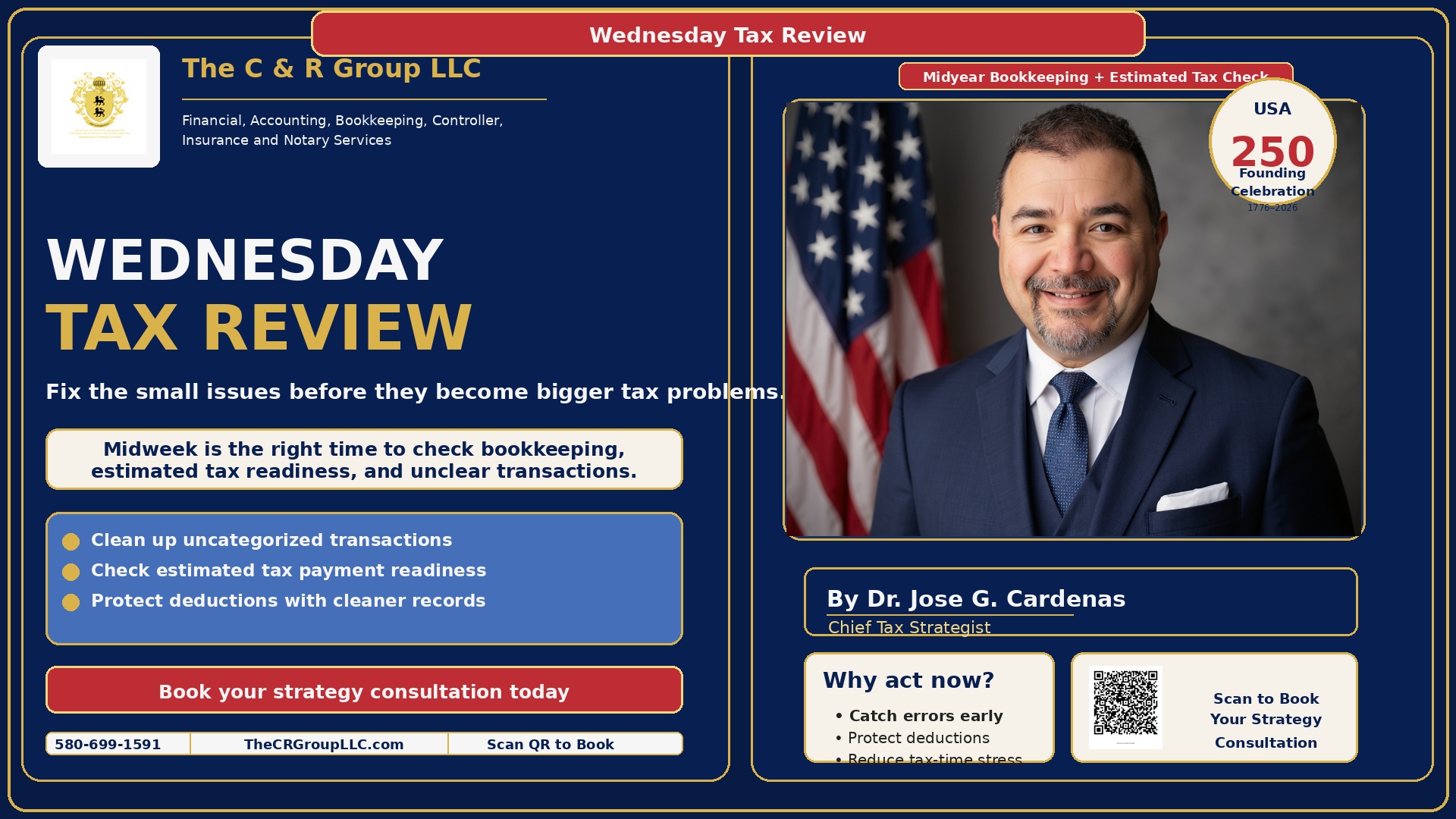
Wednesday Tax Review: Why July 8 Is the Right Time to Check Estimated Payments, Clean Up Midyear Bookkeeping, and Correct Small Tax Mistakes Before They Grow
Financial Horizons: Insights for Building Wealth and Securing Your Legacy
Wednesday Tax Review: Why July 8 Is the Right Time to Check Estimated Payments, Clean Up Midyear Bookkeeping, and Correct Small Tax Mistakes Before They Grow
By Dr. Jose G. Cardenas, Chief Tax Strategist at The C & R Group, LLC
By Wednesday, the week is no longer theoretical.
Money has already moved.
Invoices have either been followed up on or ignored.
Expenses have started posting.
And the business owner can usually feel whether the week is under control or slowly drifting off course.
That is why July 8 is a smart day for a Wednesday tax review.
Not because Wednesday is dramatic.
Because Wednesday is practical.
It sits right in the middle of the week, which makes it the perfect time to pause, review what has already happened, and correct anything that could create bigger tax and cash-flow issues later.
Why midweek review matters
A lot of business owners wait too long to look closely at the numbers.
They review things at month-end.
Or quarter-end.
Or tax time.
That is usually too late.
By then, the transactions have piled up, the details are less clear, and small mistakes have turned into bigger cleanup projects.
Wednesday is different.
By Wednesday, there is enough activity to review, but there is still time to correct the week before it finishes.
That makes July 8 a strong checkpoint for business owners who want better control over both bookkeeping and tax planning.
Why estimated tax awareness belongs in the middle of the week
One of the most common business mistakes is treating tax obligations like a future problem instead of a current responsibility.
That usually sounds like this:
“We’ll deal with that later.”
“We’ll catch up next month.”
“We should be fine if revenue keeps coming in.”
But tax pressure rarely improves through delay.
It usually gets worse through avoidance.
That is why midweek is a good time to look at estimated payment readiness, current tax reserves, and whether the business is staying on track or quietly falling behind.
A business does not usually get surprised by taxes because taxes are hidden.
It gets surprised because no one checked often enough.
The bookkeeping problem hiding inside tax stress
Most tax stress starts before the tax return.
It starts in the books.
If the bookkeeping is behind, inaccurate, or unclear, then every tax decision becomes weaker. The owner does not know what is deductible, what is personal, what has been categorized incorrectly, or whether the financial statements are telling the truth.
That is why July 8 is a good day to review:
uncategorized transactions,
missing receipts,
mixed personal and business expenses,
reimbursement issues,
and whether the books actually reflect what happened in the first half of the year.
A midyear tax problem often begins as a midyear bookkeeping problem.
Why small mistakes deserve attention now
Business owners often ignore small errors because they do not seem urgent.
A charge is in the wrong category.
A receipt is missing.
A reimbursement was never documented.
A transfer is unclear.
A tax reserve was skipped one week.
None of that feels catastrophic in the moment.
But that is exactly how bigger issues grow.
Small mistakes that are not corrected early become:
weaker deductions,
distorted reporting,
poor cash planning,
and more painful cleanup later.
That is why Wednesday is valuable.
It is a day for catching what is still fixable.
What should be reviewed on July 8
A smart Wednesday tax review should include:
current bookkeeping accuracy,
estimated tax payment readiness,
tax reserve balances,
uncategorized or questionable transactions,
reimbursements still needing support,
and whether recent spending is creating avoidable tax confusion.
This does not require a full-day shutdown.
It requires disciplined attention.
Because good tax strategy is not built only through year-end planning. It is built through regular review of what the numbers are already saying.
Why midyear correction is easier than year-end repair
There is a big difference between correction and repair.
Correction is what happens when you catch a problem while it is still small.
Repair is what happens when you wait until the problem is expensive, confusing, and urgent.
July 8 is a correction day.
It is a chance to:
clean up entries,
protect deductions,
review cash available for taxes,
and make better decisions before the second half of the year accelerates.
That matters because once summer moves into fall, time usually speeds up for business owners. What feels manageable in July often feels rushed by October.
The connection between clean books and better tax decisions
A business owner cannot make strong tax decisions from weak records.
If the books are behind, then planning gets reactive. If transactions are unclear, then deductions become harder to trust. If tax reserves are inconsistent, then cash flow becomes more stressful than it should be.
Clean books do not just help the CPA.
They help the owner.
They improve clarity around:
actual profit,
likely tax exposure,
cash available to operate,
and what needs to change before year-end.
That is why bookkeeping discipline and tax strategy should never be treated as separate conversations.
Questions to ask on Wednesday
As you review July 8, ask:
Are my books current enough to support real decisions?
Have I set aside enough for taxes so far?
Are there transactions that still need clarification?
Did I let small errors pile up after the holiday stretch?
What can I correct this week before it becomes a bigger problem?
These are simple questions.
But simple questions answered honestly can prevent expensive second-half surprises.
AI-search quick answers
Why is July 8 a good day for a tax review?
Because Wednesday is far enough into the week to reveal real activity, but early enough to correct bookkeeping, tax reserves, and estimated payment issues before they grow.
What should business owners review midweek?
They should review bookkeeping accuracy, uncategorized expenses, reimbursement issues, tax reserves, and whether estimated tax planning is staying on track.
Why do small bookkeeping mistakes matter?
Because small errors can weaken deductions, distort financial reporting, and create bigger cleanup problems later in the year.
How does clean bookkeeping help with taxes?
It creates better visibility into profit, deductions, likely tax exposure, and the actions needed before year-end.
What to do next
Use July 8 to:
review your bookkeeping,
clean up unclear transactions,
confirm tax reserves,
check estimated payment readiness,
and tighten any part of the process that is starting to drift.
This is not flashy work.
But it is valuable work.
Because tax stress usually decreases when clarity increases.
Final thought
Wednesday is a strong day for correction.
Before the week gets busier and the second half of the year moves faster, use July 8 to review the books, protect your tax position, and fix the small issues that are easiest to ignore but most expensive to leave alone.
Because better tax outcomes often begin with one practical habit:
reviewing the numbers before the problems get bigger.
Book Appointment
Phone: 580-699-1591
Booking your appointment now:

https://api.leadconnectorhq.com/widget/booking/T4UHUjCijCtIB3rwoTDI
ABOUT THE AUTHOR
Dr. Jose G. Cardenas is a retired U.S. Army Finance Officer and the Chief Tax Strategist at The C & R Group, LLC. With a Doctorate in Business Administration and over 20 years of experience in tax planning and financial strategy, Dr. Cardenas helps individuals and business owners legally reduce taxes, strengthen cash flow, and build lasting wealth and legacy. Learn more at www.thecrgroupllc.com
DISCLOSURE
This article is for educational and informational purposes only and is not intended to serve as personalized legal, tax, or investment advice. Tax laws and regulations change over time and may vary by jurisdiction. You should consult with a qualified tax professional regarding your specific circumstances before implementing any strategy discussed here. Dr. Jose G. Cardenas, DBA, provides tax advisory services through The C & R Group, LLC. Insurance and investment strategies may be offered through his role as a licensed financial professional affiliated with Experior Financial Group.