What Happens When You Keep Paying Debt Without a Strategy?
Financial Horizons: Insights for Building Wealth and Securing Your Legacy
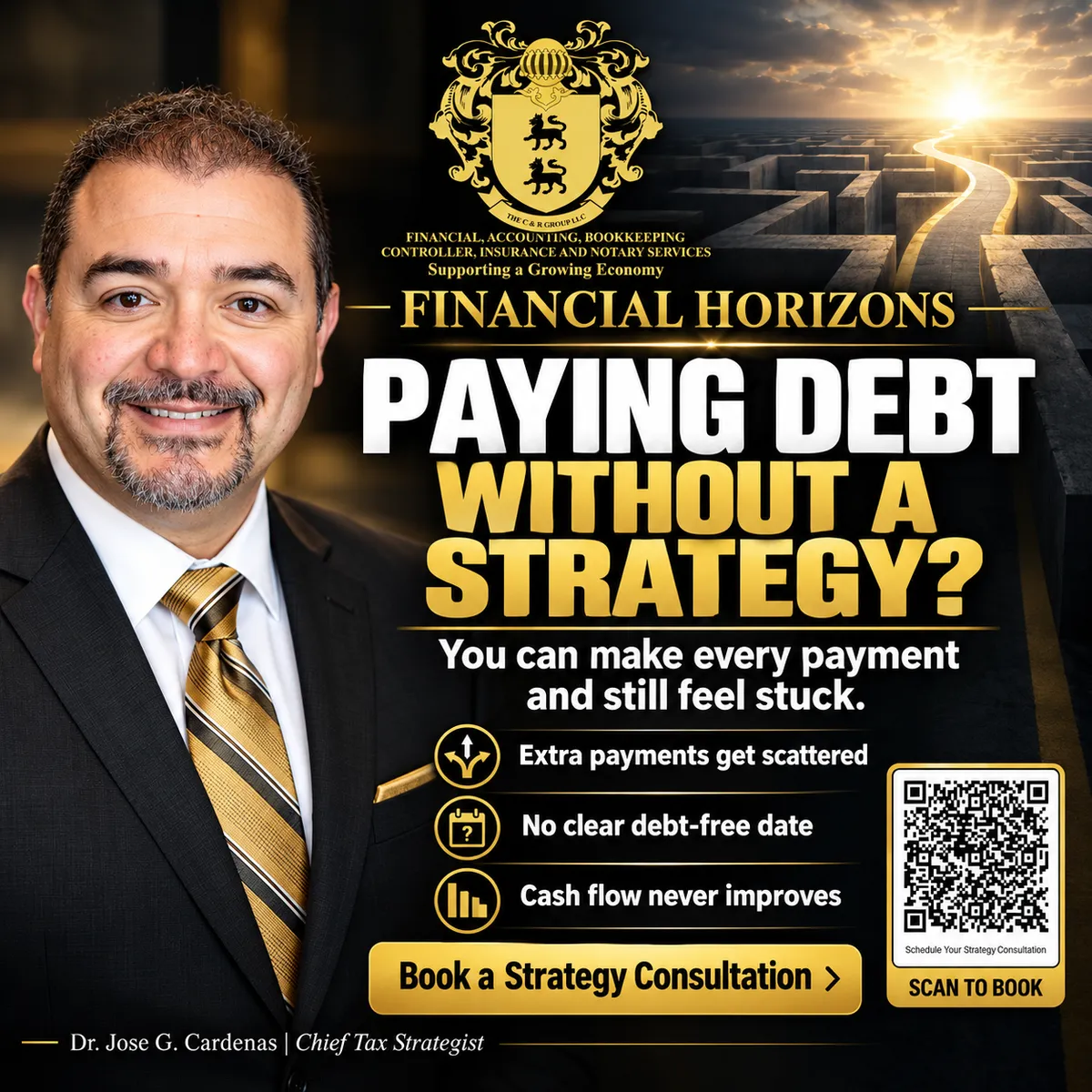
What Happens When You Keep Paying Debt Without a Strategy?
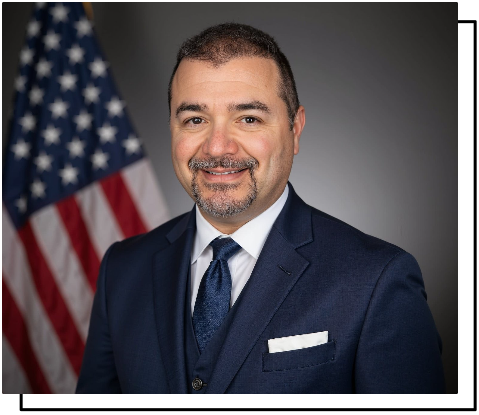
By Dr. Jose G. Cardenas | Chief Tax Strategist, The C & R Group, LLC
You can make every payment on time and still feel like you are getting nowhere.
That is one of the most frustrating parts of debt.
The mortgage gets paid.
The car gets paid.
The credit cards get paid.
Maybe you even throw a little extra at one balance whenever you can.
Yet months later, the household still feels financially tight.
The balances have moved, but not enough.
Cash flow still feels restricted.
Retirement still seems far away.
And every unexpected expense threatens to send the family right back to the credit card.
The problem may not be effort.
The problem may be that the family is paying debt without a strategy.
Making payments keeps you current.
A strategy tells you where those payments are supposed to take you.
Paying Debt Is Not the Same as Eliminating Debt
Most households already have a debt-payoff system.
Unfortunately, the system often belongs to the lenders.
Each lender tells you the minimum payment.
Each lender tells you when the payment is due.
So families follow those instructions.
That prevents late payments, but it does not necessarily answer the larger questions:
Which debt should disappear first?
Which one is costing us the most?
Which payment would free the most cash flow?
Should we build more emergency savings before accelerating payoff?
Will these debts still exist when we retire?
What happens to the payment after the debt is gone?
Without answers to those questions, the family can spend years making perfectly responsible payments without creating much financial momentum.
That is why I distinguish between debt service and debt strategy.
Debt service means keeping the accounts current.
Debt strategy means deciding how those obligations fit inside your larger financial mission.
What Happens Without a Strategy
The first problem is that extra money gets scattered.
One month, an additional $300 goes toward the mortgage.
The next month, $500 goes toward a credit card.
A tax refund pays down the vehicle.
Then holiday spending adds a balance back to the credit card.
The family is working hard, but the dollars are moving in too many directions.
The second problem is that high-interest debt may remain alive longer than necessary.
A family may feel good about making extra mortgage payments while carrying expensive revolving debt elsewhere.
The mortgage balance goes down, but high-interest charges continue eating into cash flow.
The third problem is that paid-off payments disappear.
You finally eliminate a $600 car payment.
Excellent.
But if that $600 is not immediately reassigned, lifestyle spending has a way of claiming it.
Now the debt is gone, but the financial system is not significantly stronger.
And the fourth problem may be the most dangerous:
You never build a clear debt-free date.
If your answer to “When will we be debt-free?” is “hopefully before retirement,” you do not have a route yet.
You have a goal.
Goals matter.
Routes make them achievable.
A Financial GPS Changes the Conversation
A Financial GPS starts by looking at the entire household instead of one debt at a time.
You look at balances, interest rates, required payments, cash flow, emergency savings, retirement, insurance, taxes, and future family goals.
Then you decide what each debt is supposed to accomplish.
For example, one family may need to prioritize a high-interest credit card because the interest cost is crushing them.
Another family may have a vehicle loan that is only months from payoff. Eliminating it may release enough monthly cash flow to attack the next debt aggressively.
Another may need to slow aggressive debt payments temporarily because their emergency reserve is dangerously low.
The right route depends on the actual family.
That is why I do not believe every household should blindly follow one formula.
The mission matters.
A Simple Example
Consider a family with:
$16,000 in credit-card debt,
a $12,000 vehicle balance,
a mortgage,
and $800 of extra monthly cash flow.
They have been spreading the $800 across all three debts.
Everything is declining slowly.
But nothing is disappearing.
After reviewing the numbers, they decide to concentrate the $800 on the high-interest credit card while maintaining the required payments everywhere else.
Once the credit card disappears, its $450 required payment joins the $800.
Now they have $1,250 per month available for the next objective.
They target the vehicle.
When that loan is gone, another $650 payment becomes available.
Now the family has $1,900 of monthly cash flow that used to belong to debt.
Nothing changed about their salary.
What changed was the strategy.
That recovered cash flow can now support emergency savings, retirement, mortgage acceleration, or another long-term goal.
That is how debt payoff begins creating wealth-building capacity.
Debt Strategy Should Connect to Retirement and Wealth
Debt elimination should not exist in isolation.
Every debt you carry into retirement increases the amount of retirement income you need.
A $2,000 mortgage payment in retirement is still $2,000 that must come from Social Security, a pension, TSP, 401(k), IRA distributions, investment income, or another source.
That is why your debt-free date and retirement date should know each other.
If you plan to retire at 62 but your mortgage schedule runs until 69, that deserves attention.
The same is true for vehicle loans and revolving debt.
Reducing monthly obligations before retirement can create as much value as building another asset because it lowers the amount of income your future household needs.
For some families with strong cash flow, appropriate insurance needs, and a long planning horizon, permanent life insurance such as an indexed universal life policy may eventually fit into the wealth side of the Financial GPS.
A properly structured IUL may build cash value and may provide future access to policy value through loans or withdrawals under the contract.
But that comes after the foundation.
An IUL does not fix uncontrolled spending.
It does not replace an emergency reserve.
And it should not distract from expensive debt that needs immediate attention.
Plan first. Product second.
Five Moves to Stop Paying Debt Blindly
If your household has been paying debt for years without feeling meaningful progress, start here:
List every balance, interest rate, and required monthly payment.
Choose a target debt-free date instead of simply “paying extra.”
Decide which debt deserves priority based on cost, cash-flow impact, and your family goals.
Protect enough emergency savings so one surprise does not restart the debt cycle.
Assign every paid-off payment to its next mission before lifestyle spending claims it.
You do not need a complicated spreadsheet to begin.
You need clarity.
Final Thought
Making payments is responsible.
But responsibility without direction can still leave a family stuck.
If you keep paying debt without a strategy, you may spend years sending money out the door without building the momentum your family actually needs.
The objective is not simply to lower balances.
The objective is to recover cash flow.
Reduce financial pressure.
Coordinate debt with retirement.
Create more options.
And eventually redirect money that once belonged to lenders toward your family's future.
Do not just ask, “How much did we pay toward debt this month?”
Ask:
“What did that payment move us closer to?”
That is the difference between paying debt and running a debt strategy.
Protect, Grow, and Transfer Wealth — The Right Way.
Book Your Strategy Consultation
If you are making payments every month but still do not have a clear debt-free route, it may be time to build your Financial GPS.
Schedule a consultation to review your debt, cash flow, retirement goals, and long-term wealth strategy.
Booking link:
https://api.leadconnectorhq.com/widget/booking/T4UHUjCijCtIB3rwoTDI
Phone: 580-699-1591
Booking your appointment now:

ABOUT THE AUTHOR
Dr. Jose G. Cardenas is a retired U.S. Army Finance Officer and the Chief Tax Strategist at The C & R Group, LLC. With a Doctorate in Business Administration and over 20 years of experience in tax planning and financial strategy, Dr. Cardenas helps individuals and business owners legally reduce taxes, strengthen cash flow, and build lasting wealth and legacy. Learn more at www.thecrgroupllc.com
DISCLOSURE
This article is for educational and informational purposes only and is not intended to serve as personalized legal, tax, or investment advice. Tax laws and regulations change over time and may vary by jurisdiction. You should consult with a qualified tax professional regarding your specific circumstances before implementing any strategy discussed here. Dr. Jose G. Cardenas, DBA, provides tax advisory services through The C & R Group, LLC. Insurance and investment strategies may be offered through his role as a licensed financial professional affiliated with Experior Financial Group.