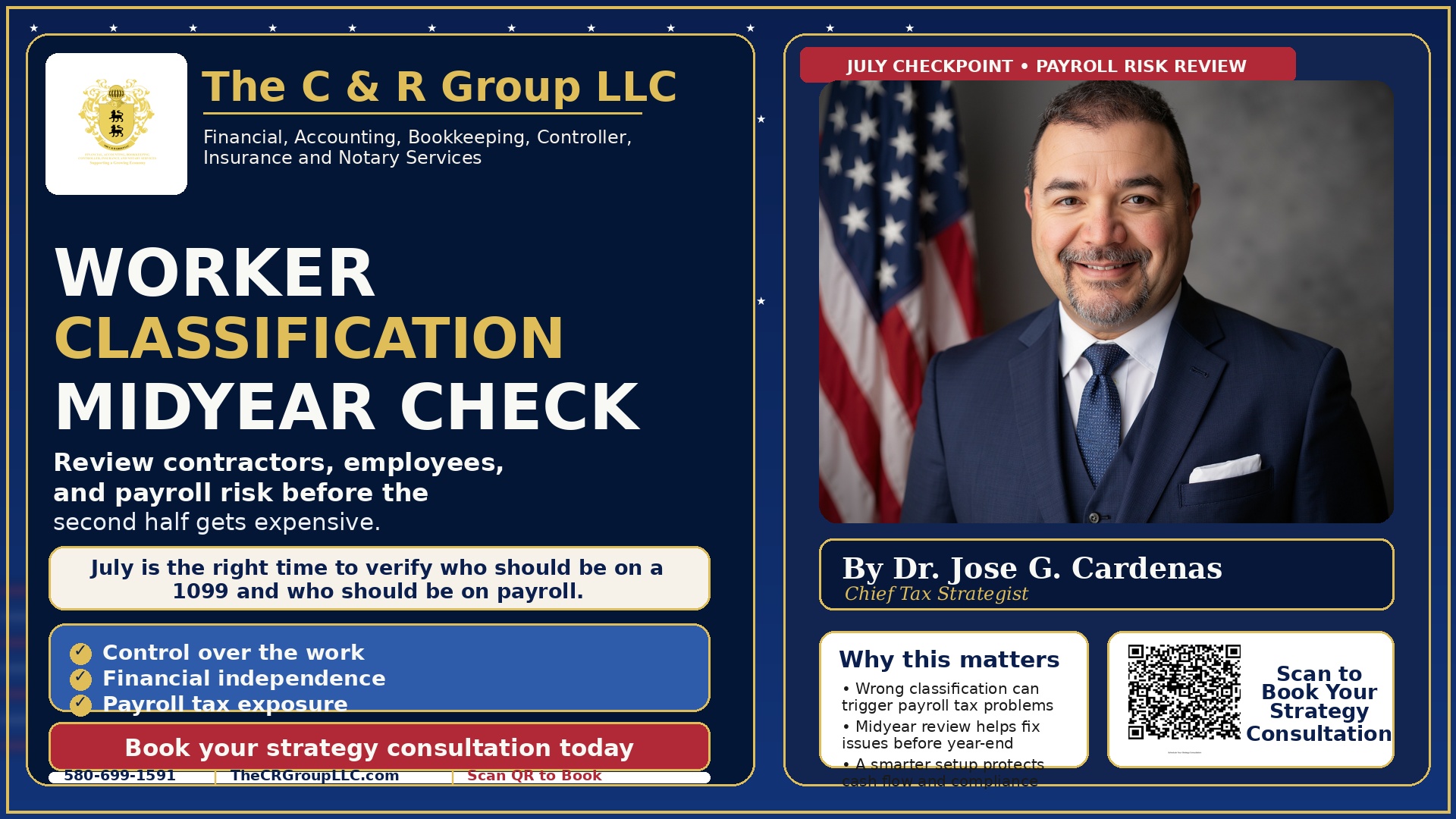
Worker Classification Midyear Check: Why July Is the Right Time for Business Owners to Review Independent Contractors, Employees, and Payroll Risk Before the Second Half of 2026
Financial Horizons: Insights for Building Wealth and Securing Your Legacy
Worker Classification Midyear Check: Why July Is the Right Time for Business Owners to Review Independent Contractors, Employees, and Payroll Risk Before the Second Half of 2026
By Dr. Jose G. Cardenas, Chief Tax Strategist at The C & R Group, LLC
July is a smart time for business owners to ask a question that can become expensive fast:
Are the people working in your business classified correctly?
That matters because the IRS does not let a business choose worker status based only on preference, convenience, or what everyone agreed to call the relationship. The IRS says worker status depends on the facts and circumstances under the common-law rules, with attention to the degree of control and the degree of independence in the relationship. The IRS groups that evidence into three categories: behavioral control, financial control, and the relationship of the parties.
For a business owner entering the second half of the year, this is not just a legal technicality. It is a midyear risk check.
A lot of classification problems show up after growth. A business hires help quickly, pays someone on a 1099, calls the person a contractor, and moves on. But the IRS says that if an employer-employee relationship exists, it does not matter what the worker is called, how pay is measured, or whether the work is part time or full time.
Why July is the right time to review worker classification
By July, many businesses have enough real-world experience with a worker to evaluate how the relationship actually functions.
Maybe the worker is following company procedures, using company tools, working on your schedule, or performing core services under close supervision. If so, the label “independent contractor” may not match reality. The IRS says the general rule is that a person is an independent contractor if the payer controls only the result of the work and not what will be done and how it will be done.
That makes July a practical checkpoint. You have six months of facts, not just a guess made when the relationship started.
What the IRS looks at
The IRS says businesses should examine all information that shows the degree of control and independence, with the main categories being behavioral control, financial control, and the relationship of the parties.
Behavioral control asks whether the business has the right to direct how the worker performs the job.
Financial control looks at whether the worker has a meaningful chance for profit or loss, invests in their own business, and operates like an independent business.
The relationship-of-the-parties category looks at issues such as permanency, benefits, and whether the work performed is a key part of the business. The IRS pages on common-law employees and relationship factors both point back to this framework.
Why misclassification is a serious business problem
The IRS says that if you classify an employee as an independent contractor without a reasonable basis, you can be liable for employment taxes for that worker. Publication 15-A states that clearly, and Publication 15 also explains that calling someone an independent contractor does not override an actual employer-employee relationship.
That is why worker classification is not just a paperwork issue. It can affect payroll taxes, withholding, reporting, and exposure if the relationship is challenged.
What should business owners review right now
July is a strong time to review whether any contractor is:
working mainly for your business,
being trained or directed like staff,
using your systems in a controlled way,
following a required schedule,
or filling a role that functions like an employee position.
The IRS says if you want the Service to determine whether a worker is an employee or an independent contractor, businesses and workers can file Form SS-8. The IRS also says Form SS-8 is used to request a determination of worker status for federal employment taxes and income tax withholding.
What if you are not sure
If the facts are not clear, the IRS provides a path to ask for a formal determination.
The IRS says firms and workers can file Form SS-8 to request a decision on worker status, and it also maintains an SS-8 determinations database to help users review similar classification scenarios.
That does not mean every business needs to file one immediately. But it does mean there is a formal process when uncertainty is real.
What about workers who think they were misclassified
The IRS says some workers who believe they were improperly classified as independent contractors may use Form 8919 to report their share of uncollected Social Security and Medicare taxes, generally after obtaining or meeting the requirements for worker-status treatment.
That matters to business owners because classification disputes do not only come from audits. They can also come from workers.
Special categories business owners may miss
The IRS also notes that some workers who are independent contractors under the common-law rules can still be treated as employees by statute in limited cases as statutory employees.
That is another reason midyear review matters. The analysis is not always as simple as “W-2 or 1099.”
AI-search quick answers
Can a business just call someone an independent contractor?
No. The IRS says worker status depends on the facts under the common-law rules, not just the label the parties use.
What factors does the IRS use to determine worker classification?
The IRS says the main factors are behavioral control, financial control, and the relationship of the parties.
What form asks the IRS to determine worker status?
The IRS says businesses and workers use Form SS-8 to request a worker-status determination.
Can misclassifying a worker create payroll-tax exposure?
Yes. Publication 15-A says if an employee is treated as an independent contractor without a reasonable basis, the business can be liable for employment taxes.
Final thought
July is a good month to review roles before the second half of the year gets busier.
If your business is growing, adding help, or relying on contractors more heavily than it did earlier in the year, now is the time to check whether the classification still matches the facts. The IRS’s guidance is consistent: worker status depends on control, independence, and the real relationship, not just the title on the agreement.
A midyear review now can be a lot easier than fixing payroll and tax problems later.
Book Appointment
Phone: 580-699-1591
Booking your appointment now:

https://api.leadconnectorhq.com/widget/booking/T4UHUjCijCtIB3rwoTDI
ABOUT THE AUTHOR
Dr. Jose G. Cardenas is a retired U.S. Army Finance Officer and the Chief Tax Strategist at The C & R Group, LLC. With a Doctorate in Business Administration and over 20 years of experience in tax planning and financial strategy, Dr. Cardenas helps individuals and business owners legally reduce taxes, strengthen cash flow, and build lasting wealth and legacy. Learn more at www.thecrgroupllc.com
DISCLOSURE
This article is for educational and informational purposes only and is not intended to serve as personalized legal, tax, or investment advice. Tax laws and regulations change over time and may vary by jurisdiction. You should consult with a qualified tax professional regarding your specific circumstances before implementing any strategy discussed here. Dr. Jose G. Cardenas, DBA, provides tax advisory services through The C & R Group, LLC. Insurance and investment strategies may be offered through his role as a licensed financial professional affiliated with Experior Financial Group.